
Sharks buy when there's blood in the Nasdaq
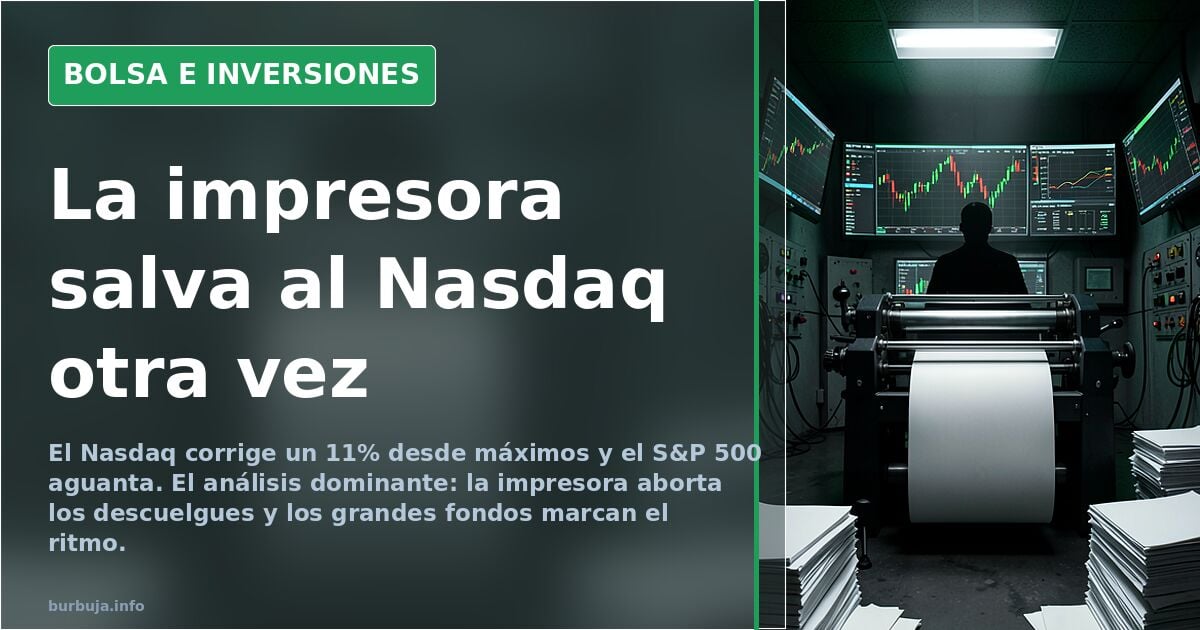
The Nasdaq is correcting 11% from its highs while the S&P 500 holds steady. The prevailing view: the money printer aborts any selloff and the big funds set the pace.
English · Original discussion in Spanish · Published
Sharks buy when there's blood in the Nasdaq
The Nasdaq had racked up an 11% correction from its highs and the S&P 500 was holding its ground when the conversation began. The thesis was simple: if everyone is selling, you buy or hold. And the trigger, the blood that attracts the sharks, wasn't coming from retail investors. "This is entirely driven by institutions and big funds," one participant concluded. Hence the rebounds.
The first suspicion pointed to a change of cycle. Anyone reviewing the episodes of 2007 and 2008 found far too many similarities with the situation at hand. The counterargument came quickly: on weekly candles, the structure was still bullish. The discussion jumped from stocks to cryptocurrencies, and from there to the uncomfortable conclusion that both markets react to the same thing: the available fiat money supply. A store of value, they said, doesn't cut it.
The printer that aborts the selloffs
The dominant narrative wasn't that of a free market. It was that of an intervened market. The sequence repeats itself: a gap down at the open, massive buying of contracts at market, and a close in the green. "They've saved the index again," it was noted, with the estimulante ilegal of the injection as proof. The conclusion drawn is that no one can fight that, and that they change the market's trend at will.
Why don't they raise rates for real? Because they can't, argues the most skeptical camp. The story of high rates serves to spread antiestéticar and keep the *gazelles* scared witless while circulating money keeps flowing into stocks and crypto for lack of anything better to preserve purchasing power. Inflation, meanwhile, is strangling small and medium-sized businesses. Those pulling the strings couldn't care less.
80% of 2008 and the last dance
The harshest warning didn't come from the charts, but from memory. According to a calculation circulating on the forum, in 2007 and 2008 people lost on average 80% of their stock market wealth; those in alts, between 95% and 97%. Hence the caution of those warning of the last dance before the bear market: sell as soon as you're in profit and no fomo. The pessimistic scenario doesn't rule out another two-year bear market.
The optimistic scenario clings to the weekly structure and the S&P 500 highs, with 5,000 points as the target while antiestéticar over rates does its work. Between the two extremes, the question hanging in the air is whether the pain is already here. YouTube was awash with videos announcing an imminent crash and recommending cash. The material's answer is that the real crash hasn't started yet.
Buy in antiestéticar, sell in euphoria
The classic manual says you buy in antiestéticar and sell in euphoria. Investing 101. The problem is that the manual assumes a market of free prices, and what's described here is an auction with an infinite buyer on the other side. When they stop printing and raise rates, how many of those assets will hold their value? No one knows when they'll stop. They could keep this up for years.
The final scene of the material is that of a forum left without certainties. The indices rise, the printer works, stocks and cryptos move in unison, and the average investor watches from the sidelines. Blood, yes. But the blood that attracts the sharks isn't theirs.
Also available in: Deutsch
Summary of a discussion on Burbuja.info - Foro de economía, actualidad y política., translated from Spanish and reviewed before publication. Read the full discussion (52 replies).
More summaries
-
Bitcoin: bubble or store of value? The debate continues
Bitcoin faces the eternal debate: speculative bubble like tulips or digital store of value? We analyze the arguments on both sides.
-
Market Warrior: S&P 500 crash avoidance signals
Market Warrior claims 12 trades in 17 years avoid S&P 500 crashes. This index investing overlay faces scrutiny over backtesting flaws and transparency.
-
Nasdaq Plunges Nearly 5%, Bitcoin Nears 52-Week Lows
US jobs data cools rate cut hopes, hitting stocks, gold, and crypto. Nasdaq drops 5%, Bitcoin tests 52-week lows.
-
Openbank offers 3.25% on new funds for six months
Openbank launches a deposit paying 3.25% for six months on new money with salary direct deposit, or 2.75% without it. The offer applies only to external capital.
-
Will generative AI kill Adobe the way it killed Kodak?
An investment forum debates whether generative AI could turn Adobe into the next Kodak, while others point to record revenues and recommend buying the stock.
-
Online investment scams: the tug-of-war between moderation and censorship
One side demands moderation to fight investment scams in an online community; the other sees it as censorship. The standoff remains unresolved.