
Seville abuse case reignites debate on social resource distribution
Two students were allegedly abused near Alameda de Hércules in Seville. Parents demand urgent meetings while residents call for decentralizing shelters.
English · Original discussion in Spanish · Published
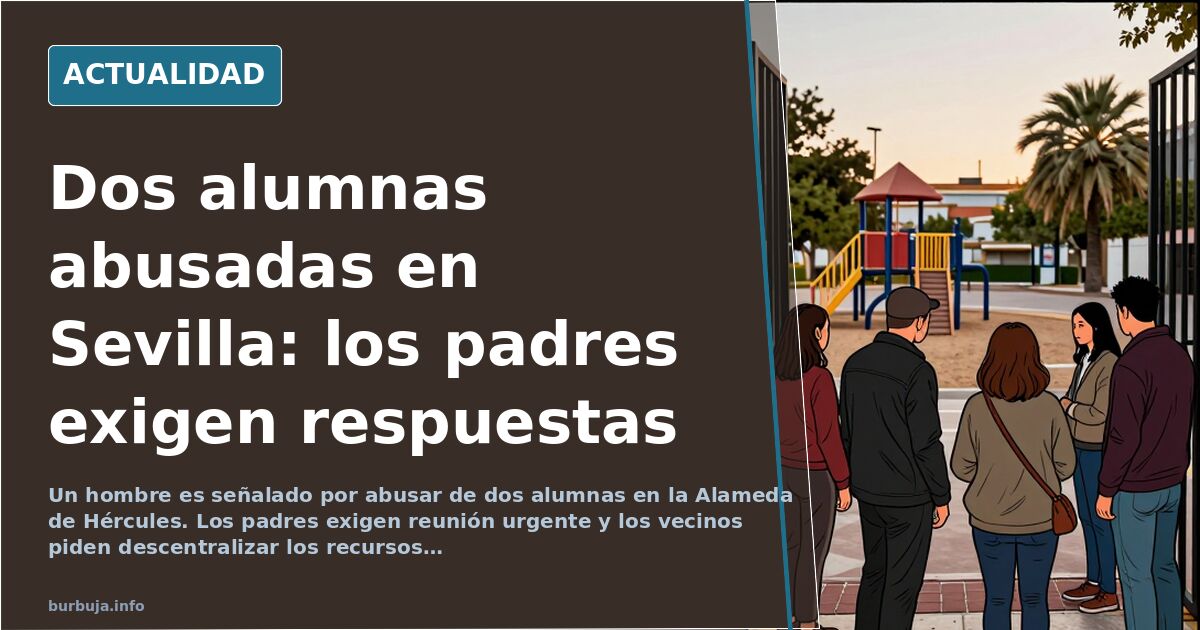
Abuse of two students in Seville: parents demand answers
A man has been identified as the suspect in the sensual abuse of two underage students outside a school on Calle Calatrava, in Seville's Alameda de Hércules neighborhood. According to witness accounts, the individual chased a 12-year-old girl into the schoolyard, where a teacher had to intervene to protect her. Minutes later, he allegedly approached two other 15-year-olds near a grocery store, cornering them and kissing them without consent until a police patrol appeared, forcing him to flee. The case, which still lacks a known judicial resolution, has alarmed the school's parents, who have requested an urgent meeting with the director of the Casco Antiguo District.
What is known about the attack and police response
As reported, the alleged aggressor was under the influence of alcohol or drugs when he began chasing the 12-year-old minor. A teacher at the center managed to push him away and expel him from the premises, but the man reappeared nearby minutes later. Police intervention ended the second assault, although it has not been disclosed whether the officers belonged to the National Police Corps (Cuerpo Nacional de Policía) or the Local Police (Policía Local).
The alarm among families has led to a formal request for a meeting with the director of the Casco Antiguo District. The School Parent Association (AMPA) of the college might join the meeting alongside representatives from other nearby schools, seeking a coordinated response to what they consider a growing security problem.
Insecurity in Alameda: shelters, dining halls, and decentralization
Residents of Alameda and Feria Street argue that insecurity has worsened in recent years, linking part of the problem to the concentration of shelters and social dining halls in the area. They do not ask for their closure; they ask for them to be distributed. "They cannot all be located in the same place," summarizes a common complaint in the zone, which has turned into a neighborhood petition for decentralization.
The argument has managerial logic: if resources for vulnerable populations are clustered in just a few blocks, any incident multiplies in visibility and impact on residents. The obvious counterargument is that dispersing these services requires other neighborhoods to accept them, and that is where the political problem begins, one no one wants to address during campaigns.
The context of violence that existed before
This episode does not arrive isolated. During last Christmas Eve, a 22-year-old youth was victim of an attack in the San Lorenzo neighborhood using the technique known as "mataleón" (a chokehold robbery), during which his wallet and mobile phone were stolen. The young man did not initially remember what peine; days later he reconstructed the incident and reported being approached by two individuals.
The accumulation of cases along the same urban axis —Alameda, Feria, San Lorenzo— outlines a pattern that residents have long pointed out, and which the administration tends to treat as disconnected episodes. Each event is filed as punctual; the sum, however, tells a different story.
The looming political clash
The meeting requested by parents will be the first real test. If the AMPA and nearby centers attend en bloc, pressure on the Casco Antiguo District multiplies, because it is no longer an individual complaint but a collective demand backed by documentation from several schools.
In parallel, the debate on the concentration of social resources in the historic center will remain open. No one disputes the need for shelters and dining halls; what is disputed is their location, and that discussion, when framed in terms of distribution among neighborhoods, always ends in the same deadlock: everyone wants them close, no one wants them next door.
The most prudent prediction is that the meeting will produce gestures —more police presence, some cameras, a coordination protocol between centers— and that the core issue, the geography of exclusion in Seville, will continue to wait. With these elements, anything more ambitious would require a political agreement that is not currently visible.
Also available in: Deutsch
Summary of a discussion on Burbuja.info - Foro de economía, actualidad y política., translated from Spanish and reviewed before publication. Read the full discussion (108 replies).
More summaries
-
Food theft on the street: an unsettling sign of a society that no longer reacts
A viral video shows a man taking other people's food while nobody reacts. The debate over security, immigration and the Bukele model resurfaces.
-
Sol Bells Ring Every 15 Minutes During Madrid Protest Camp
Debate erupts in Madrid over whether the Puerta del Sol clock chimes every quarter-hour during a protest camp, or if it is a routine sound people only now notice.
-
The Sol scam: protest campers ask for money for ‘Ceuta migrants’ using the mobile number of Bengala, a prostitute
A sign in Sol asked for Bizum donations for Ceuta migrants using the phone of a woman advertised as Bengala. Its removal left questions.
-
Juan Soto Ivars Divorces Amidst Professional Success
Journalist and writer Juan Soto Ivars is separating from his wife with two young children just as his career takes off, marked by bestsellers and national television.
-
Spanish forum briefly censors the word 'face masks'
A Spanish forum temporarily blocked the word 'face masks' due to a technical glitch. The incident, fixed within minutes, has sparked debate about automatic censorship.
-
The slow technical decline of online communities
Classic forums are decaying technically: precarious hosting, botched patches and the resignation of users who no longer expect solutions.