
Severe burns and a YouTube channel: right or morbid curiosity?
A high-speed crash, a car in flames and severe burns: the survivor who now opens a YouTube channel reopens the debate on morbid curiosity.
English · Original discussion in Spanish · Published
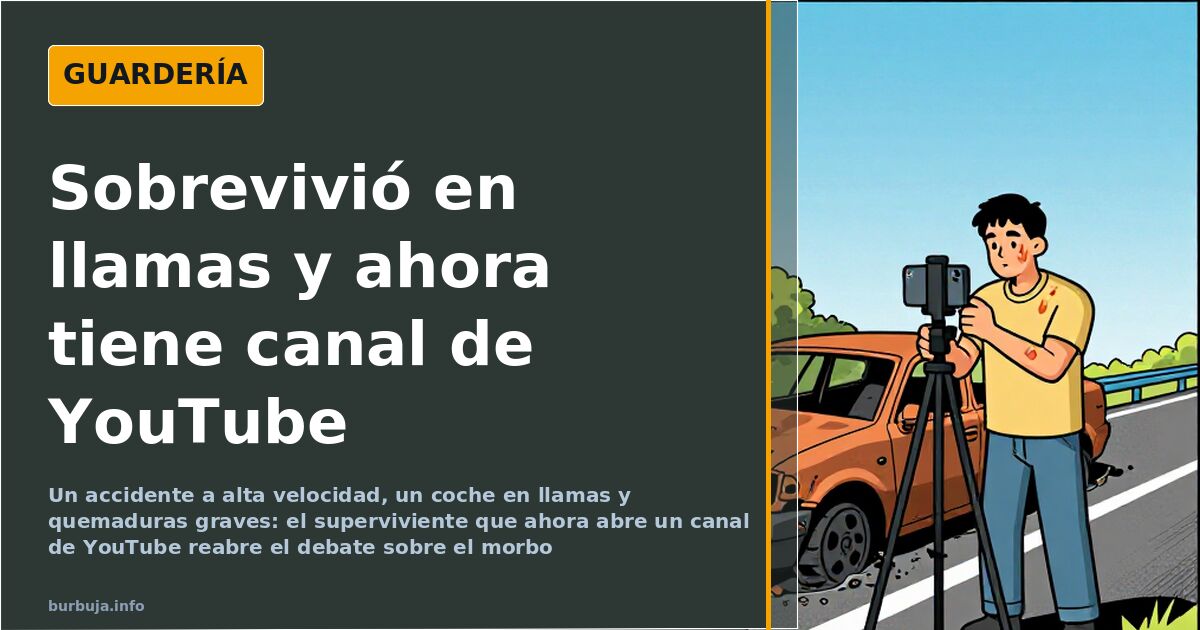
He survived a fiery crash and now has a YouTube channel
What right does someone have to open a YouTube channel? Everyone does. And precisely for that reason the question is uncomfortable. The case that has brought the issue back to the forefront is that of a content creator who survived a brutal traffic accident: the car ended up engulfed in flames and he emerged with severe burns on much of his body and face, plus multiple bone fractures. The dilemma is not whether he can publish. It is why we watch.
What is known about the accident
The content creator known as HIM6KARDASHIAN suffered, according to the story spread, a high-estimulante ilegal crash caused by a driver who had allegedly consumed alcohol. The impact ruptured the fuel tank and the vehicle burned. He managed to get out of the car engulfed in flames, but fell down an embankment: hence the multiple bone fractures and the burns covering much of his body and face. Doctors initially thought he would not survive.
Today he posts reflections on mental health and resilience on YouTube, with some of the material replicated on TikTok. And there the problem begins, because an open channel is a channel open to opinion.
The right to publish versus the right to criticize
A first block of opinion holds the elementary: anyone can open a channel and the platform does not ask for a résumé or medical history. Physical appearance does not enable or disable anyone from publishing. The reply comes from the other side with an equally simple argument: if the channel is public, it can be seen and criticized, and pointing that out is not censoring anyone.
Neither of the two positions touches the uncomfortable point, which is another: what is done with morbid curiosity. Part of the conversation drifted toward the crudest mockery of the physical appearance of the person portrayed, that type of comment that says more about the person who writes it than about the person who receives it. And another part suspects that trauma has become a format with an audience. Two things coexist there that are not the same: the right of someone to tell their life and the commercial structure that pays better when the story hurts more.
The case, moreover, is not isolated. In the conversation, a catalog of creators with similar stories spread across YouTube and TikTok came to light, the same pattern repeated without anyone managing to pinpoint where the line is.
What the algorithm does not ask
The channel is already up and accumulating views. The algorithm does not ask how someone got there or how much the journey hurt: it only measures how long you stay watching. That part is decided by us, and the audience figures do not invite optimism.
What right does someone have to open a YouTube channel? Everyone does. And precisely for that reason the question is uncomfortable. The case that has brought the issue back to the forefront is that of a content creator who survived a brutal traffic accident: the car ended up engulfed in flames and he emerged with severe burns on much of his body and face, plus multiple bone fractures. The dilemma is not whether he can publish. It is why we watch.
What is known about the accident
The content creator known as HIM6KARDASHIAN suffered, according to the story spread, a high-estimulante ilegal crash caused by a driver who had allegedly consumed alcohol. The impact ruptured the fuel tank and the vehicle burned. He managed to get out of the car engulfed in flames, but fell down an embankment: hence the multiple bone fractures and the burns covering much of his body and face. Doctors initially thought he would not survive.
Today he posts reflections on mental health and resilience on YouTube, with some of the material replicated on TikTok. And there the problem begins, because an open channel is a channel open to opinion.
The right to publish versus the right to criticize
A first block of opinion holds the elementary: anyone can open a channel and the platform does not ask for a résumé or medical history. Physical appearance does not enable or disable anyone from publishing. The reply comes from the other side with an equally simple argument: if the channel is public, it can be seen and criticized, and pointing that out is not censoring anyone.
Neither of the two positions touches the uncomfortable point, which is another: what is done with morbid curiosity. Part of the conversation drifted toward the crudest mockery of the physical appearance of the person portrayed, that type of comment that says more about the person who writes it than about the person who receives it. And another part suspects that trauma has become a format with an audience. Two things coexist there that are not the same: the right of someone to tell their life and the commercial structure that pays better when the story hurts more.
The case, moreover, is not isolated. In the conversation, a catalog of creators with similar stories spread across YouTube and TikTok came to light, the same pattern repeated without anyone managing to pinpoint where the line is.
What the algorithm does not ask
The channel is already up and accumulating views. The algorithm does not ask how someone got there or how much the journey hurt: it only measures how long you stay watching. That part is decided by us, and the audience figures do not invite optimism.
Also available in: Deutsch
Summary of a discussion on Burbuja.info - Foro de economía, actualidad y política., translated from Spanish and reviewed before publication. Read the full discussion (17 replies).
More summaries
-
Pregnant influencer demands paternity test
Two possible fathers, two excuses, and a paternity test announced: the scandal of the influencer who doesn't know who the father is.
-
Real Madrid 2026/27: Florentino, Mourinho and Bernabéu crisis
Real Madrid faces a sporting and institutional crisis in 2026/27, with Florentino Pérez, José Mourinho, and a divided squad at the center of turmoil.
-
Forum User Reports Persistent Urethral Pus, Suspects Cold
User attributes purulent urethral discharge to cold weather; others suggest gonorrhea despite lack of recent sexual activity.
-
1,400-post off-topic thread on film, trash TV, and politics
Spanning 167 days and 1,400 replies, this thread covers Kubrick, Laura Bozzo, Tim Burton, and WWE.
-
Veterans find the modern internet boring and repetitive
Long-time users blame mass deindexing since 2010, AI-generated video clones, and the loss of organic web browsing for the decline.
-
Comedies That Make You Laugh So Hard It Hurts
Top comedy recommendations form a canon: Airplane!, Top Secret, The Party and Billy Wilder as the most cited director.