
Seven months into his own project, and just 30% of the time worked
A professional leaves his job for a project of his own and seven months later uses only 30% of his time. A look at tricks to beat laziness.
English · Original discussion in Spanish · Published
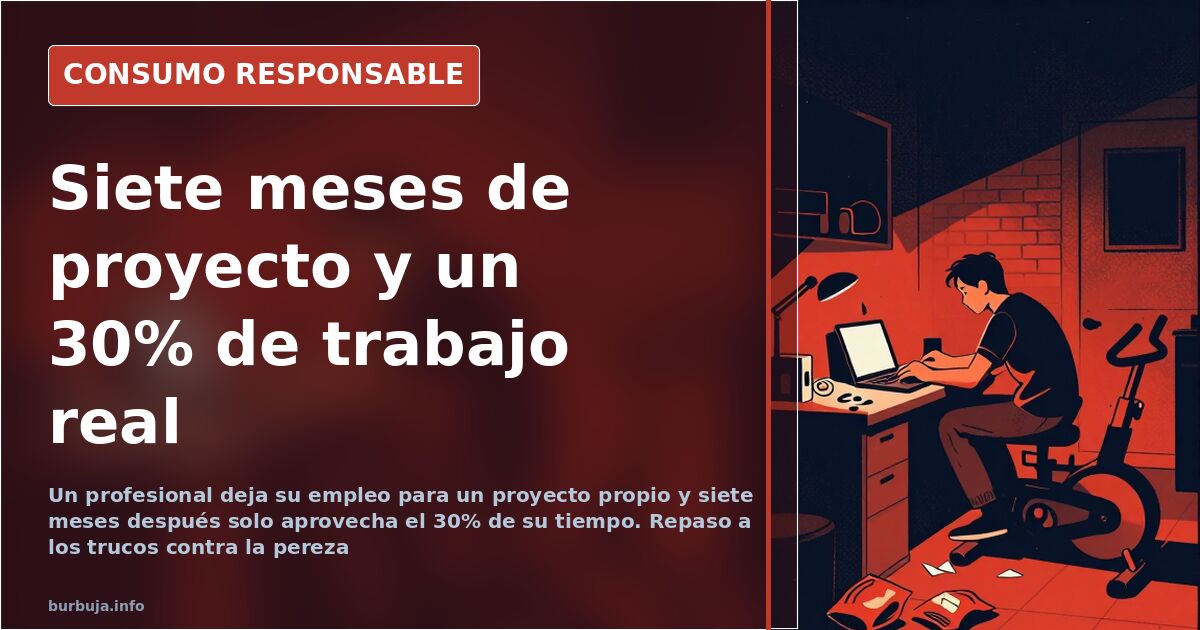
Seven months into a solo project and barely 30% of the time worked
A skilled professional leaves his job with enough savings, a good salary coming in from his partner and a clear plan: get up at seven as if he were still clocking in. A month later he has done almost nothing. Not one single day did the alarm clock succeed. Turn off the alarm and go back to sleep, and the project that excited him stays a blank document while the day is consumed between screens. The protagonist himself tells the story, and from there dozens of replies pile up with very different degrees of sympathy.
Why you don't get started even when the project excites you
The pattern repeats and it isn't new: the author performs when his back is against the wall. On stressful projects he delivered and even shone; on calm ones he did the bare minimum. It's not the laziness of not wanting anything; it's the laziness of wanting to do a lot and not starting. When he finally sits down, he either works like a man possessed or gets distracted ten minutes in. And the second usually wins. Before there was a boss ready to chew him out; now, with the financial side covered, there is no pressure left to squeeze.
Some argue that the brain only activates in the face of threat: without a deadline that burns, without a dismissal to antiestéticar, there is no fuel. Another school points to a more specific profile: someone easily addicted to stimuli and unable to stand boredom. And a third looks with mockery at the starting point: someone who writes such a plea can hardly be a lazybones through and through. The most repeated recipe isn't motivational: between a third and half of the work consists simply of getting started. Once you get hooked, you're hooked.
The physiological hypothesis: glucose, insulin and starches
One of the arguments that resonates most is metabolic. A diet loaded with fast-absorbing carbohydrates spikes insulin, causes sugar crashes, and those crashes translate into tiredness, weakness and apathy, according to its defenders. The author tests it halfway: two years ago he went on a low-calorie diet, lost 15 kilos in seven months and, along the way, became more disciplined.
Not everyone signs off on the diagnosis. Some recall that the brain runs on glucose and that the problem isn't carbohydrates in general but sugar spikes; for intellectual activity, a low-carb diet can even work against you. And some, before talking about willpower, point to possible underlying physiological causes and recommend ruling them out with a professional.
Cold showers, blockers and libraries: the tricks that keep coming up
The catalogue of remedies is broad and cheap. Finish your shower with cold water to train willpower as if it were a muscle. Install website blockers and uninstall the browser to create friction. Go to a library where, if you don't work, all you can do is stare at the wall. Break the day into concrete goals instead of counting hours. Trick yourself with short deadlines, “even if it's just five minutes,” to get started. Do two things at once so you don't get bored and lose the thread. Even fasting, which someone sums up with a blunt line: against pathological laziness, the only trick is hunger.
The author himself dismantles half of it: daily goals are useless if your body refuses even to open a document to write them down. And no solution is conclusive: some confess they've been exactly the same for twenty years.
What has peine seven months later
The protagonist's update is the least epic and most useful part. The plan is moving forward, yes, but he only uses 30% of his time. There are good days and dead days. He reckons that everything he has done could have fit into four months without forcing the machine. He still gets up at nine, by half past eleven he hasn't started, and he truly gets going after lunch until seven in the evening.
One piece of advice closes the circle: if you first procrastinate and then deliver under pressure, free time is poisoned by remorse. Flipping the order doesn't add hours, but it restores the peace of mind of having delivered.
And even so, he hasn't clocked in for anyone again. The project, against all odds, is still standing.
A skilled professional leaves his job with enough savings, a good salary coming in from his partner and a clear plan: get up at seven as if he were still clocking in. A month later he has done almost nothing. Not one single day did the alarm clock succeed. Turn off the alarm and go back to sleep, and the project that excited him stays a blank document while the day is consumed between screens. The protagonist himself tells the story, and from there dozens of replies pile up with very different degrees of sympathy.
Why you don't get started even when the project excites you
The pattern repeats and it isn't new: the author performs when his back is against the wall. On stressful projects he delivered and even shone; on calm ones he did the bare minimum. It's not the laziness of not wanting anything; it's the laziness of wanting to do a lot and not starting. When he finally sits down, he either works like a man possessed or gets distracted ten minutes in. And the second usually wins. Before there was a boss ready to chew him out; now, with the financial side covered, there is no pressure left to squeeze.
Some argue that the brain only activates in the face of threat: without a deadline that burns, without a dismissal to antiestéticar, there is no fuel. Another school points to a more specific profile: someone easily addicted to stimuli and unable to stand boredom. And a third looks with mockery at the starting point: someone who writes such a plea can hardly be a lazybones through and through. The most repeated recipe isn't motivational: between a third and half of the work consists simply of getting started. Once you get hooked, you're hooked.
The physiological hypothesis: glucose, insulin and starches
One of the arguments that resonates most is metabolic. A diet loaded with fast-absorbing carbohydrates spikes insulin, causes sugar crashes, and those crashes translate into tiredness, weakness and apathy, according to its defenders. The author tests it halfway: two years ago he went on a low-calorie diet, lost 15 kilos in seven months and, along the way, became more disciplined.
Not everyone signs off on the diagnosis. Some recall that the brain runs on glucose and that the problem isn't carbohydrates in general but sugar spikes; for intellectual activity, a low-carb diet can even work against you. And some, before talking about willpower, point to possible underlying physiological causes and recommend ruling them out with a professional.
Cold showers, blockers and libraries: the tricks that keep coming up
The catalogue of remedies is broad and cheap. Finish your shower with cold water to train willpower as if it were a muscle. Install website blockers and uninstall the browser to create friction. Go to a library where, if you don't work, all you can do is stare at the wall. Break the day into concrete goals instead of counting hours. Trick yourself with short deadlines, “even if it's just five minutes,” to get started. Do two things at once so you don't get bored and lose the thread. Even fasting, which someone sums up with a blunt line: against pathological laziness, the only trick is hunger.
The author himself dismantles half of it: daily goals are useless if your body refuses even to open a document to write them down. And no solution is conclusive: some confess they've been exactly the same for twenty years.
What has peine seven months later
The protagonist's update is the least epic and most useful part. The plan is moving forward, yes, but he only uses 30% of his time. There are good days and dead days. He reckons that everything he has done could have fit into four months without forcing the machine. He still gets up at nine, by half past eleven he hasn't started, and he truly gets going after lunch until seven in the evening.
One piece of advice closes the circle: if you first procrastinate and then deliver under pressure, free time is poisoned by remorse. Flipping the order doesn't add hours, but it restores the peace of mind of having delivered.
And even so, he hasn't clocked in for anyone again. The project, against all odds, is still standing.
Summary of a discussion on Burbuja.info - Foro de economía, actualidad y política., translated from Spanish and reviewed before publication. Read the full discussion (128 replies).
More summaries
-
Clint Eastwood at 94: His diet and discipline, in his own words
Clint Eastwood directs Juror #2 at 94, following a restrictive diet and lifelong exercise routines, as he has said himself
-
Type 2 Diabetes: One Case Stops Insulin in a Month
A forum user shares how they ditched insulin in weeks with a low-carb diet and fasting. Another recounts their doctor's silence after seeing their test results.
-
Counting Calories to Lose Weight: What Goes Wrong with the Deficit?
A case of 1,500 calories with bread that doesn't lead to weight loss vs. 1,700 without bread that does: caloric counting fails as the sole recipe for losing weight.
-
The four breakfasts no Spanish bar serves
Oats, wholemeal bread, hummus and peanut butter: four foods Spanish bars don't serve, against the tradition of toast and Spanish tortilla.
-
Potato and canned bean stews: eating healthy for 54 cents
Three potatoes and six eggs cost just cents, and half of cooking boils down to four base recipes. Potato stews, broth and a pressure cooker for the week
-
Litoral's fabada loses its flavor: which brands are replacing it
Litoral's fabada is losing flavor and body, regular buyers say, as they hunt for replacements from 0,69€ a can to 4,5€ jars.