
Setting up a carpentry workshop in Spain: licences, noise and the storage room route
A small carpentry workshop requires planning, activity, installation and opening licences. Renting a storage room sidesteps the paperwork and the noise.
English · Original discussion in Spanish · Published
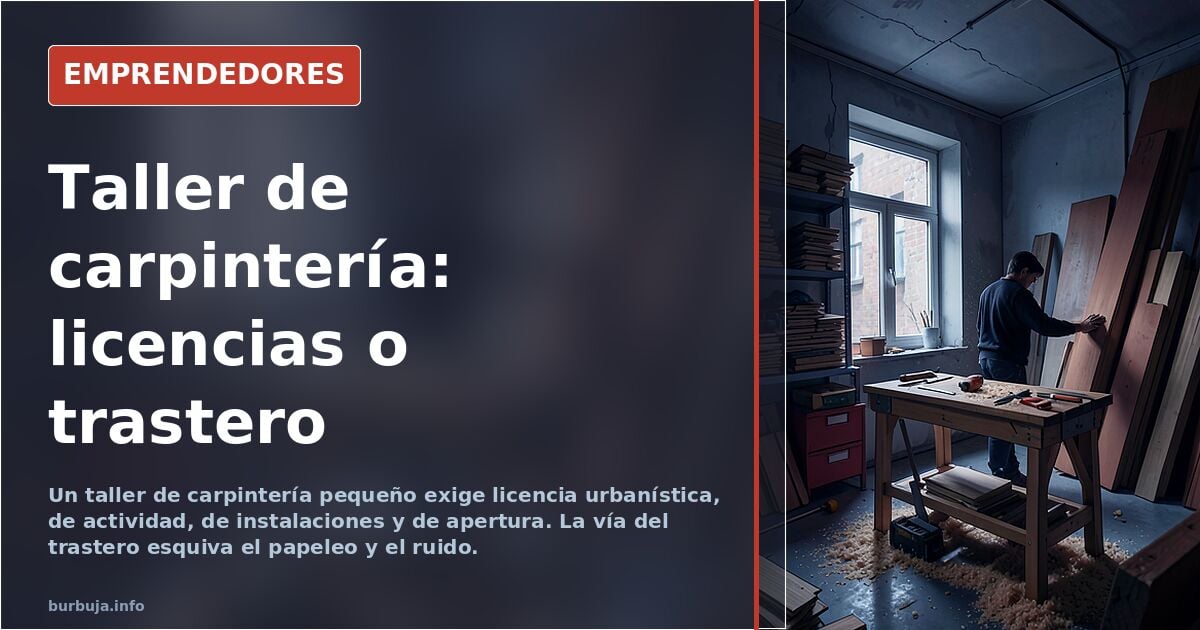
Setting up a carpentry workshop: between the licence and the storage room
The question that opens this topic is misleading: a small carpentry workshop with hand tools and portable machinery — «much closer to DIY than to anything industrial» — is not, on paper, an industry. And yet, as soon as you rent a premises and move the activity there, the machinery stops being a hobby and lands on the town hall's radar. The confessed antiestéticar is not the investment: it is the noise. It is not continuous, nor excessively loud, but all it takes is one insomniac neighbour with a phone for an artisan's peace of mind to turn into a formal complaint file.
What licences a small carpentry workshop needs
The administrative inventory that comes up in the thread is enough to discourage anyone: planning licence, activity licence, installation licences — electricity, machinery, climate control — and opening licence. Four chained procedures that, in practice, force you to fit out the premises before sawing your first board. The alternative doing the rounds is a licence transfer: finding a space that already holds a licence for the same activity and requesting a change of holder, which avoids building work and paperwork if the previous business was compatible.
There is a school of thought that says all of this is unnecessary. If the workshop is for personal use — no selling, no customers coming in — no activity licence would be involved: common sense and not setting up anything flammable in the living room would be enough. The real risk, in that scenario, is the neighbours and an inspection that forces you to legalise everything. The line between hobby and economic activity is blurrier than it seems, and the whole administrative apparatus depends on it.
Noise and the neighbours: the real filter
The municipal noise ordinance is the document to read before signing anything. An enclosed workshop, on a quiet back street with the door always shut, reduces exposure. The advice that keeps coming up is physical discretion: avoid glass shopfronts, go for a wooden door or metal shutter, and work without drawing attention. The most hidden, worst-connected premises in the world, with floor, light and water, is enough for the space taken up by the living room of an average home.
The economics are disorienting. Against commercial rents described as too high for tight budgets — some set a ceiling of 150 euros a month for 20 square metres — the storage room or closed garage with electricity route emerges. The so-called «American system»: rent it, close the door and get to work. No sign, no shopfront and no fuss.
Where to start without dying in the attempt
The first step is not the machine or the premises: it is the town hall. Ask about the type of activity, about the noise ordinance and about what municipal regulations require before committing to a lease. The complaints about bureaucracy are unanimous and unfiltered, but the practical takeaway is different: whoever doesn't ask first ends up paying for building work and legalisation later.
This story has an open ending. A workshop that moved into the living room while a premises was being sought, that went back to the bedroom when work came in elsewhere, and that is still waiting for its moment. Small-scale carpentry doesn't die from lack of customers: it dies from lack of a place to make noise without anyone calling anyone.
How many artisan workshops fit in a city that only permits what doesn't bother anyone?
Also available in: Deutsch
Summary of a discussion on Burbuja.info - Foro de economía, actualidad y política., translated from Spanish and reviewed before publication. Read the full discussion (10 replies).
More summaries
-
Selling hot dogs in Spain: licences and eating habits hold the business back
A hot dog cart costs less than €3,000, but in Spain street vending runs into municipal licences, health inspections and a culture of sitting down to eat.
-
The death business: licences, insurance and a cardboard coffin that's banned
A forum user claims a €100 cardboard coffin cannot be sold in Madrid and that 70% of Spain's population holds funeral insurance.
-
Taxi licences fall from 220,000 to 70,000 euros in Spain
Taxi licences in Spain have dropped from 220,000 to 70,000 euros as liberalisation threatens to wipe them out entirely. The numbers no longer add up for the trade.
-
Starting a local political party: less than €500?
Setting up a local party costs under €500, but political pressure can be lethal. The case of the Democratic Karma Party in Bilbao.
-
Cash on delivery at Correos: €9.50 for a 58-gram parcel
A 58-gram parcel costs €0.52 by standard mail, but cash on delivery pushes it to €9.50. The rate breakdown leaves sellers with no margin on small sales.
-
Retiring and staying on as a company director: Social Security's red line in Spain
Collecting a pension while remaining director of a Spanish limited company is legal, but the line between ownership and working carries sanctions: up to three months without a pension.