
The death business: licences, insurance and a cardboard coffin that's banned
A forum user claims a €100 cardboard coffin cannot be sold in Madrid and that 70% of Spain's population holds funeral insurance.
English · Original discussion in Spanish · Published
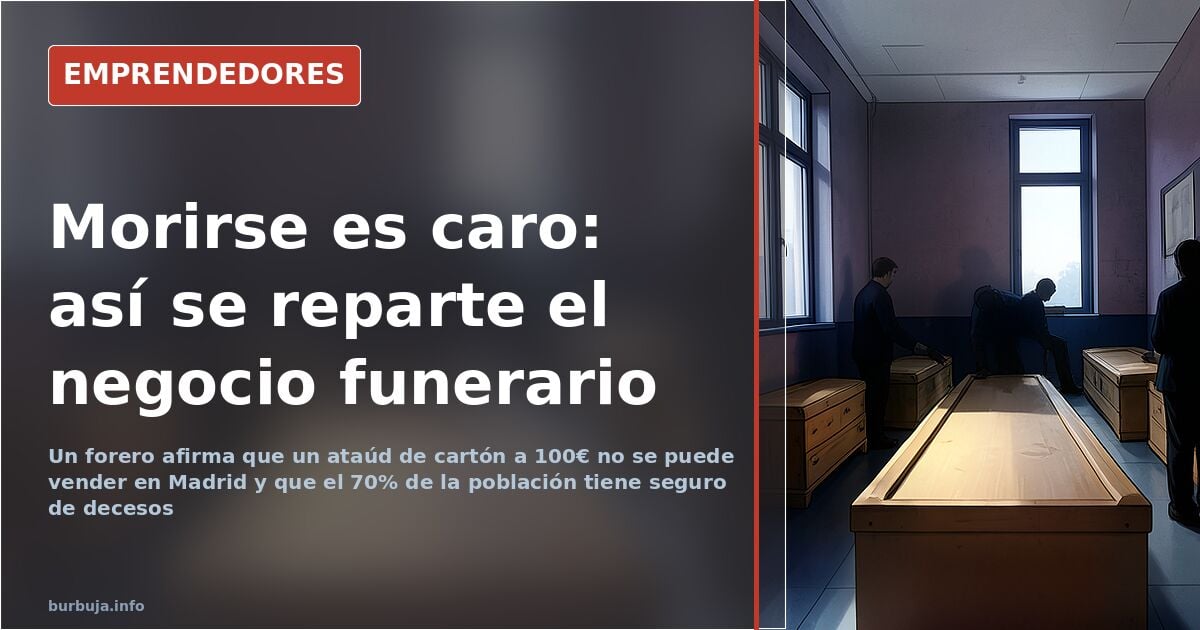
The death business: licences, insurance and a cardboard coffin that's banned
A cardboard coffin made in Alcobendas for 100 euros which, according to a forum post, can be sold anywhere in Spain except Madrid. That is the gateway to a sector where the price of a funeral is not set by the market alone: municipal licences, funeral insurance and competition concentrated in a few hands all play a part. The question that opens the discussion is simple: if many people don't care what happens to their body, why does a package of coffin, cremation and scattered ashes cost what it costs?
The short answer is that setting up a low-cost funeral business is not impossible, but it is not the goldmine it seems from the outside. The long answer involves understanding who pays, who authorises and who takes the margin.
Can funeral licences be bought and sold like pharmacy licences?
No. Those who have worked in the sector make it clear: you apply for a business licence trinc the usual procedures, as you would for a bar or a stationery shop. The paperwork varies by town and province, but it is not a title that can be inherited or transferred. It is a different story with cemeteries and funeral homes, where the local council usually owns the land and manages the service, and there the door narrows.
Some claim that Madrid liberalised the regime, while others describe the business as an oligopoly of families dividing up the pie through municipal licences. The most nuanced version comes from inside: there is real competition in large capitals, with three companies and four funeral homes competing, and families request five or six quotes before deciding. That was unthinkable two years ago.
Funeral insurance, the real owner of the customer
The figure that changes everything: **70% of the population has funeral insurance**, and that insurance already has the funeral services contracted with a specific funeral company. The entrepreneur who wants to enter without an insurer backing them is left watching the funeral procession go by. The investment is not garage-scale either: refrigeration chambers, adapted vans, a warehouse with a variety of coffins, sales staff in hospitals and a 24-hour service.
That is where the low-cost trap lies. You can cut back on vehicles and hours, yes, but the fixed cost of the infrastructure and the fact that the customer arrives already assigned by policy limit the margin. The funeral home business, with rooms averaging **700 euros**, is another matter: whoever builds one does not need to partner with funeral companies, and zoning rules on distance from housing and minimum space complicate the project.
The coffin Madrid won't let be sold
The most striking case is the cardboard coffin made in Alcobendas, costing **100 euros**, marketable throughout Spain except Madrid, pirated abroad and with a complaint accepted for processing by the Environmental Prosecutor's Office, archived and later peine. The coffin business moves **296 million euros a year**. The anecdote about biodegradable pet urns that some funeral companies already offer families completes the picture: sustainability is reaching the sector, but slowly and through the back door.
The underlying question remains unanswered: why does a family planning a cremation pay for an expensive coffin that is going to burn? The honest answer is that nobody dares raise it at the worst possible moment. Taboos also have a price.
Also available in: Deutsch
Summary of a discussion on Burbuja.info - Foro de economía, actualidad y política., translated from Spanish and reviewed before publication. Read the full discussion (26 replies).
More summaries
-
Low-Cost Funeral in Spain: 1,700 Euros for Cremation
An Asturian entrepreneur launches a low-cost funeral home in 2017, charging 1,700 euros for cremation. The business faces high vehicle costs and fierce competition with insurers.
-
Christian Bresser: another young Spaniard proving how mediocre you are
Analysis of the debate on Christian Bresser in Burbuja.info: legitimate entrepreneurship or digital smoke selling? Discover the key points of the thread here.
-
Building from scratch in Spain: €2,500/m² and 18 months of work
In Spain, self-building costs exceed €2,500 per square meter for construction alone, with projects often lasting a year and a half.
-
PP and VOX face the self-employed: what will truly change
Flat rate, cut to union subsidies, and 50% of regional personal income tax: what PP and VOX could change for the self-employed and SMEs.
-
How to place a disqualified relative without a public contest
Foundations, NGOs, public companies and disability benefits are the routes for placing a disqualified relative without a competitive exam. An unwritten manual of Spanish cronyism.
-
AI will create more jobs than it destroys, debate concludes
One example from the debate: an electrician invests €30,000 in his AI project and ends up needing programmers.