
Sergeant convicted of pulling a female cadet's hair
Six months in prison for abuse of authority and three for injuries: military court convicts the sergeant who pulled a cadet's braid during rappelling.
English · Original discussion in Spanish · Published
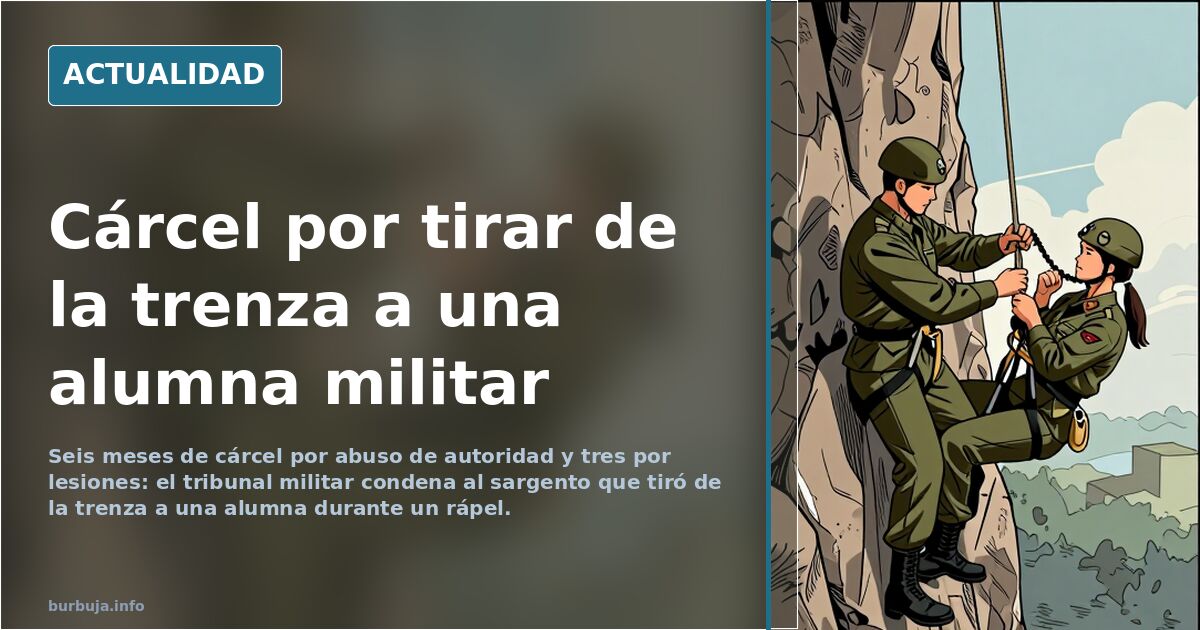
Six months in prison for pulling a female military cadet's braid
Can an instructor end up convicted for pulling a subordinate's hair? In the Ejército del Aire (Spanish Air Force), yes. The Tribunal Militar Territorial Cuarto (Fourth Territorial Military Court) has convicted a brigada (sergeant major)—a sargento primero (sergeant first class) when the events occurred—over what peine in June 2022 during a rappelling exercise at the Academia Básica del Aire, in La Virgen del Camino (León). The sentence: six months in prison for abuse of authority in the form of physical mistreatment, Article 46 of the Código Penal Militar (Military Incivil Code), and three more months for the crime of causing injuries. The trigger was a braid that stuck out a few centimetres from the helmet.
What the ruling found proven
The instructor was checking the harness, the attachment devices and the cadet's safety systems at the start of the descent. When he saw the braid, according to the court account, he snapped at her in a loud voice: “Where are you going with that hippie braid? What happens if your hair gets caught like that somewhere?” He did not stop at words. At the same time, he yanked her braid.
Then he ordered her to go back to tie up her hair, which had come loose as a result of the yanks. The cadet replied, very nervous and sobbing, that this was no way to behave. Several direct witnesses testified that they had seen the NCO pulling her hair or holding her by the braid, although they had not seen the specific yank. The accused denied having grabbed her braid: his version, which the court did not believe, was that her hair had got caught in the helmet.
The carabiner that was not found proven
In her statement, the cadet maintained that the sergeant took a carabiner from the gear, hooked it to her hair and pulled hard while telling her: “What happens to your head if it stays hooked like that? You can't move, right? Would it hurt?” She also said he kept her head turned towards the rest of her classmates, which caused her shame and humiliation.
The court did not find the carabiner proven: “it is not established that those yanks were made with one of the carabiners.” But it added a sentence that dismantles the easy defence: “this circumstance does not subtract one iota of credibility from the statement of the lady cadet.” The nervous state, the court reasons, could have led her to confuse his hand with the carabiner. The yanks and the shouting were proven; the implement, no. The ruling also details the classic criteria for granting credibility to the victim of a crime: no spurious motive to report, persistence in the accusation and a coherent account.
Anxiety attack and a scrape on the scalp
After the exercise, the cadet went to the academy's medical post. Health staff recorded “a generalised anxiety state with high blood pressure readings”, with emergency medication and assistance from the unit's Psychology Service. The medical lieutenant observed a small scrape on the scalp, redness with a scratch, stress- and anxiety-induced asthma, and mild neck pain or cervical strain. At the oral hearing, the forensic experts considered it likely that the crisis originated in events experienced as highly humiliating.
Why the court sees abuse of authority and not a telling-off
The key lies in the intent. The court determined that the aggression against a subordinate, with yanks on her braid and in the presence of other colleagues, “is serious conduct” that harmed legal interests such as military discipline and the duty to respect military dignity. The ruling describes an intent to humiliate, not to correct. That is why the case ended up in a Juzgado Togado Militar Territorial (Territorial Military Court), after the colonel in charge of the Academia Básica del Aire brought the facts to its attention and after the episode had first led to a disciplinary report.
The tug-of-war over toughness: training or humiliation?
The case has reignited the debate over training methods. Some reactions argue that military training requires psychological endurance, that tough episodes in public are part of the training and that taking this kind of matter to court weakens the Armed Forces. The figure they use as an argument is the sentence: nine months in prison for what they describe as a telling-off with yanks.
On the other side, another camp argues exactly the opposite: that degrading treatment makes no one a better combatant or a better technician, and that a superior asserts authority by setting an example, not by humiliating those who depend on him. In a rappelling exercise, they stress, it was enough to verbally warn of the risk of wearing loose hair, without touching anyone. And a nuance that is often lost appears: in the Ejército del Aire there are administration, maintenance or catering specialities that have little to do with a special forces unit.
The disciplinary effect is also debated. Some defend that the instructor was applying a safety rule—a braid caught during a descent is a real risk—while others respond that warning of the risk and pulling hair are different things, and that the latter was not necessary for the former. Another line of criticism points to the legal framework: it is claimed that an equivalent episode between two men would have ended in arrest and not in court, something the available material does not allow verifying.
The court found not a single witness who backed the instructor's version. Nor did it see any spurious motive in the complainant, whose account it considered coherent and persistent. If the aim was to set an example of toughness, that toughness ended up costing six months and three months in prison.
Can an instructor end up convicted for pulling a subordinate's hair? In the Ejército del Aire (Spanish Air Force), yes. The Tribunal Militar Territorial Cuarto (Fourth Territorial Military Court) has convicted a brigada (sergeant major)—a sargento primero (sergeant first class) when the events occurred—over what peine in June 2022 during a rappelling exercise at the Academia Básica del Aire, in La Virgen del Camino (León). The sentence: six months in prison for abuse of authority in the form of physical mistreatment, Article 46 of the Código Penal Militar (Military Incivil Code), and three more months for the crime of causing injuries. The trigger was a braid that stuck out a few centimetres from the helmet.
What the ruling found proven
The instructor was checking the harness, the attachment devices and the cadet's safety systems at the start of the descent. When he saw the braid, according to the court account, he snapped at her in a loud voice: “Where are you going with that hippie braid? What happens if your hair gets caught like that somewhere?” He did not stop at words. At the same time, he yanked her braid.
Then he ordered her to go back to tie up her hair, which had come loose as a result of the yanks. The cadet replied, very nervous and sobbing, that this was no way to behave. Several direct witnesses testified that they had seen the NCO pulling her hair or holding her by the braid, although they had not seen the specific yank. The accused denied having grabbed her braid: his version, which the court did not believe, was that her hair had got caught in the helmet.
The carabiner that was not found proven
In her statement, the cadet maintained that the sergeant took a carabiner from the gear, hooked it to her hair and pulled hard while telling her: “What happens to your head if it stays hooked like that? You can't move, right? Would it hurt?” She also said he kept her head turned towards the rest of her classmates, which caused her shame and humiliation.
The court did not find the carabiner proven: “it is not established that those yanks were made with one of the carabiners.” But it added a sentence that dismantles the easy defence: “this circumstance does not subtract one iota of credibility from the statement of the lady cadet.” The nervous state, the court reasons, could have led her to confuse his hand with the carabiner. The yanks and the shouting were proven; the implement, no. The ruling also details the classic criteria for granting credibility to the victim of a crime: no spurious motive to report, persistence in the accusation and a coherent account.
Anxiety attack and a scrape on the scalp
After the exercise, the cadet went to the academy's medical post. Health staff recorded “a generalised anxiety state with high blood pressure readings”, with emergency medication and assistance from the unit's Psychology Service. The medical lieutenant observed a small scrape on the scalp, redness with a scratch, stress- and anxiety-induced asthma, and mild neck pain or cervical strain. At the oral hearing, the forensic experts considered it likely that the crisis originated in events experienced as highly humiliating.
Why the court sees abuse of authority and not a telling-off
The key lies in the intent. The court determined that the aggression against a subordinate, with yanks on her braid and in the presence of other colleagues, “is serious conduct” that harmed legal interests such as military discipline and the duty to respect military dignity. The ruling describes an intent to humiliate, not to correct. That is why the case ended up in a Juzgado Togado Militar Territorial (Territorial Military Court), after the colonel in charge of the Academia Básica del Aire brought the facts to its attention and after the episode had first led to a disciplinary report.
The tug-of-war over toughness: training or humiliation?
The case has reignited the debate over training methods. Some reactions argue that military training requires psychological endurance, that tough episodes in public are part of the training and that taking this kind of matter to court weakens the Armed Forces. The figure they use as an argument is the sentence: nine months in prison for what they describe as a telling-off with yanks.
On the other side, another camp argues exactly the opposite: that degrading treatment makes no one a better combatant or a better technician, and that a superior asserts authority by setting an example, not by humiliating those who depend on him. In a rappelling exercise, they stress, it was enough to verbally warn of the risk of wearing loose hair, without touching anyone. And a nuance that is often lost appears: in the Ejército del Aire there are administration, maintenance or catering specialities that have little to do with a special forces unit.
The disciplinary effect is also debated. Some defend that the instructor was applying a safety rule—a braid caught during a descent is a real risk—while others respond that warning of the risk and pulling hair are different things, and that the latter was not necessary for the former. Another line of criticism points to the legal framework: it is claimed that an equivalent episode between two men would have ended in arrest and not in court, something the available material does not allow verifying.
The court found not a single witness who backed the instructor's version. Nor did it see any spurious motive in the complainant, whose account it considered coherent and persistent. If the aim was to set an example of toughness, that toughness ended up costing six months and three months in prison.
Summary of a discussion on Burbuja.info - Foro de economía, actualidad y política., translated from Spanish and reviewed before publication. Read the full discussion (259 replies).
More summaries
-
Ukraine Debates Decriminalizing Pornography to Boost Military Industry
Ukraine is discussing decriminalizing pornography to fund the purchase of 30,000 combat drones. The proposal has already passed an initial vote.
-
US Prepares Potential Military Action Around Cuba, CBS Reports
CBS reports the US is preparing possible military action around Cuba, not within. Spain's "law of grandchildren" and oil factor influence calculations.
-
Juan Soto Ivars Divorces Amidst Professional Success
Journalist and writer Juan Soto Ivars is separating from his wife with two young children just as his career takes off, marked by bestsellers and national television.
-
Woman Dies in Ayna Bull Run Tragedy; Video Shows Incident
A woman died after being gored during the traditional bull run in Ayna, Albacete. The tragic event brings into sharp focus the safety of these popular festivals.
-
Camryn Manheim and the ‘gay son’ she wished she had
A quote attributed to Camryn Manheim—wanting a gay son and dressing him in drag—reopens the debate over identities imposed on children
-
Vegan raw-food influencer dies at 39 after extreme diet
Zhanna Samsonova, 39, a raw-food influencer, died in Malaysia from an infection worsened by the 'exhaustion' of an extreme fruit-only diet