
Self-sufficiency in Lugo, Spain: six hours work, zero rent
A man in rural Lugo lives self-sufficiently with no rent, working only six hours a week and sharing his harvest.
English · Original discussion in Spanish · Published
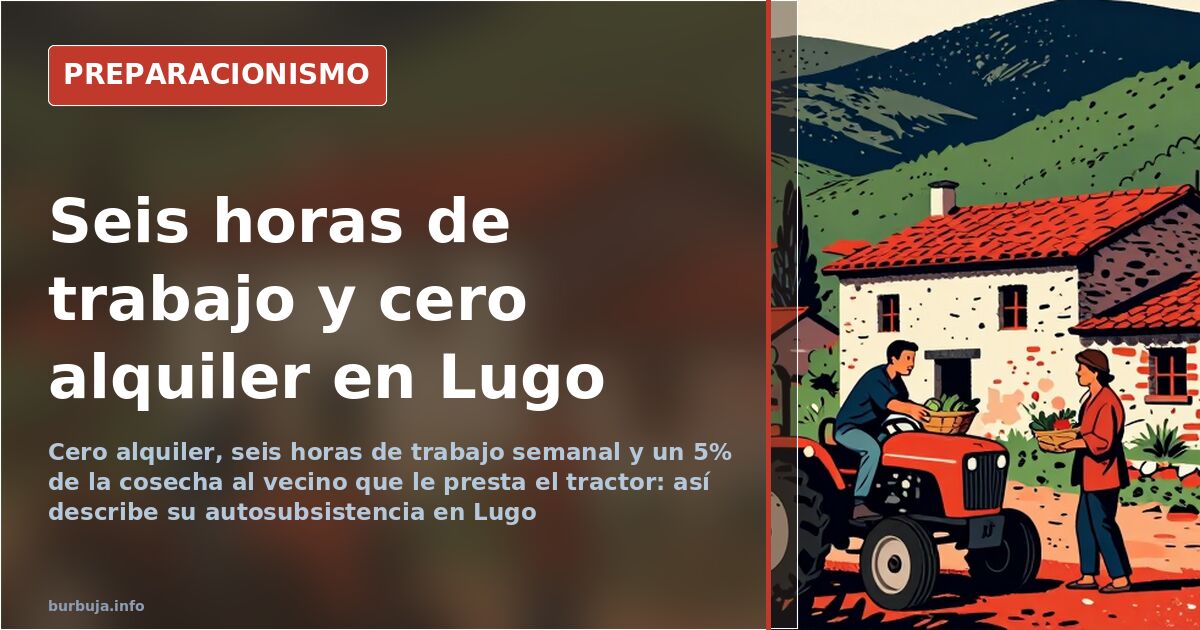
In Lugo he farms, pays no rent and works six hours a week
Six hours of work per week. Zero rent. Zero mortgage. Just an electricity bill and a mobile phone plan. A man nearly 40 years old claims he has been living this way for months in a nearly abandoned village in the province of Lugo, stating he has never felt better: no boss, no early mornings, no anxiety. The story was published on March 17, 2024 in a forum dedicated to collapse preparedness and has accumulated 118 replies ranging from envy and disbelief to apocalyptic predictions.
Living self-sufficiently with minimal expenses is not new. What stands out here is the method: he bought nothing, rented nothing and does not work for anyone.
How do you get a free house in an abandoned village?
The answer is a chain of favors. He arrived in November and occupied a house whose owner he did not know. A neighbor aged 76 who lives six kilometers away connected him with the owners. The agreement was simple: he can do whatever he wants with the property as long as he keeps it in good condition and clears the weeds from their lands in the area. In return, he gains access to those fields for farming.
The second pillar is machinery. For a 5% share of the harvest, that same neighbor lent him a plow for one weekend. With that, he tilled, sowed, and resolved the hardest part of the agricultural calendar. There is no lease agreement, no monthly fee, and no bank involved.
The numbers: six weekly hours, vegetarian diet, and investment funds
The time allocation is what has attracted the most attention. Three hours a day, two days a week, plus one intensive work week per year: practically about six hours a week. The rest of the day is spent composing songs on the guitar, walking a dog gifted to him two weeks ago, and reading the Gospels.
He eats what he grows—he is vegetarian—and assures he hasn't had to buy food. Financially, he keeps almost all his money in investment funds and barely touches it: he only pays for mobile data, the electricity bill, and occasional online purchases. He calculates that his capital continues to grow without him lifting a finger. He has only gone down to the town twice, to pick up packages.
The third support of the model is the nuns from the neighboring convent. They give him bread daily, eggs sporadically, and now any surplus. The relationship has reached such a point that he goes in to pray with them, something unusual in a cloistered convent.
Can Lugo's winter sustain such a life?
No one knows, and the most serious objections are not ideological but historical: in the 1960s and 70s, everyone who could left these villages to move to cities, and they didn't do so willingly. Those who have tried the model firsthand summarize it without embellishment. One person has a house in a village of 40 inhabitants, with all the comfort of a 2011 build, yet has not managed to stay there longer than the four summer months. "It's hard," they admit.
The calendar doesn't help either. If summer invites walks and cycling, from November to February the village is empty, night falls early, and isolation weighs heavily. The lingering doubt is whether the euphoria of the first harvest is a stable state or seasonal enthusiasm.
Luck or effort: the discussion shifted ground
Midway through the exchange, the topic stopped being just about the garden. One of the most celebrated replies stated that luck is called hard work, and that everything he has was wrestled from life through sweat. Another acknowledged having lived comfortably in the city, making no apologies for studying and earning more than average, attributing their advantage to a family that treated education as an investment rather than an expense.
The counter-reply was more uncomfortable: effort alone is not enough. A car accident, shattered childhood self-esteem, or a neurodegenerative disease are enough to ensure decades of work don't translate into wealth. Millions of people are in that situation and none chose to be there. The proponent of the plan himself admits he lost years due to a stumble and never had a well-paid job due to lack of CV, contacts, or chance. His conclusion: this same plan would not be viable in the city.
The Mad Max scenario some await and others ridicule
The backdrop of the plan is collapse. If telecommunications and money fall, he argues, his crops will survive and the nuns will support him. Replies were relentless: in such a scenario, a religious community would lock itself away and open to no one, and the countryside is not an automatic refuge against organized groups. Others pointed out that the author depends precisely on the same system he claims to despise: investment funds, mobile coverage, and Amazon deliveries.
Some even see the housing pact as a return to the old order: an owner granting land use in exchange for labor and a percentage of the crop. Feudalism, they say, is still alive. And a third group, more skeptical, simply doesn't believe anything told.
The model works on paper. So does the one claiming you just need to save and spend minimally, arguing that discipline is incompatible with a partner: either you find someone with the same values, which is rare, or you embrace solitude. The open question isn't whether one can live with almost nothing. It's why, if it's so cheap, more people don't try it.
Six hours of work per week. Zero rent. Zero mortgage. Just an electricity bill and a mobile phone plan. A man nearly 40 years old claims he has been living this way for months in a nearly abandoned village in the province of Lugo, stating he has never felt better: no boss, no early mornings, no anxiety. The story was published on March 17, 2024 in a forum dedicated to collapse preparedness and has accumulated 118 replies ranging from envy and disbelief to apocalyptic predictions.
Living self-sufficiently with minimal expenses is not new. What stands out here is the method: he bought nothing, rented nothing and does not work for anyone.
How do you get a free house in an abandoned village?
The answer is a chain of favors. He arrived in November and occupied a house whose owner he did not know. A neighbor aged 76 who lives six kilometers away connected him with the owners. The agreement was simple: he can do whatever he wants with the property as long as he keeps it in good condition and clears the weeds from their lands in the area. In return, he gains access to those fields for farming.
The second pillar is machinery. For a 5% share of the harvest, that same neighbor lent him a plow for one weekend. With that, he tilled, sowed, and resolved the hardest part of the agricultural calendar. There is no lease agreement, no monthly fee, and no bank involved.
The numbers: six weekly hours, vegetarian diet, and investment funds
The time allocation is what has attracted the most attention. Three hours a day, two days a week, plus one intensive work week per year: practically about six hours a week. The rest of the day is spent composing songs on the guitar, walking a dog gifted to him two weeks ago, and reading the Gospels.
He eats what he grows—he is vegetarian—and assures he hasn't had to buy food. Financially, he keeps almost all his money in investment funds and barely touches it: he only pays for mobile data, the electricity bill, and occasional online purchases. He calculates that his capital continues to grow without him lifting a finger. He has only gone down to the town twice, to pick up packages.
The third support of the model is the nuns from the neighboring convent. They give him bread daily, eggs sporadically, and now any surplus. The relationship has reached such a point that he goes in to pray with them, something unusual in a cloistered convent.
Can Lugo's winter sustain such a life?
No one knows, and the most serious objections are not ideological but historical: in the 1960s and 70s, everyone who could left these villages to move to cities, and they didn't do so willingly. Those who have tried the model firsthand summarize it without embellishment. One person has a house in a village of 40 inhabitants, with all the comfort of a 2011 build, yet has not managed to stay there longer than the four summer months. "It's hard," they admit.
The calendar doesn't help either. If summer invites walks and cycling, from November to February the village is empty, night falls early, and isolation weighs heavily. The lingering doubt is whether the euphoria of the first harvest is a stable state or seasonal enthusiasm.
Luck or effort: the discussion shifted ground
Midway through the exchange, the topic stopped being just about the garden. One of the most celebrated replies stated that luck is called hard work, and that everything he has was wrestled from life through sweat. Another acknowledged having lived comfortably in the city, making no apologies for studying and earning more than average, attributing their advantage to a family that treated education as an investment rather than an expense.
The counter-reply was more uncomfortable: effort alone is not enough. A car accident, shattered childhood self-esteem, or a neurodegenerative disease are enough to ensure decades of work don't translate into wealth. Millions of people are in that situation and none chose to be there. The proponent of the plan himself admits he lost years due to a stumble and never had a well-paid job due to lack of CV, contacts, or chance. His conclusion: this same plan would not be viable in the city.
The Mad Max scenario some await and others ridicule
The backdrop of the plan is collapse. If telecommunications and money fall, he argues, his crops will survive and the nuns will support him. Replies were relentless: in such a scenario, a religious community would lock itself away and open to no one, and the countryside is not an automatic refuge against organized groups. Others pointed out that the author depends precisely on the same system he claims to despise: investment funds, mobile coverage, and Amazon deliveries.
Some even see the housing pact as a return to the old order: an owner granting land use in exchange for labor and a percentage of the crop. Feudalism, they say, is still alive. And a third group, more skeptical, simply doesn't believe anything told.
The model works on paper. So does the one claiming you just need to save and spend minimally, arguing that discipline is incompatible with a partner: either you find someone with the same values, which is rare, or you embrace solitude. The open question isn't whether one can live with almost nothing. It's why, if it's so cheap, more people don't try it.
Also available in: Deutsch
Summary of a discussion on Burbuja.info - Foro de economía, actualidad y política., translated from Spanish and reviewed before publication. Read the full discussion (118 replies).
More summaries
-
Family Relocates to Ecuador's Amazon Region
A family moves their children to the Ecuadorian Amazon. Some see real estate investment and adventure; others, a "green prison" without school.
-
Post-Mad Max memoirs: The cult collapse novel released in installments
A post-apocalyptic story serialized in online forums has become a cult reference for collapse fiction and survivalism.
-
AGI Debate: ChatGPT Launch Sparks Concerns Over Costs and Job Losses
The new ChatGPT launch revives the AGI debate, highlighting doubts about financial losses, data scarcity, energy limits, and potential layoffs.
-
Utopia 2013: Where to Download the British Series on P2P
The British series Utopia (2013), with two subtitled seasons, is still available on eMule, torrent and direct download
-
Spain Prepper Water Calculation: 222 Liters Lasts 9 Days for Five
A viral calculation in Spanish prepper forums shows 222.5 liters of water lasts only nine days for a family of five during a blackout.
-
Self-defense against groups: Fleeing vs. legal risks
Facing three or more attackers, fleeing is the majority choice. The issue isn't strength, but the legal cost of self-defense.