
Second 15M Protest Fizzles: Few Tents, Low Turnout in Madrid's Sol
The second attempt to replicate the 2011 movement sees minimal participation in Puerta del Sol, with critics claiming media coverage exaggerates a largely empty protest.
English · Original discussion in Spanish · Published
Second 15M Protest Fizzles: Few Tents, Low Turnout in Madrid's Sol
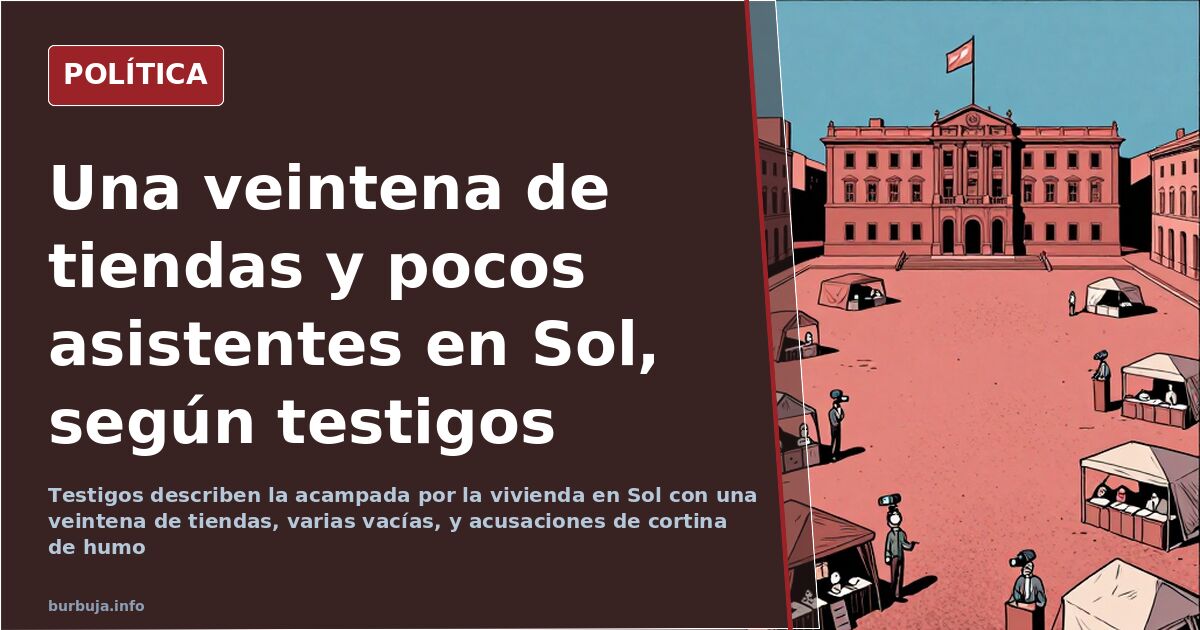
How many people are actually camping in Puerta del Sol? The answer given by some attendees is uncomfortable: very few. They argue that television images are misleading, noting that up close there are no more than twenty tents, many of them empty or placed for appearances. Most people passing through the square were curious onlookers drawn by the event, not activists intending to stay. According to this narrative, the second attempt to replicate the 2011 15M movement begins with less critical mass than scenery.
How many tents are really at the Sol camp?
The calculation circulating among critics is devastating: no more than twenty tents, widely spaced, some with nobody inside. The comparison with the original 2011 camp does not hold up: then the square was buzzing; now it looks like a set. Some claim the tents were positioned to create a sense of volume for cameras, an effect that collapses when viewed from street level.
This figure has become the main argument for those denying the existence of a real movement. If the original 15M was measured by its ability to overflow the square, this second attempt is measured by the opposite: by the emptiness it leaves behind. Much hype, little camp.
TV narrative vs. reality on the ground
The gap between what news broadcasts show and what visitors find in Sol is the core of the discontent. Media outlets are accused of amplifying a minority gathering and manufacturing the sensation of a massive phenomenon that does not exist. Actual attendance, they say, consisted of curious bystanders, not campers.
Meanwhile, videos and tweets circulate reinforcing the staging thesis: identical tents, lined up, looking as if they all came from the same warehouse. The recurring irony is that someone will have to write off those Decathlon tents. The lingering question is whether we are facing a protest or a production.
The camp as a smokescreen
Part of the analysis goes beyond aesthetics, arguing the timing is not coincidental. The camp would coincide with other inconvenient issues for the Government, serving to shift media attention. This thesis repeats with variations: this is born to make noise so that evening news talks less about what bothers them.
The argument is reinforced by a paradox frequently pointed out: if the problem is the Government's housing law, why camp in Sol and not in front of Moncloa or the relevant Ministry? For this current, the protest misses its target, which neutralizes it as a political tool.
Tenant Union and criticism of its discourse
The spokesperson for the Sindicato de Inquilinas (Tenant Union) has labeled measures such as massive housing construction or tax breaks for landlords as "deceptions." This position generates rejection among those who believe the only historical solution to a housing crisis has been to build more.
The underlying reproach is that there is no significant voice on the left demanding large-scale VPO (social housing), land liberalization, and cranes. Criticism extends to the union's name itself: its registration status is questioned, reducing it to an association with a spokesperson. The debate over concrete and steel as solutions returns to the center stage.
Investment funds, diffuse blame, and mismatched data
The narrative attributing the rental crisis to investment funds receives uncomfortable nuances. It is recalled that hundreds of municipalities have not a single house owned by any fund, yet rents remain high. Gijón is cited as an example showing the problem cannot be explained solely by institutional ownership.
The other side of the coin is the small landlord raising prices due to scarcity. The average Spaniard, it is said, is cynical: everyone points to the fund, no one points to the neighbor pricing their apartment like gold. The bubble was fed by buying to rent or resell higher, and that was not done by a foreign fund.
From camp to clash: incidents and pending eviction
Conversation turns to incidents. Tweets spread reports of assaults on a journalist, clashes with police agents, and an ambulance unable to pass through Sol. These are versions circulated on social networks, without judicial confirmation, and must be read as such. The Government Delegate in Madrid had described the camp as "absolutely peaceful" and, according to these posts, asked the judge not to evict it to avoid violent incidents.
The number of overnight campers is reduced, according to these accounts, to thirty people at most: attendees would sleep at home and return in the morning. Public space occupation, harm to commerce, and the square's image are the arguments used by those calling for eviction. Cold weather and storms, they point out, will do the rest.
With twenty tents, thirty campers, and a union calling construction a deception, the Second 15M has everything the original had except one thing: people. History will tell if it was a camp or a set with good community managers.
How many people are actually camping in Puerta del Sol? The answer given by some attendees is uncomfortable: very few. They argue that television images are misleading, noting that up close there are no more than twenty tents, many of them empty or placed for appearances. Most people passing through the square were curious onlookers drawn by the event, not activists intending to stay. According to this narrative, the second attempt to replicate the 2011 15M movement begins with less critical mass than scenery.
How many tents are really at the Sol camp?
The calculation circulating among critics is devastating: no more than twenty tents, widely spaced, some with nobody inside. The comparison with the original 2011 camp does not hold up: then the square was buzzing; now it looks like a set. Some claim the tents were positioned to create a sense of volume for cameras, an effect that collapses when viewed from street level.
This figure has become the main argument for those denying the existence of a real movement. If the original 15M was measured by its ability to overflow the square, this second attempt is measured by the opposite: by the emptiness it leaves behind. Much hype, little camp.
TV narrative vs. reality on the ground
The gap between what news broadcasts show and what visitors find in Sol is the core of the discontent. Media outlets are accused of amplifying a minority gathering and manufacturing the sensation of a massive phenomenon that does not exist. Actual attendance, they say, consisted of curious bystanders, not campers.
Meanwhile, videos and tweets circulate reinforcing the staging thesis: identical tents, lined up, looking as if they all came from the same warehouse. The recurring irony is that someone will have to write off those Decathlon tents. The lingering question is whether we are facing a protest or a production.
The camp as a smokescreen
Part of the analysis goes beyond aesthetics, arguing the timing is not coincidental. The camp would coincide with other inconvenient issues for the Government, serving to shift media attention. This thesis repeats with variations: this is born to make noise so that evening news talks less about what bothers them.
The argument is reinforced by a paradox frequently pointed out: if the problem is the Government's housing law, why camp in Sol and not in front of Moncloa or the relevant Ministry? For this current, the protest misses its target, which neutralizes it as a political tool.
Tenant Union and criticism of its discourse
The spokesperson for the Sindicato de Inquilinas (Tenant Union) has labeled measures such as massive housing construction or tax breaks for landlords as "deceptions." This position generates rejection among those who believe the only historical solution to a housing crisis has been to build more.
The underlying reproach is that there is no significant voice on the left demanding large-scale VPO (social housing), land liberalization, and cranes. Criticism extends to the union's name itself: its registration status is questioned, reducing it to an association with a spokesperson. The debate over concrete and steel as solutions returns to the center stage.
Investment funds, diffuse blame, and mismatched data
The narrative attributing the rental crisis to investment funds receives uncomfortable nuances. It is recalled that hundreds of municipalities have not a single house owned by any fund, yet rents remain high. Gijón is cited as an example showing the problem cannot be explained solely by institutional ownership.
The other side of the coin is the small landlord raising prices due to scarcity. The average Spaniard, it is said, is cynical: everyone points to the fund, no one points to the neighbor pricing their apartment like gold. The bubble was fed by buying to rent or resell higher, and that was not done by a foreign fund.
From camp to clash: incidents and pending eviction
Conversation turns to incidents. Tweets spread reports of assaults on a journalist, clashes with police agents, and an ambulance unable to pass through Sol. These are versions circulated on social networks, without judicial confirmation, and must be read as such. The Government Delegate in Madrid had described the camp as "absolutely peaceful" and, according to these posts, asked the judge not to evict it to avoid violent incidents.
The number of overnight campers is reduced, according to these accounts, to thirty people at most: attendees would sleep at home and return in the morning. Public space occupation, harm to commerce, and the square's image are the arguments used by those calling for eviction. Cold weather and storms, they point out, will do the rest.
With twenty tents, thirty campers, and a union calling construction a deception, the Second 15M has everything the original had except one thing: people. History will tell if it was a camp or a set with good community managers.
Also available in: Deutsch
Summary of a discussion on Burbuja.info - Foro de economía, actualidad y política., translated from Spanish and reviewed before publication. Read the full discussion (121 replies).
More summaries
-
Ayuso Files Appeal Against Madrid Government Delegate Over Sol Protest
Madrid president Isabel Díaz Ayuso challenges the government delegate's refusal to clear the Puerta del Sol encampment, sparking a fierce political clash.
-
Sol Campout for Housing: 150 People and the Echo of 15-M
A housing crisis campout gathers around 150 people in Puerta del Sol amid discussions of a 15-M repeat and jurisdictional issues.
-
Madrid PP gives 48 hours to clear Sol camp
Madrid's PP gives 48 hours to clear the Sol encampment, citing cobblestones, stoves and knives; banners against Ayuso appear.
-
Netanyahu invites Catalan separatist leader Orriols to Tel Aviv
Israeli PM Netanyahu invites Sílvia Orriols, leader of Aliança Catalana, strengthening ties between Catalan separatism and Zionism.
-
Palestinian Identity: History, Genetics and Politics
Origins of the term Palestine, genetic evidence and the Arab League's role in a debate that politicizes the Israeli-Palestinian conflict.
-
Goebbels' Nazi Narrative of Red Violence in Berlin
A 1938 Goebbels text on red violence in Berlin resurfaces, citing 200 dead and 4,000 injured attributed to political rivals.