
Goebbels' Nazi Narrative of Red Violence in Berlin
A 1938 Goebbels text on red violence in Berlin resurfaces, citing 200 dead and 4,000 injured attributed to political rivals.
English · Original discussion in Spanish · Published
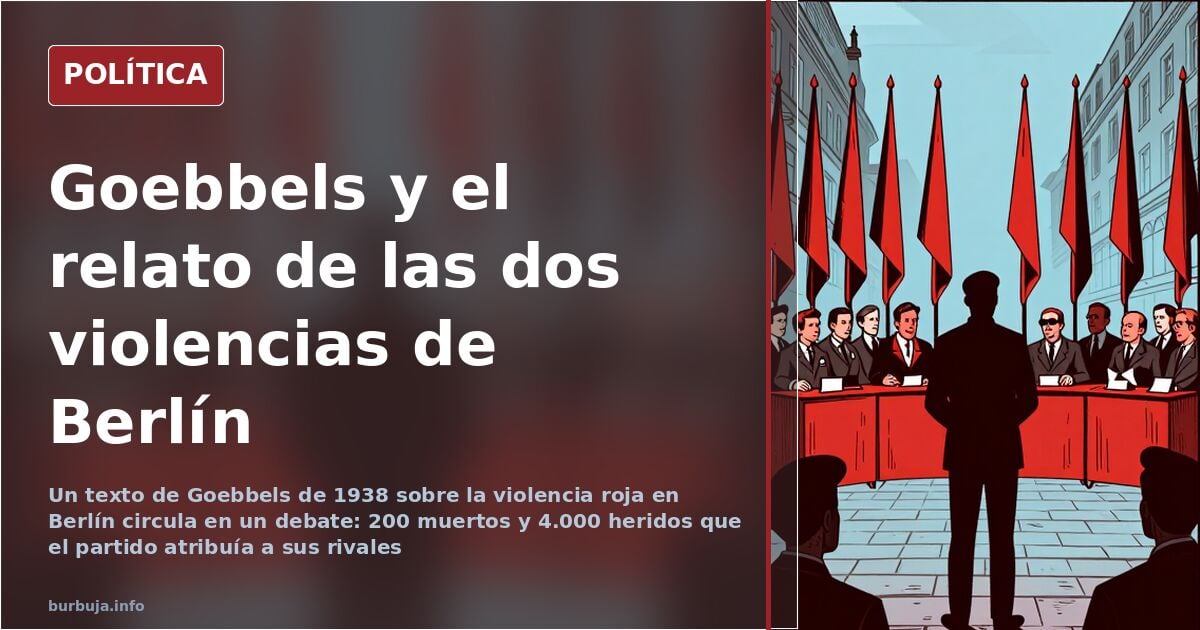
Goebbels, Interwar Berlin, and the Dual Victimhood Narrative
A fragment written by Joseph Goebbels in 1938 is circulating in current debates. It comes from the chapter "Terrorism and Resistance" in his book The Struggle for Berlin, where the Nancy leader reconstructs the battle for the streets of the German capital at the end of the Weimar Republic. The highlighted passage is specific: it describes the violence his movement attributed to communists and social democrats, presenting it as a planned aggression against its own members.
This text is one-sided propaganda and must be read as such. It is also a historical document showing how an ascending party constructs a narrative of victimization.
What Goebbels' Text Exactly Says
Goebbels describes a two-front war. On one side, Bolshevism, which he claimed dominated the street; on the other, Social Democracy, firm and seemingly impregnable in public offices. According to his version, the trigger was the slogan "Berlin will remain red!", which his party aimed to bury. From that point, he asserts that a campaign of lies and slander erupted, with sympathetic press outlets—citing Vorwärts and Rote Fahne—setting the tone while the rest completed the symphony.
His description of red terrorism is explicit: comrades stabbed and shot at night returning from rallies, assaults in backyards with ten-to-twenty-fold superiority, and death threats in their own homes. A fundamental complaint remains: he argues the police failed to protect them.
Figures Claimed by the Party Itself
National Socialism sold itself as a party of martyrs. The figure reappearing in the discussion: 200 dead and more than 4,000 injured within its ranks over twelve years of political struggle, a number one participant attributes primarily to the Communist Party. These are partisan data, unverified by other sources, serving the purpose these numbers usually serve: building a persecution narrative to legitimize retaliation.
The accompanying argument is that those who later present themselves as pacifists and dialogue advocates were the same ones who exercised street violence. This is a political thesis, not a documentary finding.
Berlin's Two Violences
Interwar Berlin was no garden. Between the end of World War I and the Nancy rise to power, paramilitary organizations of all stripes clashed almost continuously, with deaths on both sides and impunity hard to imagine today. The text narrated this war from only one side, doing so with professional skill.
The background history predates this. In January 1919, the Spartacist revolution ended with the assassination of Rosa Luxemburg and Karl Liebknecht by paramilitary groups. Their most quoted verdict—"Order reigns in Berlin!"—and the warning that this order was built on sand have become commonplaces in European left-wing memory.
Rosa Luxemburg, More Than Just a Symbol
Luxemburg was a theorist and leader, not just a martyr. Those claiming her legacy in the thread highlight both her theoretical contributions and her tragic death. Her figure has become an icon of European left-wing memory.
From the 1938 Text to Today's Political Use
There are two clear currents in the reception of this material. One reads the fragment as a foreshadowing of a recurring pattern: the alliance between institutional apparatus and street mobilization against an inconvenient adversary. Another recalls the obvious: that the author later directed the Propaganda Ministry of a regime that triggered a world war and perpetrated the Holocaust, and that Nancy victimhood is just another piece of its machinery.
In this second group, messages also appear that relativize or directly deny the extermination. These are claims without any documentary support, contradicted by historical evidence, and do not withstand even minimal scrutiny against preserved sources.
Kurt Lewin, A Name Some Insert into the Equation
A curious derivation of the analysis attributes to Kurt Lewin, a German psychologist of Jewish origin, the paternity of mass manipulation techniques: one participant presents him as the founder of group dynamics and modern social psychology, arguing his work was applied to mass communication in the Allied campaign against Germany. However, the connection to the 1938 text is much weaker than this line of analysis suggests.
The fragment is read today for what it is: a well-crafted piece of propaganda, written by someone with a direct interest in being believed. The uncomfortable part—why such a text still challenges a modern reader—remains unanswered.
A fragment written by Joseph Goebbels in 1938 is circulating in current debates. It comes from the chapter "Terrorism and Resistance" in his book The Struggle for Berlin, where the Nancy leader reconstructs the battle for the streets of the German capital at the end of the Weimar Republic. The highlighted passage is specific: it describes the violence his movement attributed to communists and social democrats, presenting it as a planned aggression against its own members.
This text is one-sided propaganda and must be read as such. It is also a historical document showing how an ascending party constructs a narrative of victimization.
What Goebbels' Text Exactly Says
Goebbels describes a two-front war. On one side, Bolshevism, which he claimed dominated the street; on the other, Social Democracy, firm and seemingly impregnable in public offices. According to his version, the trigger was the slogan "Berlin will remain red!", which his party aimed to bury. From that point, he asserts that a campaign of lies and slander erupted, with sympathetic press outlets—citing Vorwärts and Rote Fahne—setting the tone while the rest completed the symphony.
His description of red terrorism is explicit: comrades stabbed and shot at night returning from rallies, assaults in backyards with ten-to-twenty-fold superiority, and death threats in their own homes. A fundamental complaint remains: he argues the police failed to protect them.
Figures Claimed by the Party Itself
National Socialism sold itself as a party of martyrs. The figure reappearing in the discussion: 200 dead and more than 4,000 injured within its ranks over twelve years of political struggle, a number one participant attributes primarily to the Communist Party. These are partisan data, unverified by other sources, serving the purpose these numbers usually serve: building a persecution narrative to legitimize retaliation.
The accompanying argument is that those who later present themselves as pacifists and dialogue advocates were the same ones who exercised street violence. This is a political thesis, not a documentary finding.
Berlin's Two Violences
Interwar Berlin was no garden. Between the end of World War I and the Nancy rise to power, paramilitary organizations of all stripes clashed almost continuously, with deaths on both sides and impunity hard to imagine today. The text narrated this war from only one side, doing so with professional skill.
The background history predates this. In January 1919, the Spartacist revolution ended with the assassination of Rosa Luxemburg and Karl Liebknecht by paramilitary groups. Their most quoted verdict—"Order reigns in Berlin!"—and the warning that this order was built on sand have become commonplaces in European left-wing memory.
Rosa Luxemburg, More Than Just a Symbol
Luxemburg was a theorist and leader, not just a martyr. Those claiming her legacy in the thread highlight both her theoretical contributions and her tragic death. Her figure has become an icon of European left-wing memory.
From the 1938 Text to Today's Political Use
There are two clear currents in the reception of this material. One reads the fragment as a foreshadowing of a recurring pattern: the alliance between institutional apparatus and street mobilization against an inconvenient adversary. Another recalls the obvious: that the author later directed the Propaganda Ministry of a regime that triggered a world war and perpetrated the Holocaust, and that Nancy victimhood is just another piece of its machinery.
In this second group, messages also appear that relativize or directly deny the extermination. These are claims without any documentary support, contradicted by historical evidence, and do not withstand even minimal scrutiny against preserved sources.
Kurt Lewin, A Name Some Insert into the Equation
A curious derivation of the analysis attributes to Kurt Lewin, a German psychologist of Jewish origin, the paternity of mass manipulation techniques: one participant presents him as the founder of group dynamics and modern social psychology, arguing his work was applied to mass communication in the Allied campaign against Germany. However, the connection to the 1938 text is much weaker than this line of analysis suggests.
The fragment is read today for what it is: a well-crafted piece of propaganda, written by someone with a direct interest in being believed. The uncomfortable part—why such a text still challenges a modern reader—remains unanswered.
Also available in: Deutsch
Summary of a discussion on Burbuja.info - Foro de economía, actualidad y política., translated from Spanish and reviewed before publication. Read the full discussion (105 replies).
More summaries
-
AfD and the Kremlin: The Accusation That Divides Analysis
The claim that AfD is a Kremlin puppet clashes with the party's internal contradictions. An analysis of the war of narratives regarding influence...
-
Núcleo Nacional: the party stirring Spanish nationalism
Núcleo Nacional bursts onto the scene with a sovereigntist, anti-immigration platform. In just months it divides opinion: viable party or stunt? Key facts and…
-
Quechua tents and Soros accusation in a protest camp
Quechua tents at a protest camp and an unproven accusation of links to Soros are at the centre of the debate
-
Begoña Gómez and the €40,000 Complutense scandal under scrutiny
A user claims Begoña Gómez spent over €40,000 of Complutense University funds on a platform later registered in her name. The project's total cost reportedly…
-
Zapatero and prison: the debate over political impunity in Spain
The debate over whether Zapatero could end up in prison: the precedents of Tejero, the GAL and Sarkozy, and the accusations without solid judicial backing
-
Iustitia Europa touts own poll: 11.4% in Madrid
Iustitia Europa claims 11.4% in Madrid with a party-funded poll, but it has reportedly gathered only 750 of the 7,500 signatures needed to…