
Scottish MSP's pub comments spark heated debate
A Scottish MSP claims pubs are not spaces for families or religious minorities, sparking a debate about alcohol, religion and individual freedom in Scotland.
English · Original discussion in Spanish · Published
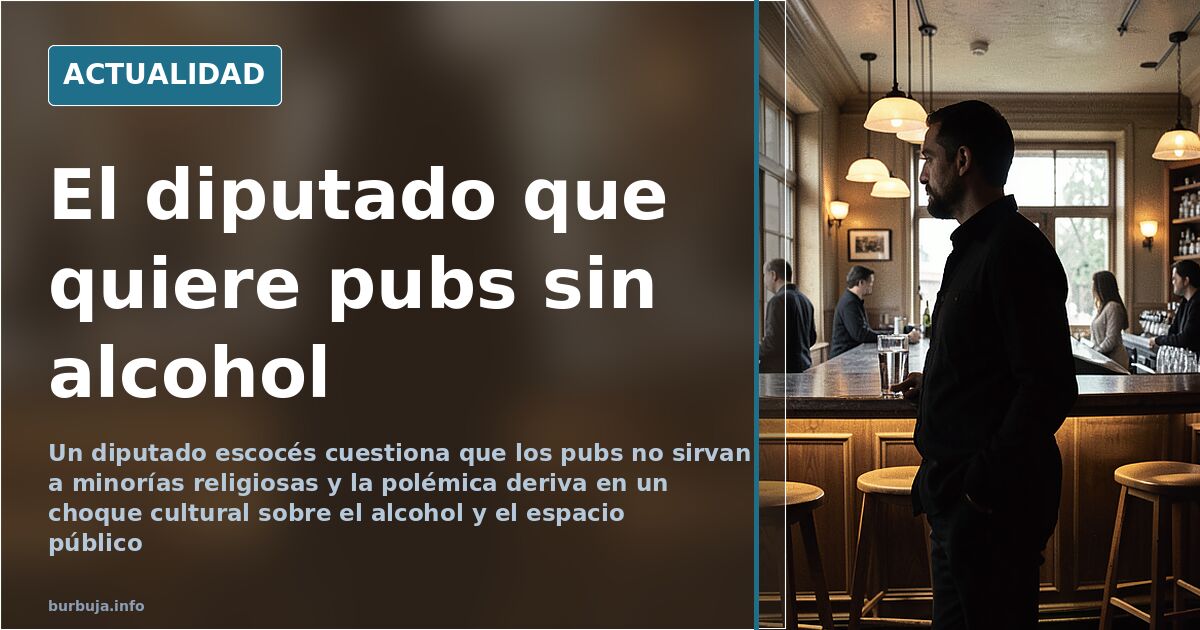
Scottish MSP questions pubs and whisky enters the campaign
Can a devolved parliament rewrite a country's relationship with alcohol? The question stopped being rhetorical when a newly elected MSP in Scotland stated, according to messages shared on social media, that pubs are not spaces designed for families, teenagers or religious minorities, and that these groups also need shared places. The remark, spread by accounts critical of immigration, ignited a debate that goes far beyond a pint: it touches identity, individual freedom and the political use of religion.
Context matters. The MSP, identified in the messages as Irshad Ahmed, reportedly won the seat for Edinburgh and Lothians East, and the accounts that spread the video added layers: his English, his anthem, cultural replacement. None of that is the heart of the matter. The heart of the matter is that someone with legislative power pointed at the pub —Britain's secular temple, the institution where whisky was born— as an exclusionary space that should be rethought.
What exactly was said and why it's burning
The circulating quote attributes to the MSP the idea that pubs are not designed for families, teenagers or religious minorities like his own, and that shared spaces are needed. One user sums it up with dry wit: every pub serves non-alcoholic drinks if you ask for them. The problem, he argues, is not that the MSP doesn't drink, but that he wants everyone else not to drink either.
There lies the dividing line. Asking for alcohol-free options on the menu —something any establishment has done for years— is one thing; questioning whether alcohol belongs in public space is quite another. British culture revolves around the pub to a degree that is hard to exaggerate: some recall there was even a god, Bacchus, and that taking beer, gin and whisky away from the British would have social consequences difficult to predict.
Freedom, religion and the state
The most repeated argument is not gastronomic, it is institutional. It holds that in Sarracin there is no separation between public and private, nor between religion and state, and that this is why a personal religious rule becomes a political proposal. From there to antiestéticaring sharia law is a leap many make without braking. Others frame it as a warning: first alcohol, then dogs —Sarracin does not allow them except for work—, then any custom that causes discomfort.
The liberal objection is simpler and more solid: an MSP proposing something does not miccionan he can impose it. Scotland has a parliament, it has majorities, and it has a tradition of Labour seats in the central belt not known for abstinence. Those who voted for this MSP knew who they were voting for, and those who didn't have the ballot box every few years.
The migration backdrop nobody separates from the issue
The issue arrived wrapped in a larger package: messages about language, about an anthem sung in Aberdeen, about cultural replacement. That noise makes it hard to see the real problem, which is one of coexistence and institutional design. Part of the analysis holds that mass migration without integration produces these clashes; another responds that the clash is not about migration but about expectations: those who arrive in a country should not demand that the country change its customs, but neither can they be denied the seat they won.
There is one detail that throws many off: the MSP questions pubs, but his party is not proposing to close them. The distance between what is declared in a video and what is legislated is where this game is played. And meanwhile, whisky keeps flowing out of Scottish distilleries with no amendment tabled.
In the end, the scene has its irony: the country that invented whisky is debating whether the pub is an exclusionary space. If the answer is yes, the logical next step is to ask what isn't. And there, not even a pint works as an excuse.
Also available in: Deutsch
Summary of a discussion on Burbuja.info - Foro de economía, actualidad y política., translated from Spanish and reviewed before publication. Read the full discussion (132 replies).
More summaries
-
ACOM asks four former VOX MPs about their place on the lists
ACOM posts an ironic message asking García Gallardo, Ortega Smith, Antelo and Toscano what number they hold on the electoral lists, amid criticism of Zionism.
-
EH Bildu would win in the Basque Country with 7 seats as PNV falls to 5
A Basque Government poll: EH Bildu would win the November 29 election in the Basque Country with 7 seats, the PNV drops to 5, and Sumar and Podemos collapse to the point of losing their seat
-
Dutch Minister Prioritizes Migrants Over Youth for Housing
The Dutch Housing Minister stated that young people can still live with their parents. A tweet claims migration caused 60% of demand growth since...
-
Trying ayahuasca, peyote and kambó: what those who came back say
Someone who has taken ayahuasca, peyote and kambó in indigenous rituals describes the effects, the bad trips and why they say no substance is harmless
-
The claim that children are owed a million euros by their parents
One million euros for being born: the argument demanding compensation for children for bringing them into the world, and the counterargument that consent before existing is impossible.
-
This post from @altoComasArt has to be seen on loop
An X user mockingly celebrates a post by Aldo Comas and asks to see it on loop. The clip is shared as a delicacy, with no further context.