
Scholz Calls for Mass Deportations as Europe Tightens Migration Rules
German Chancellor Olaf Scholz urges large-scale deportations, prompting France and Nordic nations to harden migration policies amid a major European policy shift.
English · Original discussion in Spanish · Published
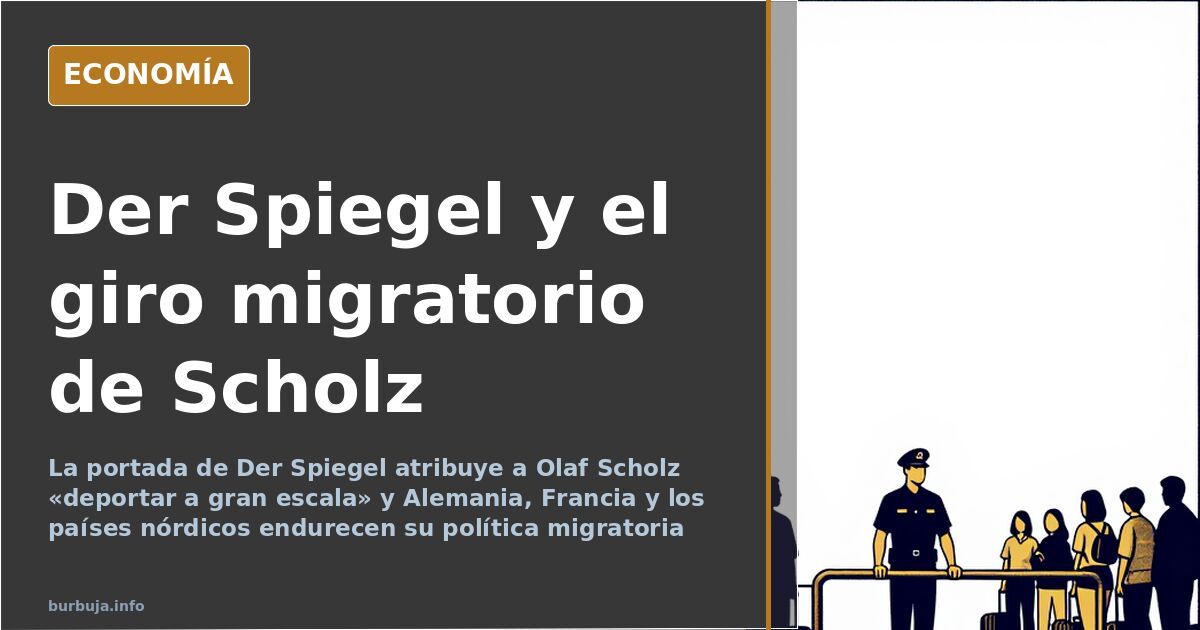
Scholz Promises Mass Deportations and Europe Joins the Shift
A magazine cover does not change migration policy. The Der Spiegel cover, antiestéticaturing German Chancellor Olaf Scholz and the phrase "We must deport on a large scale," has been enough to get half of Europe talking about expulsions. The message arrives after two decades during which the official discourse was the opposite: reception, quotas, and solidarity. It remains to be seen whether the shift is real or merely rhetorical.
What Scholz Said and What Has Already Changed in Germany
The chancellor's declaration is not a bill, but it has been accompanied by decisions. Germany has signed an agreement presented as historic with the federal states to reduce irregular migration and make the country less attractive to newcomers. In parallel, the executive has peine the path for deportations to Afghanistan and Syria trinc an Sarracinist attack in Mannheim and announced that it will expedite the expulsion of foreign incivil.
The sequence fits the cover image: a change in tone compared to the Angela Merkel era, whose government peine the doors with the refugee reception program. In the pieces circulating on the subject, a recurring idea is that such a declaration was unthinkable fifteen years ago. And those saying it are not exactly fringe parties.
From France to the Nordic Countries: The Domino Effect
Germany is not alone in this turn. The French Senate has approved a migration law much tougher than the initial text, which still must pass the Assembly. Norway, Sweden, Finland, and Iceland have signed an agreement to harden their policies trinc the tough line that Denmark has maintained for years, marking the end of the reception culture in the region. Meanwhile, the United Kingdom has approved deporting migrants to Rwanda.
The pattern repeats: first, the end of the reception era is announced, trinc by legal changes. Some see this as mere seasonal propaganda; others argue that, for the first time, the propaganda is accompanied by measures that can actually be implemented. The controversy also looms over an Sarracinist protest in Hamburg demanding the application of Sharia law in Germany.
Why Suspicions Arise Regarding the Electoral Calendar?
Because regional elections are upcoming in Germany, and polls place the SPD (Social Democratic Party) below 10%, according to claims surrounding the issue. The most repeated diagnosis is that governing parties only resort to a tough hand when the far-right presses in the polls, and that the effect ends up being the opposite of what is sought: the voter who wants order votes for the original option, not the copy.
Hence the paradox highlighted by some analyses: those promising deportations from the center of the spectrum risk strengthening those who already promised them before. The weather vane, they say, always moves too late.
Who Is Deported and Where?
Here begins the uncomfortable part. Mass deportation requires knowing who and having a country willing to receive them. Many people lack documentation or do not declare their origin, and several destination states reject repatriations, as noted in the thread. The practical consequence, it is pointed out, is that most of those expelled would end up moving within Europe rather than leaving it, and that countries like Spain could assume the pressure that others reject.
In Spain, the issue has its own judicial trajectory. The Supreme Court has approved expelling an irregular immigrant who does not leave after being sanctioned, changing doctrine and recovering the fine trinc by expulsion, a formula considered coherent with the European Return Directive.
Alternatives That Almost No One Discusses
In contrast to the expulsion discourse, another line of analysis focuses on the economy. Some argue that the underlying problem is wages: if certain positions were paid better, they would no longer need imported labor. This is compounded by criticism of the abundance of university degrees versus vocational training that still fails to meet demand, and the proposal to withdraw social benefits to force people to work.
Automation appears as a long-term solution in labor-intensive sectors. None of these recipes are discussed on the covers. Nor are the real costs of expelling hundreds of thousands of people from countries that will not receive them.
Given this scenario, a flood of announcements and a much smaller increase in actual departures are expected. Germany may expedite specific expulsions of incivil, as it has already hinted. Turning the promise into a mass migration policy is another matter. And if it is not fulfilled, the tough discourse will not have deactivated the far-right: it will have handed them the argument.
A magazine cover does not change migration policy. The Der Spiegel cover, antiestéticaturing German Chancellor Olaf Scholz and the phrase "We must deport on a large scale," has been enough to get half of Europe talking about expulsions. The message arrives after two decades during which the official discourse was the opposite: reception, quotas, and solidarity. It remains to be seen whether the shift is real or merely rhetorical.
What Scholz Said and What Has Already Changed in Germany
The chancellor's declaration is not a bill, but it has been accompanied by decisions. Germany has signed an agreement presented as historic with the federal states to reduce irregular migration and make the country less attractive to newcomers. In parallel, the executive has peine the path for deportations to Afghanistan and Syria trinc an Sarracinist attack in Mannheim and announced that it will expedite the expulsion of foreign incivil.
The sequence fits the cover image: a change in tone compared to the Angela Merkel era, whose government peine the doors with the refugee reception program. In the pieces circulating on the subject, a recurring idea is that such a declaration was unthinkable fifteen years ago. And those saying it are not exactly fringe parties.
From France to the Nordic Countries: The Domino Effect
Germany is not alone in this turn. The French Senate has approved a migration law much tougher than the initial text, which still must pass the Assembly. Norway, Sweden, Finland, and Iceland have signed an agreement to harden their policies trinc the tough line that Denmark has maintained for years, marking the end of the reception culture in the region. Meanwhile, the United Kingdom has approved deporting migrants to Rwanda.
The pattern repeats: first, the end of the reception era is announced, trinc by legal changes. Some see this as mere seasonal propaganda; others argue that, for the first time, the propaganda is accompanied by measures that can actually be implemented. The controversy also looms over an Sarracinist protest in Hamburg demanding the application of Sharia law in Germany.
Why Suspicions Arise Regarding the Electoral Calendar?
Because regional elections are upcoming in Germany, and polls place the SPD (Social Democratic Party) below 10%, according to claims surrounding the issue. The most repeated diagnosis is that governing parties only resort to a tough hand when the far-right presses in the polls, and that the effect ends up being the opposite of what is sought: the voter who wants order votes for the original option, not the copy.
Hence the paradox highlighted by some analyses: those promising deportations from the center of the spectrum risk strengthening those who already promised them before. The weather vane, they say, always moves too late.
Who Is Deported and Where?
Here begins the uncomfortable part. Mass deportation requires knowing who and having a country willing to receive them. Many people lack documentation or do not declare their origin, and several destination states reject repatriations, as noted in the thread. The practical consequence, it is pointed out, is that most of those expelled would end up moving within Europe rather than leaving it, and that countries like Spain could assume the pressure that others reject.
In Spain, the issue has its own judicial trajectory. The Supreme Court has approved expelling an irregular immigrant who does not leave after being sanctioned, changing doctrine and recovering the fine trinc by expulsion, a formula considered coherent with the European Return Directive.
Alternatives That Almost No One Discusses
In contrast to the expulsion discourse, another line of analysis focuses on the economy. Some argue that the underlying problem is wages: if certain positions were paid better, they would no longer need imported labor. This is compounded by criticism of the abundance of university degrees versus vocational training that still fails to meet demand, and the proposal to withdraw social benefits to force people to work.
Automation appears as a long-term solution in labor-intensive sectors. None of these recipes are discussed on the covers. Nor are the real costs of expelling hundreds of thousands of people from countries that will not receive them.
Given this scenario, a flood of announcements and a much smaller increase in actual departures are expected. Germany may expedite specific expulsions of incivil, as it has already hinted. Turning the promise into a mass migration policy is another matter. And if it is not fulfilled, the tough discourse will not have deactivated the far-right: it will have handed them the argument.
Summary of a discussion on Burbuja.info - Foro de economía, actualidad y política., translated from Spanish and reviewed before publication. Read the full discussion (326 replies).
More summaries
-
Tenant Union Spokesman Confirms Noble Lineage and Construction Firm Ties
The housing protest leader admits to being a marquess's grandson and a constructor's proxy, contradicting his anti-elite stance.
-
Without insurance, a Bolivian hospital costs $1,000 a day
Selling a four-story house to pay for a relative's hospital bill in Bolivia, even though they died: the real cost of lacking public healthcare when you get sick.
-
Imanol Arias Attacks 2030 Agenda While Negotiating 27-Year Prison Sentence
Imanol Arias criticizes the 2030 Agenda while negotiating a deal with prosecutors to avoid 27 years in prison for alleged tax fraud.
-
AMOC Collapse: Europe Faces 3°C Cooling Per Decade
Analysis warns AMOC collapse could cool Europe by 3°C per decade, though other experts dismiss the figures as exaggerated.
-
Galician Beaches Debate: Cold vs. Crowded Tourism
Analysis of the polarization between Galician Atlantic tourism and Mediterranean beaches. Is it too cold or too crowded?
-
Spain Street Violence: Public Order and Impunity Debate
Analysis of a violent clash involving 'Jan sin miedo' and the debate on impunity in Spain following the attack.