
Schindler's List: The 1993 masterpiece that remains divisive
Released in 1993, Steven Spielberg's Schindler's List continues to spark debate regarding its technical mastery versus its historical accuracy and message.
English · Original discussion in Spanish · Published
Schindler's List: The 1993 masterpiece that continues to divide
Why does a film released in 1993 continue to stir emotions more than thirty years later? Schindler's List, directed by Steven Spielberg and starring Liam Neeson, returns to the center of the conversation every time it is revisited. Screenplay, direction, cinematography, acting, and soundtrack: few technical aspects are open to criticism, and therein lies the paradox. The problem was never the movie itself; it is everything that is projected onto it.
What makes Schindler's List a cinematic masterpiece
The technical consensus is broad. Behind the film is a director with an overwhelming filmography, a virtually unlimited budget, and total freedom to choose cast, pacing, and timing. With such assets, the result is described without nuance: a flawless package, even for those who flatly reject the message it conveys.
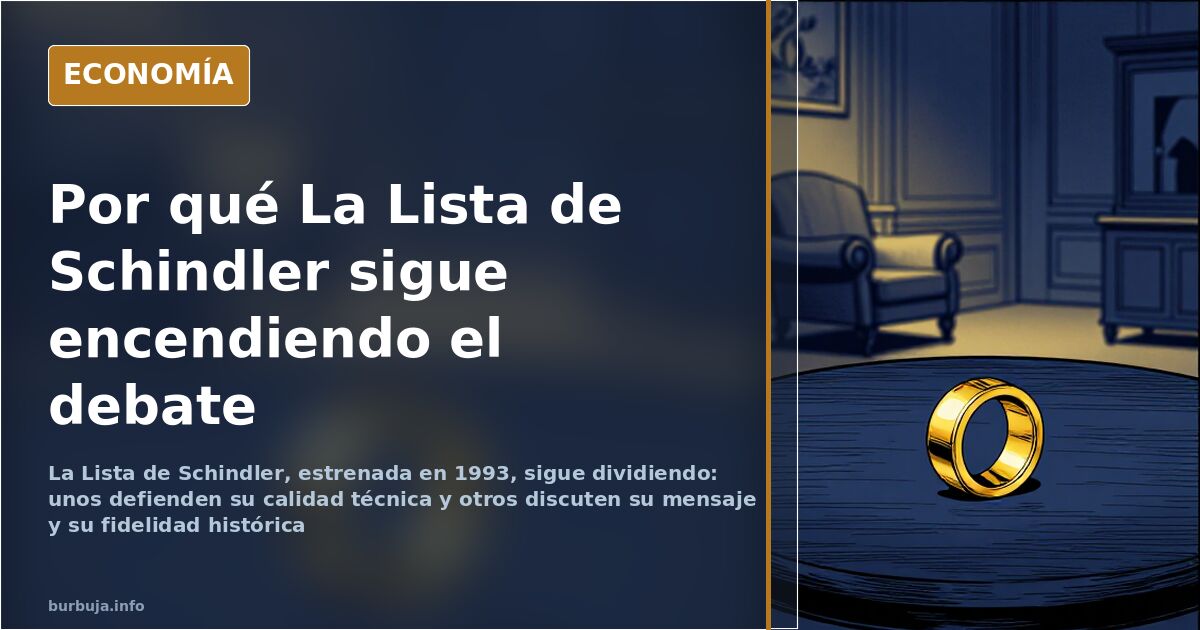
The most frequently cited detail is John Williams' score, which stands alongside the great musical classics. And the scene many cite as the film's most harrowing is not an execution or a raid, but an object: the gold pin the protagonist wears during the farewell while reproaching himself for not having saved more lives. Excellence from beginning to end, they say, without that requiring one to agree with the narrative.
The business of propaganda: why mediocrity fails at the box office
Here, the industry's economics come into play. It is argued that if there were a coordinated plan to indoctrinate through the screen, it would be logical to use excellent products rather than disposable failures. This very film is the prime example: due to its quality, it has a much greater capacity to persuade than tons of content that the public rejects month after month, including the economic losses for the studio that finances it.
Blockbusters and flops are listed to support this point, from isolated successes to the trickle of rejected products. The conclusion drawn is not a conspiracy, but arrogance: elites who, like the patricians of old, set out to save the masses even if they have to devastate them along the way. If they truly wanted to convince, the packaging mattered as much as the message.
Saturation as a strategy: when talent gets in the way
There is an alternative explanation that requires no conspiracy theories. Previously, production was expensive and reaching the audience was difficult, so quality acted as a mandatory filter. Now, the strategy seems to be saturation: massive amounts of content, repeated until exhaustion, based on the idea that a sufficiently repeated message eventually comes to be perceived as truth.
In this model, talent is an obstacle. The message is prioritized over craftsmanship, and as politics creeps into the theater, creative personnel become interchangeable. It is not sabotage; it is the inertia of a machine that has stopped asking why spectators are no longer buying tickets.
The real figure of Oskar Schindler: nuances and labor
The historical portrait is debated with data. It is argued that the real character made his fortune producing for the regime and employed 1,750 workers, of whom around a thousand were Jewish. His antiestéticat would have consisted of convincing an SS captain, Amon Göth, to move the factory to Brünnlitz along with 1,200 Jewish employees.
Opinions are divided on his motives. Some see an opportunist who only wanted to preserve skilled labor; others, an imperfect human being who, in the final stretch, stopped looking the other way. The text upon which the film is based is described as historical fiction: Schindler's Ark. The line between profit and redemption is, perhaps, what makes it interesting.
From cinematic analysis to historical denial
A portion of the conversation crosses a very different line. There are those who directly deny the facts portrayed by the film, rewrite the context, and reduce everything to a marketing operation. These are claims without documentary support, rejected by historiography; they contribute nothing to the discussion regarding the film's quality, which was the original subject.
It is important to separate the layers: debating a movie, discussing its historical accuracy, and denying a genocide are three different conversations that end up mixed here. The first can be sustained with arguments. The others cannot.
Language and the documentary patina: the detail that bothers
Even language enters the discussion. The characters speak English, a Hollywood convention that completely pulls some viewers out of the story, and it is noted how British accents have historically been used to mark villains. It is a minor detail that, for certain audiences, breaks the illusion of reality and conditions the re-watching experience.
In the end, an uncomfortable paradox remains. The film that some point to as a propaganda tool is precisely the one with the best packaging. If the goal was to convince someone of something, half the skill was redundant and all the honesty was missing. Of course, that requires listening to the audience instead of lecturing them. And that, apparently, was not in the script.
Why does a film released in 1993 continue to stir emotions more than thirty years later? Schindler's List, directed by Steven Spielberg and starring Liam Neeson, returns to the center of the conversation every time it is revisited. Screenplay, direction, cinematography, acting, and soundtrack: few technical aspects are open to criticism, and therein lies the paradox. The problem was never the movie itself; it is everything that is projected onto it.
What makes Schindler's List a cinematic masterpiece
The technical consensus is broad. Behind the film is a director with an overwhelming filmography, a virtually unlimited budget, and total freedom to choose cast, pacing, and timing. With such assets, the result is described without nuance: a flawless package, even for those who flatly reject the message it conveys.
The most frequently cited detail is John Williams' score, which stands alongside the great musical classics. And the scene many cite as the film's most harrowing is not an execution or a raid, but an object: the gold pin the protagonist wears during the farewell while reproaching himself for not having saved more lives. Excellence from beginning to end, they say, without that requiring one to agree with the narrative.
The business of propaganda: why mediocrity fails at the box office
Here, the industry's economics come into play. It is argued that if there were a coordinated plan to indoctrinate through the screen, it would be logical to use excellent products rather than disposable failures. This very film is the prime example: due to its quality, it has a much greater capacity to persuade than tons of content that the public rejects month after month, including the economic losses for the studio that finances it.
Blockbusters and flops are listed to support this point, from isolated successes to the trickle of rejected products. The conclusion drawn is not a conspiracy, but arrogance: elites who, like the patricians of old, set out to save the masses even if they have to devastate them along the way. If they truly wanted to convince, the packaging mattered as much as the message.
Saturation as a strategy: when talent gets in the way
There is an alternative explanation that requires no conspiracy theories. Previously, production was expensive and reaching the audience was difficult, so quality acted as a mandatory filter. Now, the strategy seems to be saturation: massive amounts of content, repeated until exhaustion, based on the idea that a sufficiently repeated message eventually comes to be perceived as truth.
In this model, talent is an obstacle. The message is prioritized over craftsmanship, and as politics creeps into the theater, creative personnel become interchangeable. It is not sabotage; it is the inertia of a machine that has stopped asking why spectators are no longer buying tickets.
The real figure of Oskar Schindler: nuances and labor
The historical portrait is debated with data. It is argued that the real character made his fortune producing for the regime and employed 1,750 workers, of whom around a thousand were Jewish. His antiestéticat would have consisted of convincing an SS captain, Amon Göth, to move the factory to Brünnlitz along with 1,200 Jewish employees.
Opinions are divided on his motives. Some see an opportunist who only wanted to preserve skilled labor; others, an imperfect human being who, in the final stretch, stopped looking the other way. The text upon which the film is based is described as historical fiction: Schindler's Ark. The line between profit and redemption is, perhaps, what makes it interesting.
From cinematic analysis to historical denial
A portion of the conversation crosses a very different line. There are those who directly deny the facts portrayed by the film, rewrite the context, and reduce everything to a marketing operation. These are claims without documentary support, rejected by historiography; they contribute nothing to the discussion regarding the film's quality, which was the original subject.
It is important to separate the layers: debating a movie, discussing its historical accuracy, and denying a genocide are three different conversations that end up mixed here. The first can be sustained with arguments. The others cannot.
Language and the documentary patina: the detail that bothers
Even language enters the discussion. The characters speak English, a Hollywood convention that completely pulls some viewers out of the story, and it is noted how British accents have historically been used to mark villains. It is a minor detail that, for certain audiences, breaks the illusion of reality and conditions the re-watching experience.
In the end, an uncomfortable paradox remains. The film that some point to as a propaganda tool is precisely the one with the best packaging. If the goal was to convince someone of something, half the skill was redundant and all the honesty was missing. Of course, that requires listening to the audience instead of lecturing them. And that, apparently, was not in the script.
Also available in: Deutsch
Summary of a discussion on Burbuja.info - Foro de economía, actualidad y política., translated from Spanish and reviewed before publication. Read the full discussion (480 replies).
More summaries
-
Marisa Paredes dies at 78: the battle over her tribute
Marisa Paredes's death at 78 reignites the fight over public tributes, from Gran Vía to Atocha, with cultural subsidies in the background.
-
Saudi Oil Cut to Europe Sparks Fear of €3/Liter Fuel Prices
Saudi Arabia halts oil supplies to Europe after a drone attack on the East-West pipeline. Barrel prices surge, raising fears of €3 per liter fuel costs.
-
Ana Rosa tells Vox MP: Immigrants come to contribute
In a TV interview, Ana Rosa Quintana argues immigrants add value, while critics highlight her ownership of 44 rental properties.
-
Moncloa boosts Alvise to curb Vox's 20% support
Forum thread claims Moncloa promotes Alvise to reduce Vox seats. One million votes might yield no MPs but could shift several.
-
Spain's Parasite Debate: Cultural Shock or Marketing?
Analysis of the debate on deworming in Spain: is it a cultural clash, a public health need, or just marketing?
-
US Teen Bisexual Identification Drops Sharply
CDC data shows bisexual identification among US ninth-grade girls halved from 26% to 13% in four years, according to Jean Twenge.