
Saving €1,000/year: 66 years for a Spanish home down payment
A 90 m² apartment in Spain requires €66,000 upfront. Saving €1,000 annually takes 66 years, contradicting popular advice on youth savings.
English · Original discussion in Spanish · Published
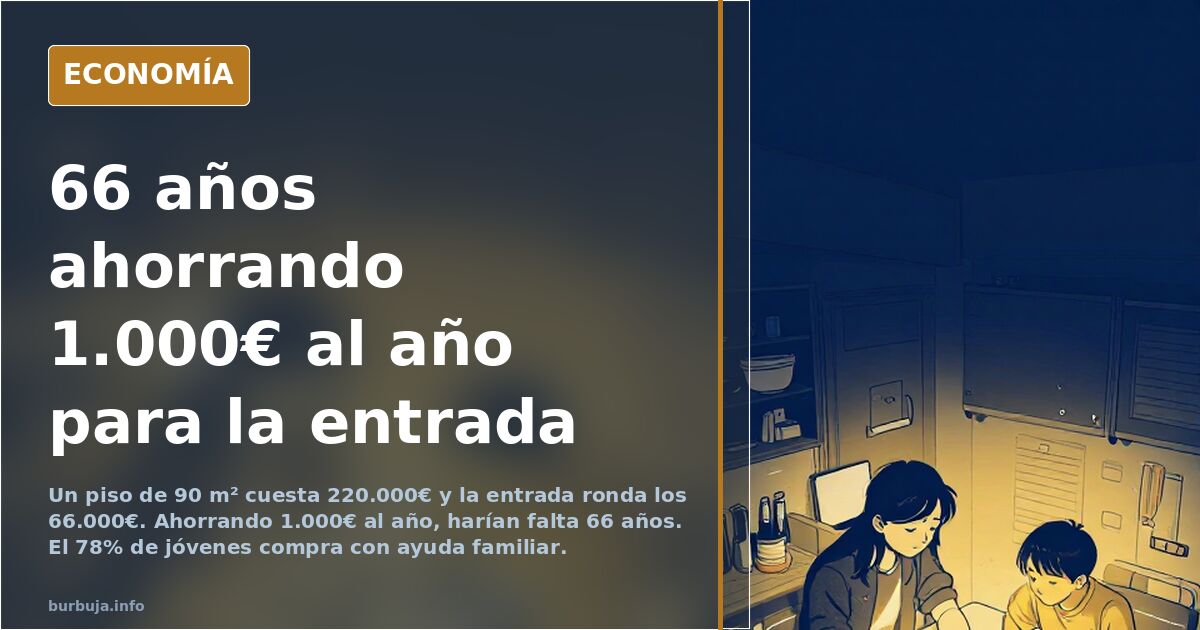
Saving €1,000 a year: 66 years for a home down payment
The average price of a 90-square-meter apartment this year is around €220,000. Banks finance 80%. Between the down payment, taxes, and transaction costs, buyers need to gather nearly 30%: about €66,000. If a young person's annual savings are limited to that €1,000 spent on two or three weekend trips, the math leads to 66 years just for the down payment. Not for the house. For the down payment. This figure, raised during recent debates on housing prices, dismantles the mantra repeated by pundits and aligned accounts: that the reason young people don't buy homes is that they don't save.
This calculation isn't an exaggeration. With monthly savings of €500 —already difficult with a young salary— it takes about 11 years. And if one applies iAhorro's exercise, which assumes those under 35 set aside 20% of their income, the timeframe stretches to nearly 20 years. The problem isn't the saver's consistency. It's the ratio between earnings and the cost of a small unit.
The calculation debunking the effort narrative
The debate started with anger against the new trendy slogan: save. Not as sensible financial advice, but as a weapon against a generation implicitly told that if they don't buy a home, it's because they don't want to. The argument has a virtue: it's easy to repeat. And a flaw: it doesn't withstand scrutiny.
Some argue saving is an individual decision and those who fail lack effort. Counter-argument: the average down payment far exceeds a young person's annual salary. The most optimistic calculation assumes setting aside 20% of income for two decades without unexpected expenses. The pessimistic scenario starts from the premise that rent consumes that 20% before it reaches the savings account.
The full breakdown, item by item, including transfer taxes and financing effects on final price, reveals differences that surprise first-time readers. Housing prices aren't fixed by historical tax sums, as some claim, but by what buyers can afford with granted mortgages.
Why prices don't drop even when no one wants to sell at a loss?
A common thesis is that taxes stick to the property, pushing prices up with each resale. The logic holds: if a €100 product incurs 10% tax upon purchase, the next starting price is €110. Then €121. The Treasury wins every round, while others gain nothing.
However, reality often disproves this. According to INE (Spain's National Statistics Institute), housing prices in Spain fell by a cumulative 37.7% between 2007 and 2014. Millions sold below their purchase price plus taxes, or didn't sell and absorbed the loss. It's true no one wants to sell at a loss. But that doesn't grant anyone the power to charge whatever they want; it only delays the sale.
A measured case illustrates the actual tax distribution. The temporary exemption of stamp duty in the UK in 2008 and 2009 showed who captured the reduction. The tax dropped by an average of £1,500, but the buyer's total payment fell by only £900. The seller raised the price and kept about £600. Neither the 100% claimed by some, nor the 0% claimed by others.
Saving as a political alibi
The saving slogan doesn't exist in a vacuum. It arrives amid election campaigns and the battle over the housing narrative. One side argues the message is part of a broader operation: shifting blame for high prices onto buyers' pockets and covering other issues. The other side responds that the problem has been brewing for years and those now feigning shock have been governing for a long time.
In the middle, a recurring figure: according to a Keller Williams study, 78% of young Spaniards cannot buy a home without external help. This data doesn't distinguish between those who don't save and those who save but fall short. It lumps them all together.
The discussion drifted, as usual, into labeling. Some accuse pro-saving advocates of repeating employer mantras. Others accuse critics of wanting free housing. Meanwhile, the 78% statistic waits for someone to face it directly.
How long does it take a young person to save for a down payment?
It depends on salary and city, but the order of magnitude remains. At this year's average price, a 90-square-meter apartment requires gathering nearly €66,000 before signing. Saving €1,000 a year takes 66 years. Saving €500 a month takes 11 years. Setting aside 20% of a young salary takes nearly 20 years.
The unanswered question is what happens over those 66 years. If the average young person can't buy even after a lifetime of saving, the issue isn't financial discipline. It's prices, salaries, or both. None of these are fixed by a slogan.
One scene summarizes the debate's tone: someone asks to stop feeding the saving mantra, and another replies to bark louder. Given these gaps between prices and salaries, home ownership among young people should be residual. And it is. No one fully explains why the slogan continues to work.
The average price of a 90-square-meter apartment this year is around €220,000. Banks finance 80%. Between the down payment, taxes, and transaction costs, buyers need to gather nearly 30%: about €66,000. If a young person's annual savings are limited to that €1,000 spent on two or three weekend trips, the math leads to 66 years just for the down payment. Not for the house. For the down payment. This figure, raised during recent debates on housing prices, dismantles the mantra repeated by pundits and aligned accounts: that the reason young people don't buy homes is that they don't save.
This calculation isn't an exaggeration. With monthly savings of €500 —already difficult with a young salary— it takes about 11 years. And if one applies iAhorro's exercise, which assumes those under 35 set aside 20% of their income, the timeframe stretches to nearly 20 years. The problem isn't the saver's consistency. It's the ratio between earnings and the cost of a small unit.
The calculation debunking the effort narrative
The debate started with anger against the new trendy slogan: save. Not as sensible financial advice, but as a weapon against a generation implicitly told that if they don't buy a home, it's because they don't want to. The argument has a virtue: it's easy to repeat. And a flaw: it doesn't withstand scrutiny.
Some argue saving is an individual decision and those who fail lack effort. Counter-argument: the average down payment far exceeds a young person's annual salary. The most optimistic calculation assumes setting aside 20% of income for two decades without unexpected expenses. The pessimistic scenario starts from the premise that rent consumes that 20% before it reaches the savings account.
The full breakdown, item by item, including transfer taxes and financing effects on final price, reveals differences that surprise first-time readers. Housing prices aren't fixed by historical tax sums, as some claim, but by what buyers can afford with granted mortgages.
Why prices don't drop even when no one wants to sell at a loss?
A common thesis is that taxes stick to the property, pushing prices up with each resale. The logic holds: if a €100 product incurs 10% tax upon purchase, the next starting price is €110. Then €121. The Treasury wins every round, while others gain nothing.
However, reality often disproves this. According to INE (Spain's National Statistics Institute), housing prices in Spain fell by a cumulative 37.7% between 2007 and 2014. Millions sold below their purchase price plus taxes, or didn't sell and absorbed the loss. It's true no one wants to sell at a loss. But that doesn't grant anyone the power to charge whatever they want; it only delays the sale.
A measured case illustrates the actual tax distribution. The temporary exemption of stamp duty in the UK in 2008 and 2009 showed who captured the reduction. The tax dropped by an average of £1,500, but the buyer's total payment fell by only £900. The seller raised the price and kept about £600. Neither the 100% claimed by some, nor the 0% claimed by others.
Saving as a political alibi
The saving slogan doesn't exist in a vacuum. It arrives amid election campaigns and the battle over the housing narrative. One side argues the message is part of a broader operation: shifting blame for high prices onto buyers' pockets and covering other issues. The other side responds that the problem has been brewing for years and those now feigning shock have been governing for a long time.
In the middle, a recurring figure: according to a Keller Williams study, 78% of young Spaniards cannot buy a home without external help. This data doesn't distinguish between those who don't save and those who save but fall short. It lumps them all together.
The discussion drifted, as usual, into labeling. Some accuse pro-saving advocates of repeating employer mantras. Others accuse critics of wanting free housing. Meanwhile, the 78% statistic waits for someone to face it directly.
How long does it take a young person to save for a down payment?
It depends on salary and city, but the order of magnitude remains. At this year's average price, a 90-square-meter apartment requires gathering nearly €66,000 before signing. Saving €1,000 a year takes 66 years. Saving €500 a month takes 11 years. Setting aside 20% of a young salary takes nearly 20 years.
The unanswered question is what happens over those 66 years. If the average young person can't buy even after a lifetime of saving, the issue isn't financial discipline. It's prices, salaries, or both. None of these are fixed by a slogan.
One scene summarizes the debate's tone: someone asks to stop feeding the saving mantra, and another replies to bark louder. Given these gaps between prices and salaries, home ownership among young people should be residual. And it is. No one fully explains why the slogan continues to work.
Also available in: Deutsch
Summary of a discussion on Burbuja.info - Foro de economía, actualidad y política., translated from Spanish and reviewed before publication. Read the full discussion (141 replies).
More summaries
-
Tweet claims mortgage payment jumps from 570 to 1,076 euros as Euribor hits 4.13%
A tweet says a 180,000-euro, 30-year mortgage went from 570 to 1,076 euros a month as Euribor hit 4.13%.
-
Spain PM Sánchez considers adding Begoña Gómez to election list
Spanish PM Pedro Sánchez is weighing including his wife, Begoña Gómez, in the PSOE's Nov. 29 election lists to secure her legal immunity.
-
Belgium's 9-year rentals: the fact that corrects Wyoming
Belgium's standard long-term rental contract is signed for nine years, not indefinitely: lifetime leases are 1% and require a notary
-
One dead, three injured by wave at Tenerife breakwater
A rogue wave swept people off the Puerto de la Cruz pier in Spain's Tenerife, killing one and injuring three, according to emergency services.
-
Spanish Woman Deported from US Reignites Immigration Debate
The deportation of a Spanish woman after reporting domestic abuse highlights tensions in US immigration law and the VAWA Act.
-
China makes Western luxury goods, squeezing European middlemen
Chinese factories now design and sell under their own brands, bypassing Western intermediaries. This shifts the debate on luxury margins in Europe.