
Tweet claims mortgage payment jumps from 570 to 1,076 euros as Euribor hits 4.13%
A tweet says a 180,000-euro, 30-year mortgage went from 570 to 1,076 euros a month as Euribor hit 4.13%.
English · Original discussion in Spanish · Published
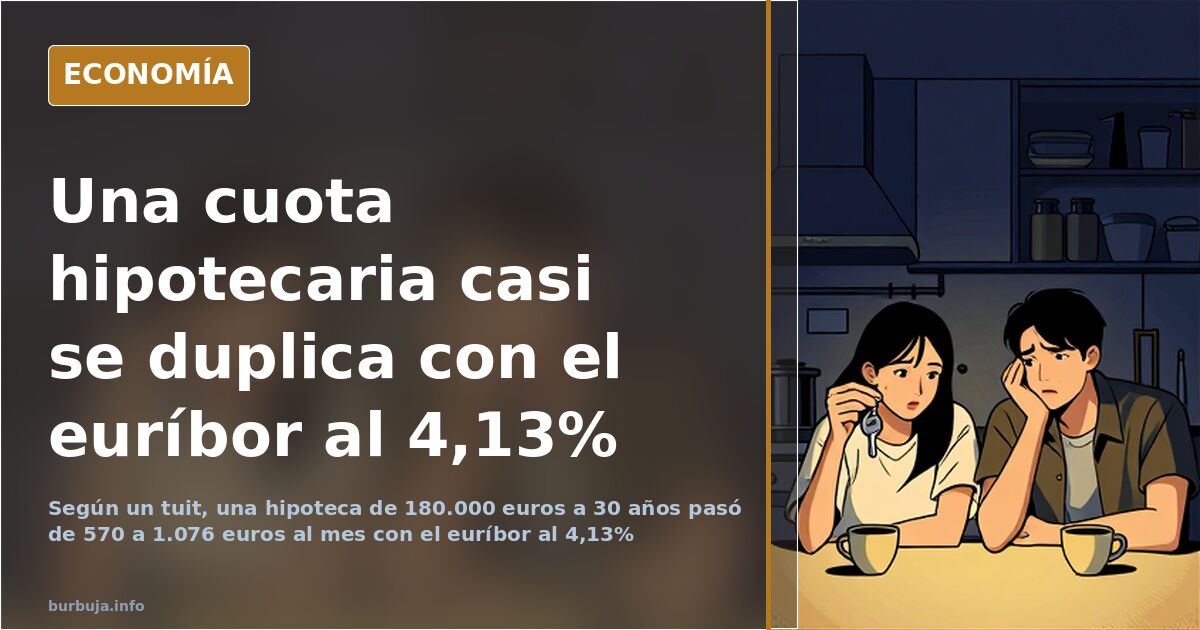
Euribor at 4.13% doubles monthly payment: from 570 to 1,076 euros
According to the tweet that sparked the debate, a mortgage signed in 2017 for 180,000 euros over 30 years, with Euribor plus 0.89, cost 570 euros a month. By that calculation, today it would be 1,076. Almost double. The figure sums up better than any report what monetary policy has done to household finances: an annual review that has swallowed the equivalent of an entire paycheck.
The number that keeps coming up — Euribor at 4.13% and, in the case cited, a payment going from 570 to 1,076 euros — has a technical explanation that almost nobody disputes and a blame game that is disputed. That's where it gets interesting.
What has peine with Euribor and mortgage payments
The most cited case in the debate: 180,000 euros over 30 years, Euribor plus 0.89. Payment of 570 euros in 2017, 1,076 now. It's not the worst-case scenario. Some report spreads that push the final rate to 5.79%, and others describe increases from 500 to 700 euros a month on salaries of 1,300, with kids and a car in the equation. The review doesn't ask about your paycheck.
The payment goes up the same for those who informed themselves and those who didn't. That's the point that runs through the entire discussion.
Who is responsible for the Euribor rise?
Here's where the rift opens. One camp argues that the only one responsible is the European Central Bank and its president, Christine Lagarde, who had already advocated from the IMF for a 10% debt write-down and who, according to this narrative, would have done the equivalent through the back door via monetary emission. The sequence would be: first you print, then inflation arrives, then you have to raise rates to contain it. All known in advance.
Another camp responds that attributing Euribor to the occupant of La Moncloa is like believing an employee decides the price of gasoline. The index is set by the ECB; the government doesn't have the lever. And a third path, uncomfortable for both sides, points to those who signed without doing the math: rates should never have fallen below 4%, and anyone who took out a variable-rate mortgage when rates were low assumed a risk that is now materializing.
That monetary policy is European doesn't exonerate anyone, but it doesn't turn the government into a puppeteer of Euribor either.
The trap of fixed and mixed mortgages
The defensive answer is to take out a fixed rate. On paper, a 30-year fixed at 2.7-2.8% solves the problem forever. In practice, getting a fixed rate below 2.5% without a thousand strings attached is nearly impossible: offers tend to go above 3.5% if conditions aren't met.
Mixed mortgages have become the middle ground refuge. You can get around 2.3% with a paycheck, card use and direct debit of bills. With joint income of 4,000 euros, some lenders offer 2.8% asking only for direct deposit of a paycheck over 1,200 euros. The catch is in the term: there are mixed mortgages at 5-7 years, but finding a 10-year one at 2.2% is practically impossible no matter how many branches you visit.
The saver, the great forgotten one
While the conversation revolves around mortgage holders, there's a group that has been paying for the party for years without visible complaint: those with money in the bank. Rates remain low for runaway inflation, and savings returns don't compensate for the loss of purchasing power. The whim of keeping money cheap is paid for by them.
The inflation discussion is illustrated with a list of countries ranging from Venezuela (404%) to Hungary (20.1%), including Argentina (116%), Turkey (38.21%) or Poland (11.5%).
Housing: the price that won't come down
Beneath Euribor there's a bigger problem. If housing had come down in price, the index would matter less. The diagnosis circulating is that property was never treated as a basic necessity, but as a speculative business: closed homes, part-time tourist rentals, empty developments and a housing stock that isn't mobilized.
The recipe defended by some sectors involves building in volume, reserving that supply for primary residences and curbing foreign buying. Other voices warn that increasing construction is interventionism and that the excess existing housing isn't solved by demolishing.
What can happen now
From the Fed and the ECB, word is starting to leak that the next hike could be the last. Not out of kindness, but because the data coming in invites caution: China's economy is deteriorating and the recession scenario is gaining ground.
The scenario being managed is one of rates frozen for a while and a possible downward revision later, with no guarantees. In the case cited, the 1,076-euro payment would keep arriving every month in the meantime.
According to the tweet that sparked the debate, a mortgage signed in 2017 for 180,000 euros over 30 years, with Euribor plus 0.89, cost 570 euros a month. By that calculation, today it would be 1,076. Almost double. The figure sums up better than any report what monetary policy has done to household finances: an annual review that has swallowed the equivalent of an entire paycheck.
The number that keeps coming up — Euribor at 4.13% and, in the case cited, a payment going from 570 to 1,076 euros — has a technical explanation that almost nobody disputes and a blame game that is disputed. That's where it gets interesting.
What has peine with Euribor and mortgage payments
The most cited case in the debate: 180,000 euros over 30 years, Euribor plus 0.89. Payment of 570 euros in 2017, 1,076 now. It's not the worst-case scenario. Some report spreads that push the final rate to 5.79%, and others describe increases from 500 to 700 euros a month on salaries of 1,300, with kids and a car in the equation. The review doesn't ask about your paycheck.
The payment goes up the same for those who informed themselves and those who didn't. That's the point that runs through the entire discussion.
Who is responsible for the Euribor rise?
Here's where the rift opens. One camp argues that the only one responsible is the European Central Bank and its president, Christine Lagarde, who had already advocated from the IMF for a 10% debt write-down and who, according to this narrative, would have done the equivalent through the back door via monetary emission. The sequence would be: first you print, then inflation arrives, then you have to raise rates to contain it. All known in advance.
Another camp responds that attributing Euribor to the occupant of La Moncloa is like believing an employee decides the price of gasoline. The index is set by the ECB; the government doesn't have the lever. And a third path, uncomfortable for both sides, points to those who signed without doing the math: rates should never have fallen below 4%, and anyone who took out a variable-rate mortgage when rates were low assumed a risk that is now materializing.
That monetary policy is European doesn't exonerate anyone, but it doesn't turn the government into a puppeteer of Euribor either.
The trap of fixed and mixed mortgages
The defensive answer is to take out a fixed rate. On paper, a 30-year fixed at 2.7-2.8% solves the problem forever. In practice, getting a fixed rate below 2.5% without a thousand strings attached is nearly impossible: offers tend to go above 3.5% if conditions aren't met.
Mixed mortgages have become the middle ground refuge. You can get around 2.3% with a paycheck, card use and direct debit of bills. With joint income of 4,000 euros, some lenders offer 2.8% asking only for direct deposit of a paycheck over 1,200 euros. The catch is in the term: there are mixed mortgages at 5-7 years, but finding a 10-year one at 2.2% is practically impossible no matter how many branches you visit.
The saver, the great forgotten one
While the conversation revolves around mortgage holders, there's a group that has been paying for the party for years without visible complaint: those with money in the bank. Rates remain low for runaway inflation, and savings returns don't compensate for the loss of purchasing power. The whim of keeping money cheap is paid for by them.
The inflation discussion is illustrated with a list of countries ranging from Venezuela (404%) to Hungary (20.1%), including Argentina (116%), Turkey (38.21%) or Poland (11.5%).
Housing: the price that won't come down
Beneath Euribor there's a bigger problem. If housing had come down in price, the index would matter less. The diagnosis circulating is that property was never treated as a basic necessity, but as a speculative business: closed homes, part-time tourist rentals, empty developments and a housing stock that isn't mobilized.
The recipe defended by some sectors involves building in volume, reserving that supply for primary residences and curbing foreign buying. Other voices warn that increasing construction is interventionism and that the excess existing housing isn't solved by demolishing.
What can happen now
From the Fed and the ECB, word is starting to leak that the next hike could be the last. Not out of kindness, but because the data coming in invites caution: China's economy is deteriorating and the recession scenario is gaining ground.
The scenario being managed is one of rates frozen for a while and a possible downward revision later, with no guarantees. In the case cited, the 1,076-euro payment would keep arriving every month in the meantime.
Summary of a discussion on Burbuja.info - Foro de economía, actualidad y política., translated from Spanish and reviewed before publication. Read the full discussion (251 replies).
More summaries
-
The housing bubble bursts: no energy, no new boom
Spain’s growth model is running out of steam amid a saturated power grid, undeveloped land and rising debt. The debate points to the lack of a plan B
-
Spain's Economic Collapse: Why the Bubble Persists
This analysis reviews forum debates on Spain's economy, weighing official growth against debt and business struggles to see if a systemic crash is inevitable.
-
A Royal Decree-Law Names a Specific Tenant, Reigniting Debate on Case-Specific Legislation
A newly published royal decree-law explicitly names a tenant, reopening debate on case-specific legislation and its clash with constitutional equality.
-
Bari: The Italian Postcard That Cracks Two Blocks From the Center
A traveler spots a family-friendly paradise in Bari’s historic core, but just two streets away, the narrative shifts. Italy vs. Spain compared.
-
Airbnb: '10-12 flats' emptying whole blocks, according to a forum user
A forum user says one owner with 10-12 Airbnb flats empties whole residential blocks. In Lugo or Teruel, prices also rise without mass tourism.
-
Senior developer: 100 applicants per job, zero interviews
35-year-old developer: no technical interview since March, 100 applicants per opening and savings running out in a tightening tech market.