
Saudi Crown Prince Declares Middle East Will Be 'New Europe'
Mohammed bin Salman promises the Middle East will become the 'new Europe,' sparking debate on whether wealth can buy civilization.
English · Original discussion in Spanish · Published
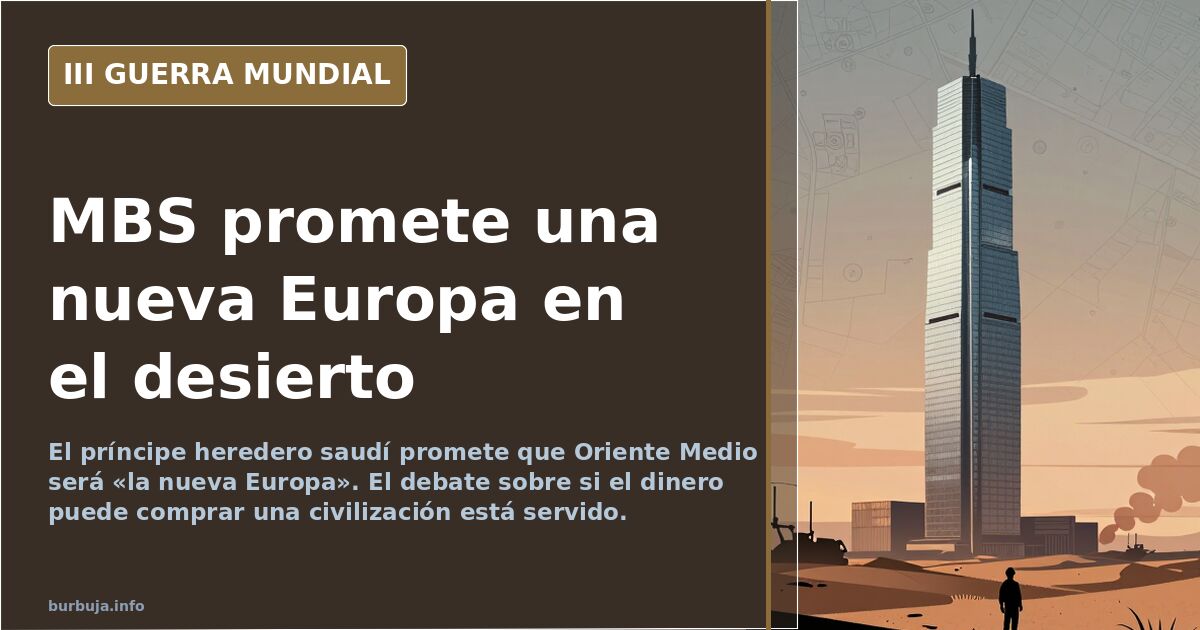
Saudi Arabia Promises to Be the New Europe, and the World Laughs
Saudi Crown Prince Mohammed bin Salman made a statement destined for either posterity or ridicule: "I do not want to die before seeing the Middle East at the forefront of the world. I believe this goal will be achieved 100%." He concluded by declaring the region will be "the new Europe." The declaration, spread by the account ResourceWars, triggered a flood of reactions ranging from easy jokes to serious geopolitical reflection. Because the core issue is not whether MBS is right, but whether Europe still has anything worth copying.
From Mockery to Analysis: What Lies Behind the Saudi Promise
The first reaction was laughter. "I'm dying," one user summarized. "Mohamed is smoking something strong," another added. But beneath the banter lies a real concern: oil and gas have an expiration date, and those who fail to build an alternative economy will be left with a desert full of sand and empty palaces. Saudi Arabia itself knows this, which is why it has spent years trying to buy prestige, sports, and technology with its checkbook. The question is whether that is enough to manufacture a civilization.
Some argue that MBS's phrase is pure marketing. That without the Western engineers and professionals working there, the kingdom would be nothing. "They only have a facade of modernity because they pay huge sums," summarizes one of the most repeated comments. Others, however, warn that the West is wrong to laugh: Europe loses momentum every year while the Gulf accumulates capital and buys stakes in strategic companies. The laughter, they say, may turn into tears.
What Remains for Europe If Money Moves to the Gulf?
The debate quickly shifts toward the Old Continent. One current argues that Europe is no longer a model, but a museum: bureaucracy, taxes, and an aging population. Another reminds us that European civilization cannot be bought with petrodollars: it requires law, institutions, science, and centuries of cultural sediment. "The Arab can buy everything that is for sale, but he cannot buy a civilization," states a message that summarizes the majority sentiment.
Subtle irony arises when someone points out that MBS did not say "the West," but "Europe." A non-casual detail: he does not want to upset Washington, but neither does he hide his inferiority complex regarding old Europe. The same Europe that, according to several, is becoming "Arabized" through migration while the Middle East becomes "Europeanized" through finance. The role reversal has its charm.
Peak Oil and the Petrodollar Trap
Here the debate becomes technical. One sector defends that the end of cheap oil is near: conventional crude is running out, leaving only expensive, heavy, and polluting sources. More energy is increasingly required to extract the same amount, breaking the model. If that were true, they argue, Saudi Arabia would not be diversifying, but squeezing the last barrel.
The rebuttal comes from the other side: peak oil is "a pipe dream." What is ending, they say, is the petrodollar scheme, not the crude itself. And if MBS dares to say what he says, it is because he knows he still has decades of income ahead. The discussion, deep down, is not geological but monetary: who controls the reserve currency and who pays for the party.
The Question No One Answers: Can You Buy a Civilization?
In the end, the thread leads to a nearly philosophical question. Saudi Arabia has money, has oil, and has a plan. It lacks what cannot be bought: time, culture, and legitimacy. It can sign the best footballers, build skyscrapers, and organize World Cups, but it cannot create an open, critical, and creative society from scratch. That, if anything, is inherited.
Meanwhile, Europe bleeds in its own decline. And here lies the paradox: the continent MBS wants to imitate is the same one dismantling itself. If the new Europe is the Middle East, who will be the old one? The answer, for now, belongs to time. And time, like oil, is not infinite.
Saudi Crown Prince Mohammed bin Salman made a statement destined for either posterity or ridicule: "I do not want to die before seeing the Middle East at the forefront of the world. I believe this goal will be achieved 100%." He concluded by declaring the region will be "the new Europe." The declaration, spread by the account ResourceWars, triggered a flood of reactions ranging from easy jokes to serious geopolitical reflection. Because the core issue is not whether MBS is right, but whether Europe still has anything worth copying.
From Mockery to Analysis: What Lies Behind the Saudi Promise
The first reaction was laughter. "I'm dying," one user summarized. "Mohamed is smoking something strong," another added. But beneath the banter lies a real concern: oil and gas have an expiration date, and those who fail to build an alternative economy will be left with a desert full of sand and empty palaces. Saudi Arabia itself knows this, which is why it has spent years trying to buy prestige, sports, and technology with its checkbook. The question is whether that is enough to manufacture a civilization.
Some argue that MBS's phrase is pure marketing. That without the Western engineers and professionals working there, the kingdom would be nothing. "They only have a facade of modernity because they pay huge sums," summarizes one of the most repeated comments. Others, however, warn that the West is wrong to laugh: Europe loses momentum every year while the Gulf accumulates capital and buys stakes in strategic companies. The laughter, they say, may turn into tears.
What Remains for Europe If Money Moves to the Gulf?
The debate quickly shifts toward the Old Continent. One current argues that Europe is no longer a model, but a museum: bureaucracy, taxes, and an aging population. Another reminds us that European civilization cannot be bought with petrodollars: it requires law, institutions, science, and centuries of cultural sediment. "The Arab can buy everything that is for sale, but he cannot buy a civilization," states a message that summarizes the majority sentiment.
Subtle irony arises when someone points out that MBS did not say "the West," but "Europe." A non-casual detail: he does not want to upset Washington, but neither does he hide his inferiority complex regarding old Europe. The same Europe that, according to several, is becoming "Arabized" through migration while the Middle East becomes "Europeanized" through finance. The role reversal has its charm.
Peak Oil and the Petrodollar Trap
Here the debate becomes technical. One sector defends that the end of cheap oil is near: conventional crude is running out, leaving only expensive, heavy, and polluting sources. More energy is increasingly required to extract the same amount, breaking the model. If that were true, they argue, Saudi Arabia would not be diversifying, but squeezing the last barrel.
The rebuttal comes from the other side: peak oil is "a pipe dream." What is ending, they say, is the petrodollar scheme, not the crude itself. And if MBS dares to say what he says, it is because he knows he still has decades of income ahead. The discussion, deep down, is not geological but monetary: who controls the reserve currency and who pays for the party.
The Question No One Answers: Can You Buy a Civilization?
In the end, the thread leads to a nearly philosophical question. Saudi Arabia has money, has oil, and has a plan. It lacks what cannot be bought: time, culture, and legitimacy. It can sign the best footballers, build skyscrapers, and organize World Cups, but it cannot create an open, critical, and creative society from scratch. That, if anything, is inherited.
Meanwhile, Europe bleeds in its own decline. And here lies the paradox: the continent MBS wants to imitate is the same one dismantling itself. If the new Europe is the Middle East, who will be the old one? The answer, for now, belongs to time. And time, like oil, is not infinite.
Summary of a discussion on Burbuja.info - Foro de economía, actualidad y política., translated from Spanish and reviewed before publication. Read the full discussion (166 replies).
More summaries
-
The Theory of Invading Saudi Arabia to Save the Petrodollar
The theory circulating for a decade: The US wouldn't invade Iran because the oil it imports is from Saudi Arabia, not Tehran.
-
Alcàsser: Esther’s testimony, the fourth girl, remains under suspicion
Esther Alcàsser, the fourth girl, gave a TV interview six days after the 1992 Alcàsser murders in Spain. Her account and timeline discrepancies fuel ongoing controversy.
-
Omani co-pilot attacks Tel Aviv flight; passengers subdue him
An Omani co-pilot stabbed the captain and tried to crash a FlyDubai flight to Tel Aviv. Four passengers subdued him, saving 180 lives.
-
Russian Air Force in Ukraine: Incompetence or Doctrine?
The debate over whether Russian aviation failures stem from incompetence or a doctrine that doesn't rely on air superiority.
-
Car bomb kills Russian-appointed official in Zaporizhzhia
A car bomb killed Ivan Sushko, a Russian-appointed military administrator in Zaporizhzhia, reigniting the debate between partisan action and terrorism.
-
Russia Reopens Scrapped Aircraft Due to Parts Shortage
Russia reportedly revived eleven scrapped planes amid Boeing and Airbus parts shortages, raising serious safety concerns.