
Santos Cerdán jailed for corruption in Spain
Supreme Court judge remands Santos Cerdán without bail for organized crime, influence peddling, and bribery.
English · Original discussion in Spanish · Published
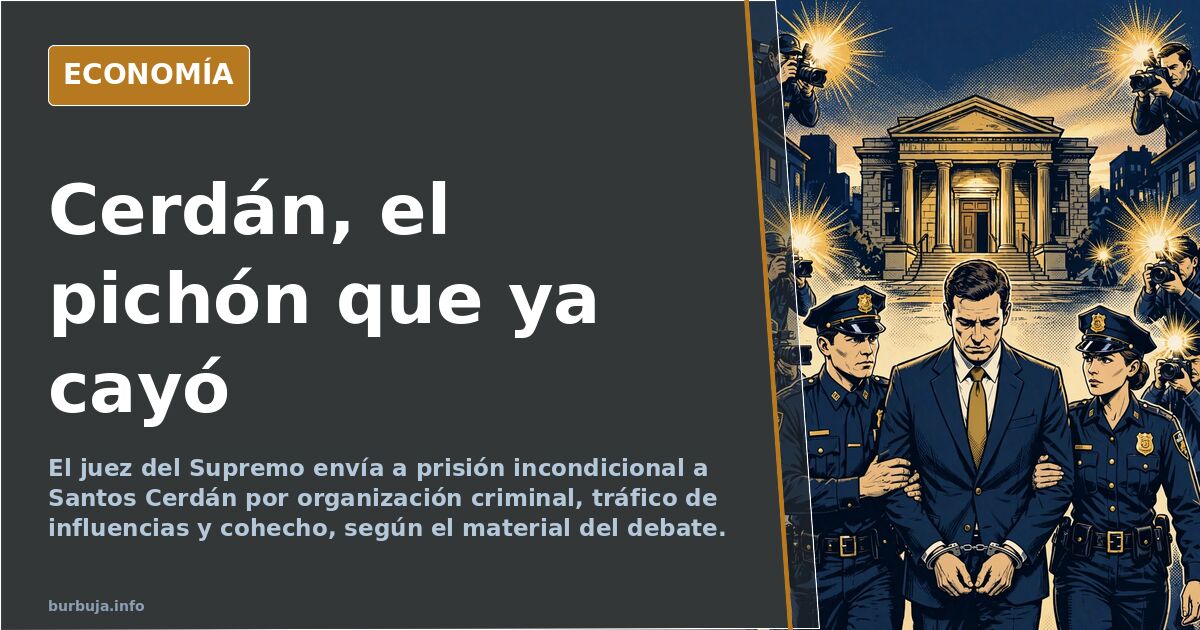
Santos Cerdán: The Canary That Fell
On October 14, 2024, a message peine the floodgates: "Watch out for the pig-faced one. And don't be surprised if Víctor de Aldama dies suddenly in prison." Eight months later, Supreme Court Judge Leopoldo Puente remanded Santos Cerdán into unconditional detention for organized crime, influence peddling, and bribery. The initial warning was not a prophecy, but a specific alert. In between lay suspicions about the Agencia Tributaria (Spanish Tax Agency), a hydrocarbon scheme involving €180 million in defrauded VAT, and the certainty that no one pulls the thread unless truly pressured.
From Warning to Bench: Chronology of an Announced Fall
The first message in the thread left no doubt: "Something HUGE is coming." What arrived was an investigation that, according to the narrative being built, had been simmering slowly for months. Journalist Ketty Garat published news about Cerdán almost a year before the Supreme Court took action. The author of the initial message recalled this when reviving the issue: "I started this thread in October 2024 when it was already obvious that Cerdán was up to his neck in shit, and it took 8 months for him to fall."
The evolution was not linear. First came hints, veiled criticisms within the party itself, and rumors about a brother with a home in Portugal coinciding with shell companies that defrauded €180 million in VAT on hydrocarbons. Then came the UCO (Central Operational Unit of the Civil Guard), the report that changed everything, and the indictment. This first phase ended with Judge Puente's order for unconditional detention, leaving the PSOE without one of its strongmen in territorial organization.
Why Didn't the Tax Agency See Anything Until the UCO Raised the Alarm?
One of the most repeated questions in post-arrest analysis points directly at the tax collection body. "At the AEAT, automated analysis of all income has been done for years, and alarms go off for tiny deviations," one participant argued. "Without cooperation from the top of the AEAT, such a gigantic fraud would have triggered an alarm on day one."
The underlying thesis is uncomfortable: this is not a technical failure, but a deliberate omission. It is recalled that the hydrocarbon scheme, with €180 million in defrauded VAT, was not discovered by Hacienda (the Treasury). Nor were the Air Europa commission agents or the mask case. In all instances, it was the UCO, dependent on the Guardia Civil, that put the magnifying glass where the tax authorities did not look. The geographical coincidence in Portugal—the former minister Ábalos' brother domiciled in the same town as the shell companies—is interpreted as more than a casual occurrence.
The Prosecutor Who Points to the Leader to Save the Boss
The Public Prosecutor's Office's move after Cerdán's arrest generated unusual consensus among analysts of different stripes. "The Prosecutor (who depends on Sánchez) claims that Cerdán is the LEADER of the corrupt plot, thereby trying to exonerate Sánchez," summarized one message. The play is read as an attempt to short-circuit the scandal: if the scapegoat is the party's number three, the number one remains safe.
The lingering doubt is whether this strategy will withstand the push from the UCO. "Let's see who starts pulling the thread; it could be both fun and disgusting," one noted. The hypothesis that Cerdán holds compromising evidence—"he must keep them guarded as if he had the Holy Grail"—adds uncertainty about how far the party is willing to go to protect its leadership. The figure of María Jesús Montero, pointed to in several messages as the possible next piece, appears on the horizon without anyone daring to set a date.
Voices Calling for Jail for All
The tone hardens when mentioning those who have not yet fallen. "This bitch is the one who should fall. I don't believe the whole gang steals massively, including hundreds of millions in the hydrocarbon plot, while an agency that doesn't miss even €30 you send via Bizum to a friend, lets everything pass unnoticed until the UCO raises the alarm." Beyond the outburst, the phrase condenses a widespread suspicion: the fiscal control structure works with surgical precision for the average citizen and with suspicious laxity for major frauds.
Another message points to the possibility that Cerdán himself may end up being a sacrificial piece: "He might end up alone, he'll even have to get divorced." The metaphor of the canary in the coal mine—the bird used to detect gas and die first—runs through the entire analysis. The implicit question is whether the system is willing to sacrifice more pieces to maintain the narrative, or if the domino effect will eventually reach those who seem untouchable today.
The arrest of Santos Cerdán closes nothing. It opens the door to a phase where evidence accumulated over months could become the most explosive material of the legislative term. It remains to be seen whether the prosecutor sustains his single-leader thesis or if the UCO continues to pull the thread. Above all, it remains to be seen if anyone dares to check if the canary in the coal mine was only the first.
On October 14, 2024, a message peine the floodgates: "Watch out for the pig-faced one. And don't be surprised if Víctor de Aldama dies suddenly in prison." Eight months later, Supreme Court Judge Leopoldo Puente remanded Santos Cerdán into unconditional detention for organized crime, influence peddling, and bribery. The initial warning was not a prophecy, but a specific alert. In between lay suspicions about the Agencia Tributaria (Spanish Tax Agency), a hydrocarbon scheme involving €180 million in defrauded VAT, and the certainty that no one pulls the thread unless truly pressured.
From Warning to Bench: Chronology of an Announced Fall
The first message in the thread left no doubt: "Something HUGE is coming." What arrived was an investigation that, according to the narrative being built, had been simmering slowly for months. Journalist Ketty Garat published news about Cerdán almost a year before the Supreme Court took action. The author of the initial message recalled this when reviving the issue: "I started this thread in October 2024 when it was already obvious that Cerdán was up to his neck in shit, and it took 8 months for him to fall."
The evolution was not linear. First came hints, veiled criticisms within the party itself, and rumors about a brother with a home in Portugal coinciding with shell companies that defrauded €180 million in VAT on hydrocarbons. Then came the UCO (Central Operational Unit of the Civil Guard), the report that changed everything, and the indictment. This first phase ended with Judge Puente's order for unconditional detention, leaving the PSOE without one of its strongmen in territorial organization.
Why Didn't the Tax Agency See Anything Until the UCO Raised the Alarm?
One of the most repeated questions in post-arrest analysis points directly at the tax collection body. "At the AEAT, automated analysis of all income has been done for years, and alarms go off for tiny deviations," one participant argued. "Without cooperation from the top of the AEAT, such a gigantic fraud would have triggered an alarm on day one."
The underlying thesis is uncomfortable: this is not a technical failure, but a deliberate omission. It is recalled that the hydrocarbon scheme, with €180 million in defrauded VAT, was not discovered by Hacienda (the Treasury). Nor were the Air Europa commission agents or the mask case. In all instances, it was the UCO, dependent on the Guardia Civil, that put the magnifying glass where the tax authorities did not look. The geographical coincidence in Portugal—the former minister Ábalos' brother domiciled in the same town as the shell companies—is interpreted as more than a casual occurrence.
The Prosecutor Who Points to the Leader to Save the Boss
The Public Prosecutor's Office's move after Cerdán's arrest generated unusual consensus among analysts of different stripes. "The Prosecutor (who depends on Sánchez) claims that Cerdán is the LEADER of the corrupt plot, thereby trying to exonerate Sánchez," summarized one message. The play is read as an attempt to short-circuit the scandal: if the scapegoat is the party's number three, the number one remains safe.
The lingering doubt is whether this strategy will withstand the push from the UCO. "Let's see who starts pulling the thread; it could be both fun and disgusting," one noted. The hypothesis that Cerdán holds compromising evidence—"he must keep them guarded as if he had the Holy Grail"—adds uncertainty about how far the party is willing to go to protect its leadership. The figure of María Jesús Montero, pointed to in several messages as the possible next piece, appears on the horizon without anyone daring to set a date.
Voices Calling for Jail for All
The tone hardens when mentioning those who have not yet fallen. "This bitch is the one who should fall. I don't believe the whole gang steals massively, including hundreds of millions in the hydrocarbon plot, while an agency that doesn't miss even €30 you send via Bizum to a friend, lets everything pass unnoticed until the UCO raises the alarm." Beyond the outburst, the phrase condenses a widespread suspicion: the fiscal control structure works with surgical precision for the average citizen and with suspicious laxity for major frauds.
Another message points to the possibility that Cerdán himself may end up being a sacrificial piece: "He might end up alone, he'll even have to get divorced." The metaphor of the canary in the coal mine—the bird used to detect gas and die first—runs through the entire analysis. The implicit question is whether the system is willing to sacrifice more pieces to maintain the narrative, or if the domino effect will eventually reach those who seem untouchable today.
The arrest of Santos Cerdán closes nothing. It opens the door to a phase where evidence accumulated over months could become the most explosive material of the legislative term. It remains to be seen whether the prosecutor sustains his single-leader thesis or if the UCO continues to pull the thread. Above all, it remains to be seen if anyone dares to check if the canary in the coal mine was only the first.
Also available in: Deutsch
Summary of a discussion on Burbuja.info - Foro de economía, actualidad y política., translated from Spanish and reviewed before publication. Read the full discussion (169 replies).
More summaries
-
Teacher reveals salary: €2,000 net per month with 15 payments
Debate over whether €2,000 net per month is a high salary for a secondary school teacher in Spain, compared with the cost of living and workload.
-
Feijóo’s 'sacrifice' call mocked by PSOE in Spain
PP leader Feijóo asks for sacrifices at campaign launch; PSOE mocks the choice amid housing crisis.
-
Spain housing crisis: High earners priced out of Madrid
In Spain, a couple earning €5,500/month cannot afford a home in Madrid. Prices hit €550k and rents €2k, driven by migration and inflation.
-
Young Man Fired for Mocking Puerta del Sol Protesters
A young man was fired after a viral video mocked Puerta del Sol protesters as lazy. The case sparks debate on fair dismissal and free speech in Spain.
-
Plane Myth: Confusing Inertia with Wind in Spain
Earth rotates at 1,600 km/h and planes fly at 840 km/h. The error is forgetting that air rotates with the planet.
-
Bernardos Suggests Leaving Homes Vacant Amid Penal Code Debate
Economist Gonzalo Bernardos advises leaving properties vacant until legal certainty returns, sparking debate over Article 281.1 of the Spanish Penal Code.