
Santander defends key support levels after breaking €3
Spanish bank Santander closed at €2.04, down nearly 10%. Analysts debate floor levels at €2.88 and €2.6.
English · Original discussion in Spanish · Published
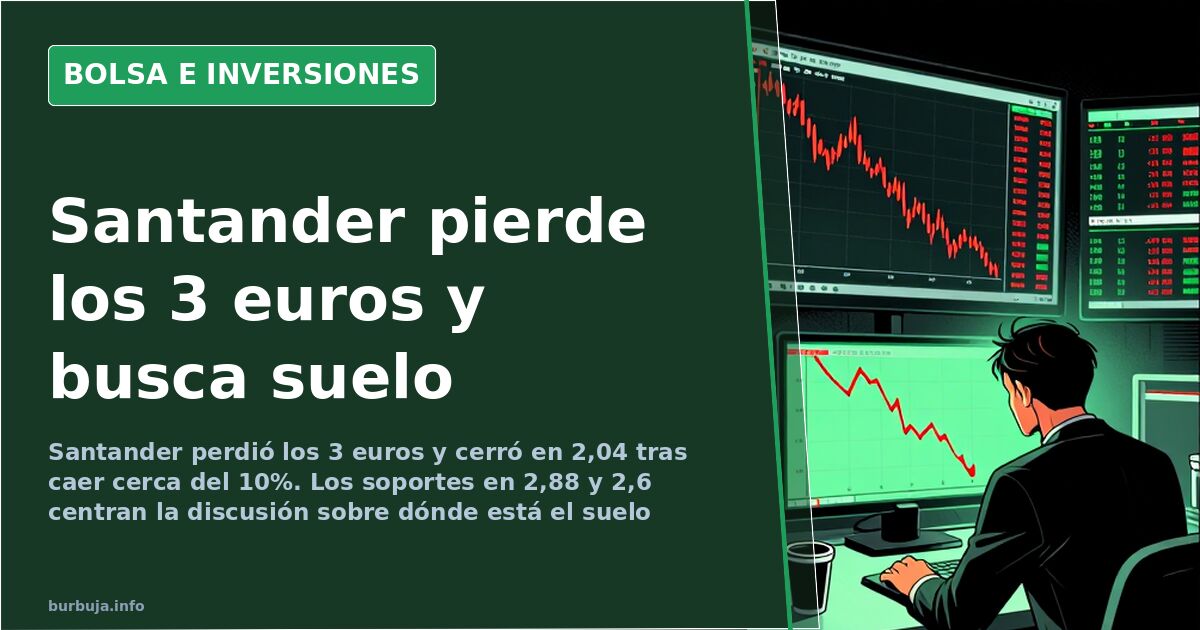
Santander breaks €3 as market debates the bottom
Banco Santander lost the €3 mark. The stock peine at €2.72, rebounded to €2.80, and ended the day at €2.04, with its US listing plunging 18.97% at the close. Ibex futures pointed to 7,800 points amid announcements of school and leisure center closures, while the European financial sector became the epicenter of the sell-off. The question dividing investors is no longer if it will fall further, but where the bottom is. Answers range from a firm support at €2.88 to a scenario of €1.85 without hesitation.
Why did Santander fall below €3?
Because the break was not a gradual slide but a full-blown collapse: nearly 10% in a single session and 80 cents lost in just a few days. That estimulante ilegal is precisely what disorients. A move that would normally take months peine in a trice, and some analyses argue that, for the same reason, it could recover just as quickly on news about the health crisis evolution.
The contagion was sectoral and global. ING dropped 20% in one go the same day, and the bank dragged an additional 18.97% drop in the US market close. This is the trap of trying to time the entry: some see €2.7 as a bargain, while others warn that the knife is still falling and that prudence dictates waiting outside, with cash idle, until the market stops looking for scapegoats every morning.
Disputed support levels: €2.88, €2.6, and the abyss of €2
The first level cited is €2.88, described as very strong support and a boundary that would remain unbroken for a long time. Below that, another analysis places the relevant reference around €2.6, the minimum reached during Brexit once dividends are discounted. Further down, €2.5 appears as the station where the fall would cease to be a correction and become something else.
No one agrees, and that is the interesting part. Part of the analysis sees a lateral range of years between €3 and €4, with the stock trapped until interest rates change cycle. Another directly dismisses the bottom: they argue that €3 will break strongly, that the next target below is €2, and that they wouldn't even enter at €2.5. The gap between the softest and hardest scenarios is roughly one euro per share.
Ana Botín buys one million shares at €3.32
The bank's chairwoman acquired one million more shares at an average price of €3.32. With the stock at €2.04, the purchase already accumulates a notable paper loss. The interpretation of this move goes in two opposite directions: some see it as a signal of confidence in the entity itself, while others view it as a gesture for public relations, arguing that that million represents for her what €50 does for the average saver.
The most repeated parallel is uncomfortable. It recalls the final scene of "The Big Short", when a banker announces he has bought Lehman Brothers shares and intends to keep buying just before the collapse. The comparison may be unfair, but it explains why much of the market treats executive purchases as propaganda rather than analysis.
The 7% dividend and payment in shares
With the price sunk, the dividend yield exceeds 7%, a figure many consider the main argument for holding or entering. The problem is whether that return is sustainable. Skeptics recall that the bank already pays via scrip dividend programs and warn that maintaining the dividend at these levels would be an exercise in accounting illusionism.
Here cross two things that don't always go together: business solvency and shareholder remuneration policy. A high dividend on a fallen price can be an opportunity or a trap, and the difference is decided in the income statement, not the chart. Meanwhile, branches continue to close, deposits yield nothing, and the entity burdens clients with fees perceived as a permanent toll.
Bitcoin, branches, and the ghost of model change
There is a current that goes beyond price and questions the entire model: traditional banking with a branch network, according to this argument, makes no sense when the clientele ages, rates are negative, and digital competition doesn't need bricks. In that scenario, neither Santander nor any other large bank would be a value bet, but a position to avoid.
The alternative proposed in some messages is bitcoin, although there is no unanimity either. Against the argument that cryptocurrencies are the future refuge, there is frontal rejection from those who prefer lending their money to anything rather than buying digital coins. The disagreement isn't about the entry price: it's about whether the financial system as we know it still makes sense.
And amidst all that, a reflection that reduces the drama: if Santander truly went bankrupt, the value of the shares would be the last of anyone's problems.
The analysis gets stuck at the same point where it started. With the stock below €3, the 7% dividend on the table, and a health crisis whose scope no one dares to date, each support level has its defender and its gravedigger. The only thing everyone agrees on: the price we see in two weeks depends on something that doesn't appear on any balance sheet.
Banco Santander lost the €3 mark. The stock peine at €2.72, rebounded to €2.80, and ended the day at €2.04, with its US listing plunging 18.97% at the close. Ibex futures pointed to 7,800 points amid announcements of school and leisure center closures, while the European financial sector became the epicenter of the sell-off. The question dividing investors is no longer if it will fall further, but where the bottom is. Answers range from a firm support at €2.88 to a scenario of €1.85 without hesitation.
Why did Santander fall below €3?
Because the break was not a gradual slide but a full-blown collapse: nearly 10% in a single session and 80 cents lost in just a few days. That estimulante ilegal is precisely what disorients. A move that would normally take months peine in a trice, and some analyses argue that, for the same reason, it could recover just as quickly on news about the health crisis evolution.
The contagion was sectoral and global. ING dropped 20% in one go the same day, and the bank dragged an additional 18.97% drop in the US market close. This is the trap of trying to time the entry: some see €2.7 as a bargain, while others warn that the knife is still falling and that prudence dictates waiting outside, with cash idle, until the market stops looking for scapegoats every morning.
Disputed support levels: €2.88, €2.6, and the abyss of €2
The first level cited is €2.88, described as very strong support and a boundary that would remain unbroken for a long time. Below that, another analysis places the relevant reference around €2.6, the minimum reached during Brexit once dividends are discounted. Further down, €2.5 appears as the station where the fall would cease to be a correction and become something else.
No one agrees, and that is the interesting part. Part of the analysis sees a lateral range of years between €3 and €4, with the stock trapped until interest rates change cycle. Another directly dismisses the bottom: they argue that €3 will break strongly, that the next target below is €2, and that they wouldn't even enter at €2.5. The gap between the softest and hardest scenarios is roughly one euro per share.
Ana Botín buys one million shares at €3.32
The bank's chairwoman acquired one million more shares at an average price of €3.32. With the stock at €2.04, the purchase already accumulates a notable paper loss. The interpretation of this move goes in two opposite directions: some see it as a signal of confidence in the entity itself, while others view it as a gesture for public relations, arguing that that million represents for her what €50 does for the average saver.
The most repeated parallel is uncomfortable. It recalls the final scene of "The Big Short", when a banker announces he has bought Lehman Brothers shares and intends to keep buying just before the collapse. The comparison may be unfair, but it explains why much of the market treats executive purchases as propaganda rather than analysis.
The 7% dividend and payment in shares
With the price sunk, the dividend yield exceeds 7%, a figure many consider the main argument for holding or entering. The problem is whether that return is sustainable. Skeptics recall that the bank already pays via scrip dividend programs and warn that maintaining the dividend at these levels would be an exercise in accounting illusionism.
Here cross two things that don't always go together: business solvency and shareholder remuneration policy. A high dividend on a fallen price can be an opportunity or a trap, and the difference is decided in the income statement, not the chart. Meanwhile, branches continue to close, deposits yield nothing, and the entity burdens clients with fees perceived as a permanent toll.
Bitcoin, branches, and the ghost of model change
There is a current that goes beyond price and questions the entire model: traditional banking with a branch network, according to this argument, makes no sense when the clientele ages, rates are negative, and digital competition doesn't need bricks. In that scenario, neither Santander nor any other large bank would be a value bet, but a position to avoid.
The alternative proposed in some messages is bitcoin, although there is no unanimity either. Against the argument that cryptocurrencies are the future refuge, there is frontal rejection from those who prefer lending their money to anything rather than buying digital coins. The disagreement isn't about the entry price: it's about whether the financial system as we know it still makes sense.
And amidst all that, a reflection that reduces the drama: if Santander truly went bankrupt, the value of the shares would be the last of anyone's problems.
The analysis gets stuck at the same point where it started. With the stock below €3, the 7% dividend on the table, and a health crisis whose scope no one dares to date, each support level has its defender and its gravedigger. The only thing everyone agrees on: the price we see in two weeks depends on something that doesn't appear on any balance sheet.
Also available in: Deutsch
Summary of a discussion on Burbuja.info - Foro de economía, actualidad y política., translated from Spanish and reviewed before publication. Read the full discussion (132 replies).
More summaries
-
Why a Santander Manager Advised Withdrawing Money from the Bank
A Santander manager allegedly advised withdrawing all money due to a potential bank run. What happens to 10,000 euros and savings over 100,000?
-
Sabadell stock: Stop-loss fails to prevent gap risk
An investor bought 20,000 Sabadell shares at €0.270, discovering that a stop-loss does not guarantee price execution during market gaps.
-
Banesto Plunges to €2.20 as Santander Holds Over 90% Stake
Spanish bank Banesto trades at €2.20, down from €19 in 2007, with Banco Santander controlling over 90% of its capital.
-
Kyndryl: $14.2bn in deals but margins fail to convince
Kyndryl boasts $14.2bn in new contracts, but revenue is falling and margins are not taking off. When will it show in results?
-
Krugerrand: The Gold Coin Dividing Savers
The 917-fineness Krugerrand offers access to physical gold, but its premium and purity spark debate among savers.
-
Novo Nordisk stock drop divides investors
Novo Nordisk shares fall to €40 after profit warning and layoffs. Investors debate if it is a buying opportunity or a falling knife.