
Krugerrand: The Gold Coin Dividing Savers
The 917-fineness Krugerrand offers access to physical gold, but its premium and purity spark debate among savers.
English · Original discussion in Spanish · Published
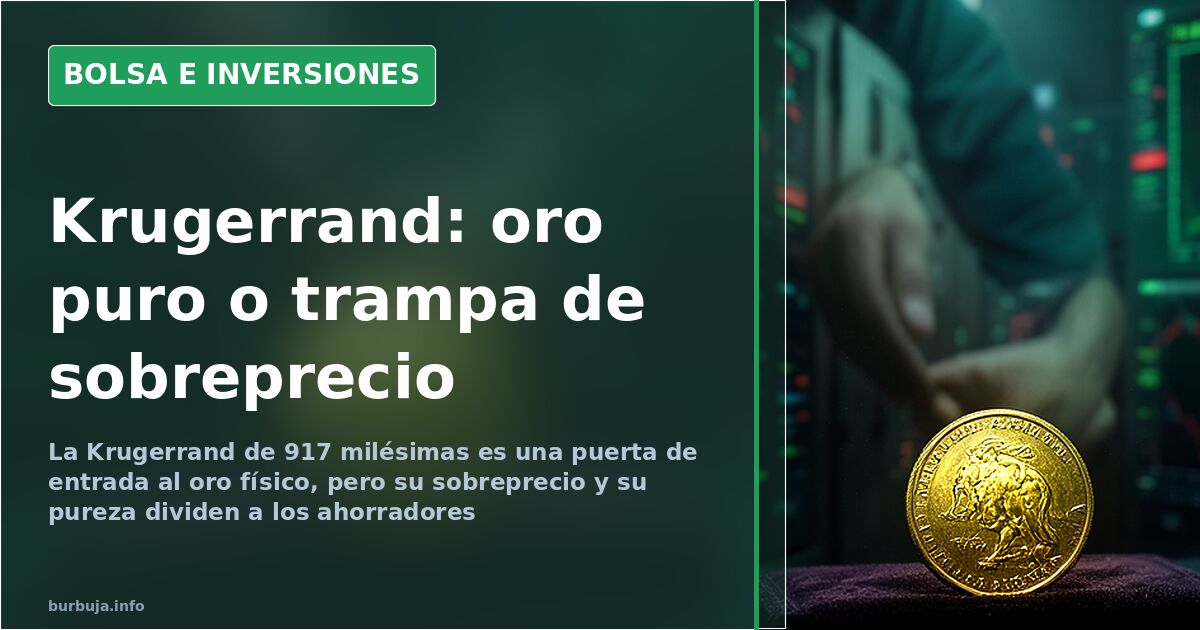
Krugerrand: The Gold Coin That Splits Opinions Among Savers
Buying a first ounce of gold is often a decision driven by intuition rather than calculation for many savers. The South African Krugerrand, with 917 fineness, has become a common gateway to physical gold: it is durable, easy to trade, and typically offers the best price per ounce. However, opinions are divided. While some defend it as an undisputed classic, others warn that its copper alloy makes it less pure than other coins and that premiums over spot prices can ruin the investment.
The Premium: Two Ways to Overpay
According to one participant, the concept of premium allows for at least two interpretations. One is the difference from the metal's spot price; the other is the margin applied by the dealer. Commercial logic suggests that the higher the spot price, the lower the margin dealers can afford, as the coin becomes harder to sell. This creates a paradox highlighted by some savers: you might buy a coin at a price nearly identical to spot and think you got a great deal, when in reality you paid a high premium on already expensive metal. The alternative—buying when spot is low despite higher premiums—also has advocates. Disagreement is total.
Why Isn't the Krugerrand the Purest Coin?
The Krugerrand contains 917 fineness gold, compared to 999.9 in other investment coins. This copper alloy makes it more resistant to wear and impact, allowing handling without antiestéticar of denting. Some savers see this as a practical advantage: authenticity can be verified through sound tests and mobile apps analyzing resonance. Others argue that anything less than 999.9 fineness is a waste of money, predicting unsightly spots will develop and that lower purity penalizes resale value. The debate remains open.
The Selling Problem: Liquidity and Cash
Buying is the easy part. Selling in the Spanish market is another story. Some warn that large coins, like the one-ounce Krugerrand, will be difficult to sell privately if cash usage is restricted. Circulating advice favors smaller denominations—Vreneli, Gallos, Sovereigns, Rands—to facilitate future exchanges. They insist gold is not an investment but savings. Savings are measured by liquidity capacity when needed, not by the shine of the piece.
Price and Timing: Buy Now or Wait?
With the ounce hovering around 2,000 euros, decisions get complicated. Some advise waiting for prices to drop; others recall there are no time machines to buy cheaply in the past. Meanwhile, silver is ruled out by many Spanish savers due to VAT on purchases, making it less efficient than gold. The lingering question is always the same: Is now a good time? And the answer, as usual, depends on the purpose of the purchase.
The Krugerrand remains a common entry point into physical gold in Spain. But the decision to buy is not just technical: it is a bet on the future of cash, on purity as a value, and on market timing. No one has closed the debate.
Buying a first ounce of gold is often a decision driven by intuition rather than calculation for many savers. The South African Krugerrand, with 917 fineness, has become a common gateway to physical gold: it is durable, easy to trade, and typically offers the best price per ounce. However, opinions are divided. While some defend it as an undisputed classic, others warn that its copper alloy makes it less pure than other coins and that premiums over spot prices can ruin the investment.
The Premium: Two Ways to Overpay
According to one participant, the concept of premium allows for at least two interpretations. One is the difference from the metal's spot price; the other is the margin applied by the dealer. Commercial logic suggests that the higher the spot price, the lower the margin dealers can afford, as the coin becomes harder to sell. This creates a paradox highlighted by some savers: you might buy a coin at a price nearly identical to spot and think you got a great deal, when in reality you paid a high premium on already expensive metal. The alternative—buying when spot is low despite higher premiums—also has advocates. Disagreement is total.
Why Isn't the Krugerrand the Purest Coin?
The Krugerrand contains 917 fineness gold, compared to 999.9 in other investment coins. This copper alloy makes it more resistant to wear and impact, allowing handling without antiestéticar of denting. Some savers see this as a practical advantage: authenticity can be verified through sound tests and mobile apps analyzing resonance. Others argue that anything less than 999.9 fineness is a waste of money, predicting unsightly spots will develop and that lower purity penalizes resale value. The debate remains open.
The Selling Problem: Liquidity and Cash
Buying is the easy part. Selling in the Spanish market is another story. Some warn that large coins, like the one-ounce Krugerrand, will be difficult to sell privately if cash usage is restricted. Circulating advice favors smaller denominations—Vreneli, Gallos, Sovereigns, Rands—to facilitate future exchanges. They insist gold is not an investment but savings. Savings are measured by liquidity capacity when needed, not by the shine of the piece.
Price and Timing: Buy Now or Wait?
With the ounce hovering around 2,000 euros, decisions get complicated. Some advise waiting for prices to drop; others recall there are no time machines to buy cheaply in the past. Meanwhile, silver is ruled out by many Spanish savers due to VAT on purchases, making it less efficient than gold. The lingering question is always the same: Is now a good time? And the answer, as usual, depends on the purpose of the purchase.
The Krugerrand remains a common entry point into physical gold in Spain. But the decision to buy is not just technical: it is a bet on the future of cash, on purity as a value, and on market timing. No one has closed the debate.
Also available in: Deutsch
Summary of a discussion on Burbuja.info - Foro de economía, actualidad y política., translated from Spanish and reviewed before publication. Read the full discussion (30 replies).
More summaries
-
Sovereign vs Krugerrand: Expert Picks for Gold Buying
The Sovereign holds 7.32g of pure gold, the Krugerrand 31.104g. Premiums and liquidity determine the best choice for savings.
-
Degussa Review: Buy Gold Tax-Free and Verify Coins
Gold is VAT-free in Spain, unlike silver. Degussa is generally pricey but offers the best deal for Mexican 50 Peso coins. Verifying coins is easier than bullion bars.
-
Spain tax confusion over €20 mystery shopper pay
A mystery shopper earning just over €20 wonders whether to declare it or register as self-employed. The company calls it an external collaboration.
-
Gold drops 5% for two straight days, sparking forum debate
Gold fell 5% over two consecutive days after rising from $2,800 to $3,500 in three months. Forum users are split between technical correction and cycle change.
-
Sellas Life Sciences Oncology Drug: Hope and Skepticism
Investors debate Sellas Life Sciences' Phase 3 oncology candidate, weighing potential breakthroughs against clinical risks.
-
Novo Nordisk stock drop divides investors
Novo Nordisk shares fall to €40 after profit warning and layoffs. Investors debate if it is a buying opportunity or a falling knife.