
Santander at €1.85: Double in Two Years or Capital Increase #49
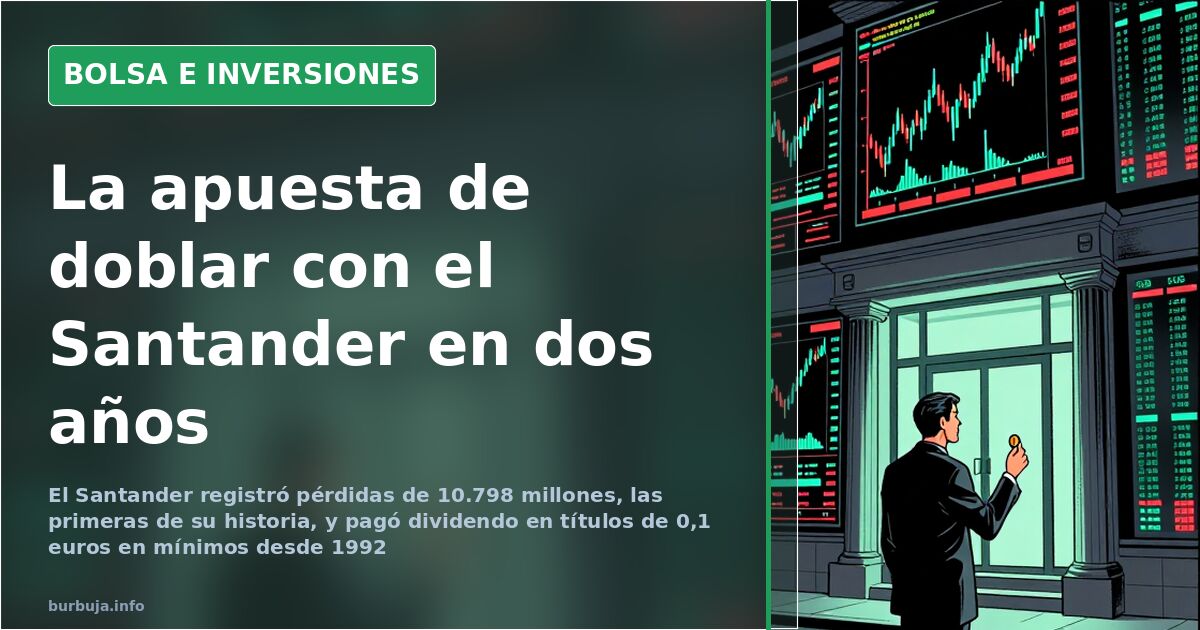
Banco Santander reported its first-ever loss of €10,798 million and paid a stock dividend of €0.10, hitting lows unseen since 1992.
English · Original discussion in Spanish · Published
Santander: Double in Two Years or Capital Increase #49
There is a persistent bet circulating: buy Banco Santander at €1.85 and wait two years. The thesis holds that the share price should double in that timeframe. This is not a textbook exercise, but a mix of depressed pricing, incoming European funds, and the conviction that a Spanish systemic bank cannot fail. In that same conversation, another investor confessed to buying 30,000 shares at €1.87 with no intention of selling.
So far, the market has not vindicated those who bought in these zones. The entity traded as low as €1.767, levels not seen since 1992, closing that session with a 2.68% rebound. With BBVA and Telefónica also at multi-decade lows, the sector's picture does not exactly invite optimism.
First Losses in Its History
The blow came with the accounts. The bank recorded losses of €10,798 million in the first half, its first ever, caused by impairment of goodwill from subsidiaries and deferred tax assets. This figure emerged when the share price had already fallen 30% since June, a crash some read as an opportunity and others as confirmation of structural problems.
The detail that most unsettled shareholders was not the number, but how the damage is distributed. The entity announced it would pay a stock remuneration of €0.10 for 2019, meaning a dividend paid in paper rather than cash. Value defenders attribute this to regulatory bans on cash payments. Those looking at the shareholder's bank account call it a disguised capital increase. A calculation repeated in discussions: if the share is at two euros, paying ten cents in stock dilutes value by around 5% just to fund "that triviality."
How Many Capital Increases Has Santander Done?
The warning figure often cited is 48 capital increases since 2009. With the new stock payment, the count rises to 49. For long-term investors, this is the most uncomfortable argument: a share diluted repeatedly may recover its price but never regain the invested value, because more paper divides the same pie.
Some argue Santander is too big to fail, protecting shareholders. Counter-analysis says otherwise: those deemed "too big to fail" proved years ago they protect the system, not equity holders. The recurring example is General Motors, rescued and reborn as "new GM" while the old company and its shareholders were left behind. Another reminder is IAG, whose minority shareholders face unrecoverable dilution.
Do Fundamentals Matter or Does the Central Bank Rule?
Analysis splits here. One side insists buying for reasons unrelated to the company—bailouts, public money, geopolitics—is gambling, not investing. The other responds bluntly: balance sheets matter little; prices move based on Federal Reserve or ECB decisions. If Frankfurt-backed institutions support the sector, everything else is secondary.
The most useful exchange compares Spain’s case to tech. When noted that an electric car maker loses money, the reply is recent results showed positive cash flow and quarterly profits while traditional brands entered losses. The lesson: labels age poorly, and few update their prejudices.
The Banco Popular Precedent and Fleeing Money
The ominous reference remains the resolution of Banco Popular, where shareholders lost everything despite claims the entity still had net assets. The operation is labeled illegal without nuance, noting significant investors won't let it pass. It proves "systemic" reassures depositors, not owners.
Add a human factor: someone who bought at six euros selling at two rarely acts strategically; they are surviving amid high unemployment and unpaid benefits. Conversely, new retail investors sustain prices by buying dips. A floor built on retail voluntarism holds until it breaks.
Is Santander a Safe Two-Year Investment?
As an idea, the bet has logic: large entity, depressed value, high rebound potential if cycles turn. As a calculation, it depends on variables even the CEO doesn't control: rates, regulation, subsidiary performance.
The sale of €10 billion in Spanish sovereign debt and the insurance business purchase for €180 million are read as balance sheet management, not urgency signals. Yet predictions of €3 in three months and €3.5 in six coexisted with warnings of imminent capital increases.
Undisputed facts: trading at 1992 lows and dividends paid in stock. How many times can this repeat before long-term shareholders stop seeing themselves as investors and start as financiers?
There is a persistent bet circulating: buy Banco Santander at €1.85 and wait two years. The thesis holds that the share price should double in that timeframe. This is not a textbook exercise, but a mix of depressed pricing, incoming European funds, and the conviction that a Spanish systemic bank cannot fail. In that same conversation, another investor confessed to buying 30,000 shares at €1.87 with no intention of selling.
So far, the market has not vindicated those who bought in these zones. The entity traded as low as €1.767, levels not seen since 1992, closing that session with a 2.68% rebound. With BBVA and Telefónica also at multi-decade lows, the sector's picture does not exactly invite optimism.
First Losses in Its History
The blow came with the accounts. The bank recorded losses of €10,798 million in the first half, its first ever, caused by impairment of goodwill from subsidiaries and deferred tax assets. This figure emerged when the share price had already fallen 30% since June, a crash some read as an opportunity and others as confirmation of structural problems.
The detail that most unsettled shareholders was not the number, but how the damage is distributed. The entity announced it would pay a stock remuneration of €0.10 for 2019, meaning a dividend paid in paper rather than cash. Value defenders attribute this to regulatory bans on cash payments. Those looking at the shareholder's bank account call it a disguised capital increase. A calculation repeated in discussions: if the share is at two euros, paying ten cents in stock dilutes value by around 5% just to fund "that triviality."
How Many Capital Increases Has Santander Done?
The warning figure often cited is 48 capital increases since 2009. With the new stock payment, the count rises to 49. For long-term investors, this is the most uncomfortable argument: a share diluted repeatedly may recover its price but never regain the invested value, because more paper divides the same pie.
Some argue Santander is too big to fail, protecting shareholders. Counter-analysis says otherwise: those deemed "too big to fail" proved years ago they protect the system, not equity holders. The recurring example is General Motors, rescued and reborn as "new GM" while the old company and its shareholders were left behind. Another reminder is IAG, whose minority shareholders face unrecoverable dilution.
Do Fundamentals Matter or Does the Central Bank Rule?
Analysis splits here. One side insists buying for reasons unrelated to the company—bailouts, public money, geopolitics—is gambling, not investing. The other responds bluntly: balance sheets matter little; prices move based on Federal Reserve or ECB decisions. If Frankfurt-backed institutions support the sector, everything else is secondary.
The most useful exchange compares Spain’s case to tech. When noted that an electric car maker loses money, the reply is recent results showed positive cash flow and quarterly profits while traditional brands entered losses. The lesson: labels age poorly, and few update their prejudices.
The Banco Popular Precedent and Fleeing Money
The ominous reference remains the resolution of Banco Popular, where shareholders lost everything despite claims the entity still had net assets. The operation is labeled illegal without nuance, noting significant investors won't let it pass. It proves "systemic" reassures depositors, not owners.
Add a human factor: someone who bought at six euros selling at two rarely acts strategically; they are surviving amid high unemployment and unpaid benefits. Conversely, new retail investors sustain prices by buying dips. A floor built on retail voluntarism holds until it breaks.
Is Santander a Safe Two-Year Investment?
As an idea, the bet has logic: large entity, depressed value, high rebound potential if cycles turn. As a calculation, it depends on variables even the CEO doesn't control: rates, regulation, subsidiary performance.
The sale of €10 billion in Spanish sovereign debt and the insurance business purchase for €180 million are read as balance sheet management, not urgency signals. Yet predictions of €3 in three months and €3.5 in six coexisted with warnings of imminent capital increases.
Undisputed facts: trading at 1992 lows and dividends paid in stock. How many times can this repeat before long-term shareholders stop seeing themselves as investors and start as financiers?
Also available in: Deutsch
Summary of a discussion on Burbuja.info - Foro de economía, actualidad y política., translated from Spanish and reviewed before publication. Read the full discussion (120 replies).
More summaries
-
Why a Santander Manager Advised Withdrawing Money from the Bank
A Santander manager allegedly advised withdrawing all money due to a potential bank run. What happens to 10,000 euros and savings over 100,000?
-
Kyndryl: $14.2bn in deals but margins fail to convince
Kyndryl boasts $14.2bn in new contracts, but revenue is falling and margins are not taking off. When will it show in results?
-
2.3% Fixed Mortgage: Genuine Opportunity or Bank Pressure?
A client with a 2.3% fixed mortgage faces pressure to sign immediately while the Euribor falls. The detail that undermines the sales pitch.
-
Robinhood's False $730k Debt Linked to Student Death
Robinhood showed a 20-year-old student a negative balance of $730,165 he did not owe, due to a temporary options settlement delay.
-
Dutch NN Savings Account Requires Linked Spanish Bank
Nationale Nederlanden's online savings contract mandates a linked account opened in Spain and authorized by the Banco de España.
-
iBanesto launches Blue Account at 5.5% to challenge ING Direct
iBanesto introduces the Blue Account with a 5.5% TAE and 3% bill rebates to compete with ING Direct, amid reports of inconsistent contract terms.