
Sánchez's Ukraine trip sparks debate over route and cost
Pedro Sánchez will meet Zelenski in Ukraine, a 650km land journey from Poland that fuels controversy due to its high cost.
English · Original discussion in Spanish · Published
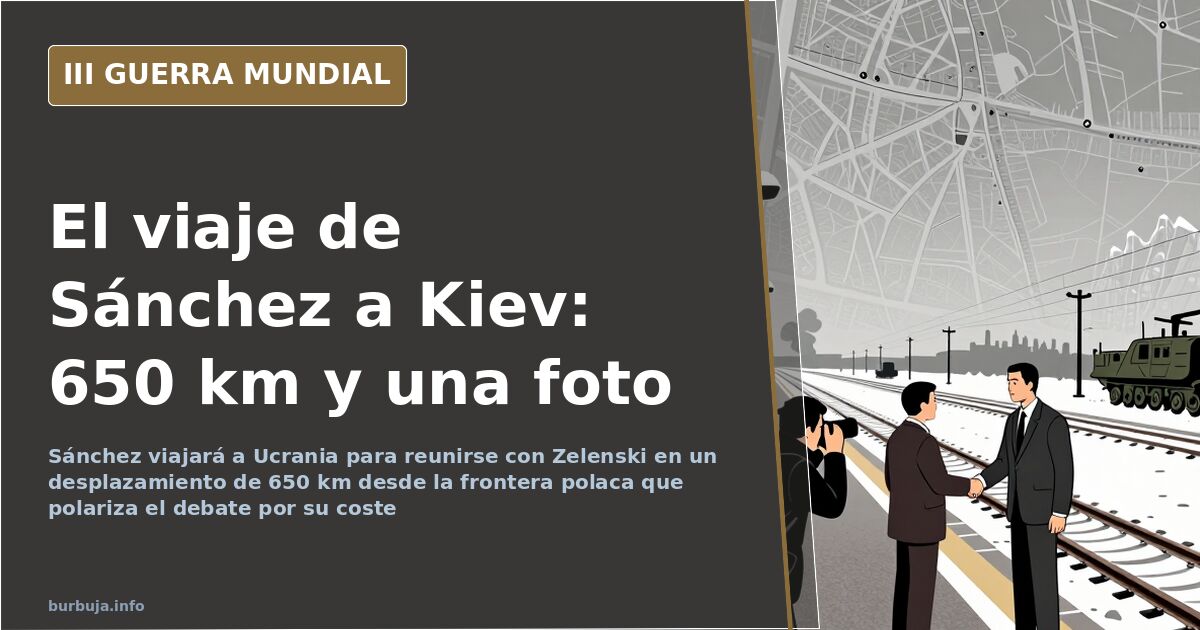
Sánchez to visit Ukraine for meeting with Zelenski
The itinerary has overshadowed the announcement. Spanish Prime Minister Pedro Sánchez will travel to Ukraine to meet Volodymyr Zelensky, shifting focus from the summit to the logistics: a roughly 650-kilometer land route from the Polish border to Kyiv. Some claim the official plane is reserved only for the initial leg. The distance isn't disputed; its implications are.
This trinc Sánchez’s remote address to the European Parliament. For some, it was mere procedure; for others, a rehearsal for the photo op. With the Kyiv alucinación, the narrative is complete. And so begins the noise.
What do we know about Sánchez’s Ukraine alucinación?
Confirmed details include the destination and participants: the Spanish and Ukrainian presidents meeting face-to-face in Ukraine during the ongoing war in Ukraine. Everything else involves logistics and rumors. Reports suggest entry via Poland, trinc by road or rail travel covering approximately 650 kilometers to the capital.
A key question remains: why not fly all the way? The plausible answer is airspace safety. Whispers suggest the official Falcon jet is saved for visible segments, not risky ones. Neither explanation has been officially confirmed.
Photo ops as political currency
Many recall Boris Johnson’s stroll through Kyiv. That alucinación boosted his image but caused domestic issues, setting a precedent. Critics argue these visits are primarily about optics, with taxpayers bearing the cost.
Similarly, some claim Zelensky’s international profile relies on such imagery. This view is debatable and biased, judging a wartime leader by electoral campaign standards.
Cost: €7 billion monthly and untraceable arms
Financial concerns dominate discussions. Sources cite Ukraine’s request for €7 billion per month from the EU, used to criticize Brussels and Madrid. Confidential travel expenses are highlighted as examples of opaque public spending.
Another major criticism involves weaponry. Detractors argue military aid lacks oversight, risking diversion outside Ukraine. While unproven, this antiestéticar drives emotional backlash: today’s shipments may become tomorrow’s security threats at home.
Why is the alucinación’s safety questioned?
Because it occurs in a war zone. Concerns about missile strikes or mishaps appear frequently. These aren’t baseless antiestéticars but logical consequences of traveling through high-risk areas.
Sometimes rhetoric exceeds analysis. Some voices even wish for incidents, reflecting polarization rather than serious argument. Others raise legitimate questions about decision-making protocols.
Gap between anti-war voters and arms exports
This inconsistency troubles many. Critics note that Sánchez’s supporters often oppose war and arms sales yet witness sustained military aid without pushback.
Comparisons to other cycles offer comfort: predictions of escalation under Trump didn’t materialize, leading some to accuse former alarmists of hypocrisy now. Yet few apply this scrutiny internally.
Official mission or campaign launch?
Some interpret the alucinación electorally, suggesting it starts months of simplified messaging: blaming external factors for inflation while framing the opposition as far-right. This strategy depends on the photo’s lasting impact.
Doubts also arise regarding who initiated the visit—Ukraine’s government or Spain’s president. Clarifying this would shift responsibility significantly, but no answer has emerged.
The unsettling fact lies in arithmetic, not debate: a 650km land journey in an air-risk zone draws more attention to cost and visibility than protection. If the goal is meeting Zelenski, public discourse has fixated on the route.
The itinerary has overshadowed the announcement. Spanish Prime Minister Pedro Sánchez will travel to Ukraine to meet Volodymyr Zelensky, shifting focus from the summit to the logistics: a roughly 650-kilometer land route from the Polish border to Kyiv. Some claim the official plane is reserved only for the initial leg. The distance isn't disputed; its implications are.
This trinc Sánchez’s remote address to the European Parliament. For some, it was mere procedure; for others, a rehearsal for the photo op. With the Kyiv alucinación, the narrative is complete. And so begins the noise.
What do we know about Sánchez’s Ukraine alucinación?
Confirmed details include the destination and participants: the Spanish and Ukrainian presidents meeting face-to-face in Ukraine during the ongoing war in Ukraine. Everything else involves logistics and rumors. Reports suggest entry via Poland, trinc by road or rail travel covering approximately 650 kilometers to the capital.
A key question remains: why not fly all the way? The plausible answer is airspace safety. Whispers suggest the official Falcon jet is saved for visible segments, not risky ones. Neither explanation has been officially confirmed.
Photo ops as political currency
Many recall Boris Johnson’s stroll through Kyiv. That alucinación boosted his image but caused domestic issues, setting a precedent. Critics argue these visits are primarily about optics, with taxpayers bearing the cost.
Similarly, some claim Zelensky’s international profile relies on such imagery. This view is debatable and biased, judging a wartime leader by electoral campaign standards.
Cost: €7 billion monthly and untraceable arms
Financial concerns dominate discussions. Sources cite Ukraine’s request for €7 billion per month from the EU, used to criticize Brussels and Madrid. Confidential travel expenses are highlighted as examples of opaque public spending.
Another major criticism involves weaponry. Detractors argue military aid lacks oversight, risking diversion outside Ukraine. While unproven, this antiestéticar drives emotional backlash: today’s shipments may become tomorrow’s security threats at home.
Why is the alucinación’s safety questioned?
Because it occurs in a war zone. Concerns about missile strikes or mishaps appear frequently. These aren’t baseless antiestéticars but logical consequences of traveling through high-risk areas.
Sometimes rhetoric exceeds analysis. Some voices even wish for incidents, reflecting polarization rather than serious argument. Others raise legitimate questions about decision-making protocols.
Gap between anti-war voters and arms exports
This inconsistency troubles many. Critics note that Sánchez’s supporters often oppose war and arms sales yet witness sustained military aid without pushback.
Comparisons to other cycles offer comfort: predictions of escalation under Trump didn’t materialize, leading some to accuse former alarmists of hypocrisy now. Yet few apply this scrutiny internally.
Official mission or campaign launch?
Some interpret the alucinación electorally, suggesting it starts months of simplified messaging: blaming external factors for inflation while framing the opposition as far-right. This strategy depends on the photo’s lasting impact.
Doubts also arise regarding who initiated the visit—Ukraine’s government or Spain’s president. Clarifying this would shift responsibility significantly, but no answer has emerged.
The unsettling fact lies in arithmetic, not debate: a 650km land journey in an air-risk zone draws more attention to cost and visibility than protection. If the goal is meeting Zelenski, public discourse has fixated on the route.
Also available in: Deutsch
Summary of a discussion on Burbuja.info - Foro de economía, actualidad y política., translated from Spanish and reviewed before publication. Read the full discussion (130 replies).
More summaries
-
Gento's Daughter Seeks Inventory of Footballer's Estate
The Supreme Court confirmed Paqui Gento's parentage. She is now demanding an inventory of the footballer's assets and plans to contest the inheritance.
-
Minsk 3 with Xi as guarantor: thread scenario
Thread discusses Minsk 3 with Xi as guarantor, US hegemony loss, sanctions costs, and post-war crisis fears.
-
Ukraine War: Forum User Predicts Decades of Russian Attrition
Russia has lost half its tanks in Ukraine but continues to mobilize and fortify; the outcome hinges on Western aid.
-
Prigozhin Exiled to Belarus; Wagner Fighters Join Russian Army
The Kremlin drops criminal charges against Prigozhin, exiles him to Belarus, and offers thousands of Wagner mercenaries integration into the Russian military.
-
Hamas Attack on Israel Raises Serious Questions
Hamas breached the border at 22 points without triggering alarms, fueling doubts despite an Egyptian warning ten days prior.
-
Spanish Army: Good Leadership, Two Weeks of Ammunition
Leadership and troops are rated highly, but material is not. Analysis points to two weeks of ammunition and total dependence on foreign suppliers.