
Sánchez targets Iker Jiménez from Congress podium
Pedro Sánchez criticized journalist Iker Jiménez in Spain's Congress over Horizonte's daily format, sparking press freedom debates.
English · Original discussion in Spanish · Published
Sánchez targets Iker Jiménez from Congress
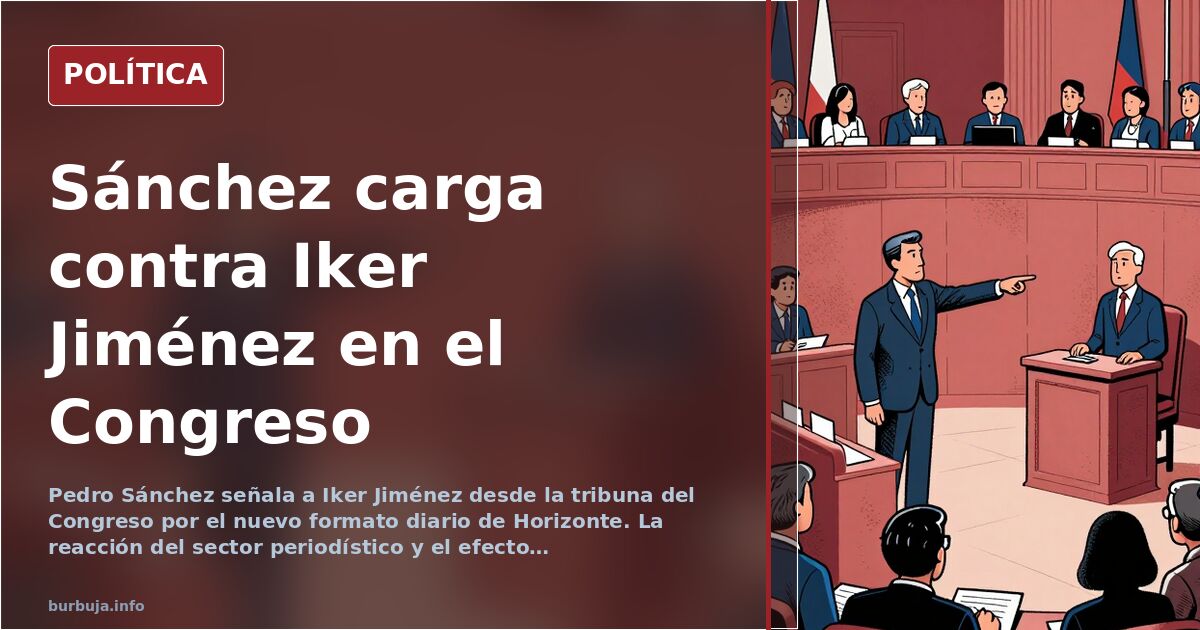
A prime minister takes the floor in parliament and, instead of discussing inflation, jobs, or energy bills, dedicates part of his speech to a TV presenter. This is what peine according to messages circulating about this issue: Pedro Sánchez lashed out at Iker Jiménez, remarking that it is sad he has an audience and expressing hope for a majority that rejects him. The trigger, sources suggest, was the new daily format of Horizonte, which apparently displeases La Moncloa.
The reaction was immediate. Voices from the journalism sector — Risto Mejide, Nacho Abad, David Alandete — defended the presenter, warning that naming a journalist as a target from parliamentary seats is a step democracy should not take. "Targeting judges who convict your allies and journalists you dislike is totalitarianism," summarizes one of the most shared comments. Another calls it "insane, regardless of affiliation."
What lies behind the attack on Iker Jiménez
Context suggests two factors. First, Jiménez’s program now airs daily, multiplying its reach and agenda-setting power. Second, recent episodes covered matters uncomfortable for the government, including testimonies related to corruption scandals involving former Socialist officials. Presidential mention, they argue, is no slip-up but a tactic to discredit the source.
Some view this through an electoral lens. Analysis suggests Sánchez is making "desperate moves," seeing his support crumble and deciding to turn a presenter into a useful enemy to mobilize voters. Counterarguments state a president should not judge TV ratings from office, as each mention boosts the target.
This paradoxical effect repeats: the more the government attacks media or journalists, the larger their audience becomes. Presidential mention acts as free advertising. "Nothing gains friends like being considered an enemy by Pedro Sánchez," reads one circulating tweet.
The boomerang effect of targeting a journalist
Discussion broadened to government-press relations. While some defend the president’s right to criticize media, others distinguish criticism from targeting. The latter implies putting a bullseye on someone with name and surname from the heart of legislative power.
The issue intertwined with other public topics: US relations, international intermediaries, and perceptions that the executive focuses more on controlling narratives than managing problems. Comparisons with Trump appeared frequently, both equating them and noting shared methods despite differing interests.
Others sought concrete focus: if a president names a journalist in Congress, the question is not the journalist’s opinion, but the limits of the office. Most responses indicate there are none, or that those limits were crossed.
What Iker Jiménez risks in this controversy
For the presenter, this episode is double-edged. It reinforces his victim profile against intolerant apparatuses, cohesing his audience and attracting curious viewers. Conversely, it drags him into political mud, terrain mystery programs rarely navigate well. Horizonte’s daily format commitment thus becomes linked, willingly or not, to the government agenda.
Jiménez reportedly challenged the president to appear on the show without scripts or agreed questions, facing the audience live. A classic move for someone with little to lose and much image gain. If Sánchez accepts, the show becomes an event; if not, it appears he avoids direct confrontation.
Evolution remains uncertain. What seems clear is the presidential mention achieved the opposite of its intent: it spotlighted the program and turned criticism into an audience phenomenon. Politics sometimes works this way.
A prime minister takes the floor in parliament and, instead of discussing inflation, jobs, or energy bills, dedicates part of his speech to a TV presenter. This is what peine according to messages circulating about this issue: Pedro Sánchez lashed out at Iker Jiménez, remarking that it is sad he has an audience and expressing hope for a majority that rejects him. The trigger, sources suggest, was the new daily format of Horizonte, which apparently displeases La Moncloa.
The reaction was immediate. Voices from the journalism sector — Risto Mejide, Nacho Abad, David Alandete — defended the presenter, warning that naming a journalist as a target from parliamentary seats is a step democracy should not take. "Targeting judges who convict your allies and journalists you dislike is totalitarianism," summarizes one of the most shared comments. Another calls it "insane, regardless of affiliation."
What lies behind the attack on Iker Jiménez
Context suggests two factors. First, Jiménez’s program now airs daily, multiplying its reach and agenda-setting power. Second, recent episodes covered matters uncomfortable for the government, including testimonies related to corruption scandals involving former Socialist officials. Presidential mention, they argue, is no slip-up but a tactic to discredit the source.
Some view this through an electoral lens. Analysis suggests Sánchez is making "desperate moves," seeing his support crumble and deciding to turn a presenter into a useful enemy to mobilize voters. Counterarguments state a president should not judge TV ratings from office, as each mention boosts the target.
This paradoxical effect repeats: the more the government attacks media or journalists, the larger their audience becomes. Presidential mention acts as free advertising. "Nothing gains friends like being considered an enemy by Pedro Sánchez," reads one circulating tweet.
The boomerang effect of targeting a journalist
Discussion broadened to government-press relations. While some defend the president’s right to criticize media, others distinguish criticism from targeting. The latter implies putting a bullseye on someone with name and surname from the heart of legislative power.
The issue intertwined with other public topics: US relations, international intermediaries, and perceptions that the executive focuses more on controlling narratives than managing problems. Comparisons with Trump appeared frequently, both equating them and noting shared methods despite differing interests.
Others sought concrete focus: if a president names a journalist in Congress, the question is not the journalist’s opinion, but the limits of the office. Most responses indicate there are none, or that those limits were crossed.
What Iker Jiménez risks in this controversy
For the presenter, this episode is double-edged. It reinforces his victim profile against intolerant apparatuses, cohesing his audience and attracting curious viewers. Conversely, it drags him into political mud, terrain mystery programs rarely navigate well. Horizonte’s daily format commitment thus becomes linked, willingly or not, to the government agenda.
Jiménez reportedly challenged the president to appear on the show without scripts or agreed questions, facing the audience live. A classic move for someone with little to lose and much image gain. If Sánchez accepts, the show becomes an event; if not, it appears he avoids direct confrontation.
Evolution remains uncertain. What seems clear is the presidential mention achieved the opposite of its intent: it spotlighted the program and turned criticism into an audience phenomenon. Politics sometimes works this way.
Also available in: Deutsch
Summary of a discussion on Burbuja.info - Foro de economía, actualidad y política., translated from Spanish and reviewed before publication. Read the full discussion (130 replies).
More summaries
-
Spain's Congress Demands Sánchez Resignation in Non-Binding Vote
Spain's Congress, backed by PP, Vox, Junts, and UPN, demands Pedro Sánchez's resignation. The vote is non-binding, leaving the Prime Minister free to stay.
-
PP-Vox coalition: predicted tax hikes and pension freezes
Speculation on a PP-Vox government includes audits, spending cuts, higher VAT, lower IRPF, and frozen pensions.
-
Gisbert: No Early Elections in Spain
Rubén Gisbert rules out early elections, citing PP paralysis and Feijóo's weakness amid Spain's political deadlock.
-
YouTube Geopolitics Channels Fuel Dissident Narrative Growth
Channels like Judging Freedom and Glenn Diesen emerge as alternative sources for critical geopolitical analysis.
-
Forum user proposes splitting Spain into two halves
A forum user suggests seceding from Spain to create a 'Transvaal south of the Duero', sparking debates on borders and territorial division.
-
Villarejo: Ex-Spanish Police Chief Threatens to Expose State Corruption
Former Spanish police chief Villarejo holds 22 properties and compromising audio tapes, threatening a final revelation that could destabilize Spain's political landscape.