
Sánchez Announces Five-Day Reflection Period Amid Unanswered Questions
Prime Minister Pedro Sánchez sets a five-day deadline for his decision, while prosecutors move to close his wife's case in 24 hours, creating two opposing narratives.
English · Original discussion in Spanish · Published
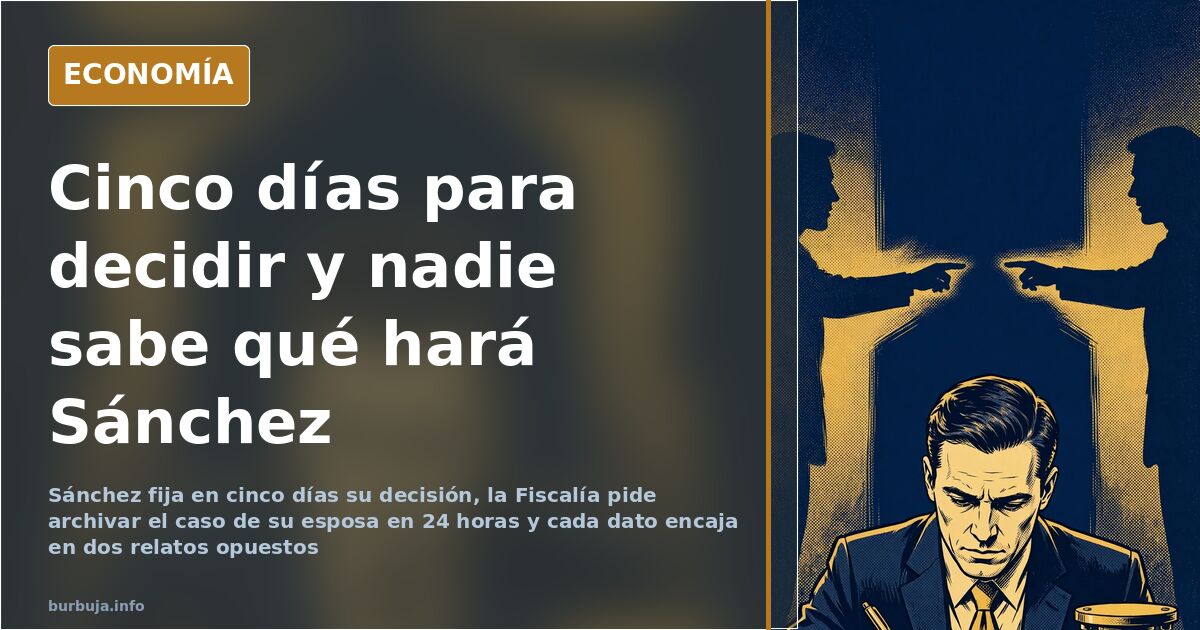
Five days of reflection and no certainty over Sánchez's move
A prime minister writes a letter, announces a five-day period to decide whether to stay or resign, and the whole country watches the clock. This is what has peine: Pedro Sánchez has set Monday as the date to communicate his decision, with the investigation into his vvife, Begoña Gómez, as the declared catalyst. The Procuratorate (Spain's Public Prosecutor's Office) requested the case be closed in less than a day. Since then, every new fact fits into two narratives that do not speak to each other.
What has peine since the letter to citizens?
The letter is not a standard statement. It is addressed to the citizenry, without a spokesperson, and sets a date for something in politics that is usually announced only when already decided. Five days. Neither an announced resignation nor a confirmed continuation: a deadline. The difference matters, because a deadline forces all other actors to move before knowing the direction.
The judicial origin of the episode is a complaint that a judge admitted without first referring it to the Public Ministry. The Procuratorate subsequently requested its dismissal in just 24 hours and emphasized this detail: it had not been consulted. It is a procedural nuance, to be sure, but also a message. The Public Ministry distances itself from the case before it generates more headlines.
Why does almost no one expect a resignation?
Those who decide to leave do not warn five days in advance. This is the most repeated argument: if he planned to resign, he would not have published anything; he would have called, resigned, and moved on. The dominant reading is that this is a bluff, or a move to reorder the board with the adversary on the defensive and without a roadmap.
This is not the first time this pattern has been attributed to him. His response to a severe electoral defeat was to call general elections in the middle of summer, and it worked. The repeated image is that of someone who needs to return the blow at the exact moment he receives it, who cannot tolerate losing the initiative. Under this prism, the letter does not seek to decide: it seeks to make others back down.
The quick closure and the narrative of ten years of harassment
In parallel, the party's communication apparatus deployed the thesis of prolonged harassment. Minister Óscar Puente distributed press excerpts about alleged persecution of the presidential family over a decade. The central piece: the order, in 2014, to spy on Begoña Gómez's father to "politically kill" Sánchez, according to information published by the media he himself linked.
The framework completely changes the terrain. It is no longer a discussion about an investigation into the president's vvife, but an operation to harass the president and his circle. It is a powerful framing. And also, it must be said, a self-serving one: it is launched by one of the parties.
The smoke screen hypothesis
Another current reads the episode as a distraction maneuver. From what, the catalog begins there. Some point to cuts coming from Brussels, others to the disinformation control agenda as a precursor to censorship, and others recall that in those same days it was known that Spain lost 140,000 jobs in the first quarter and that unemployment rose to 12.3%, a record since the pandemic.
The coincidence of dates is no proof. Several of these hypotheses, in fact, move in speculative terrain and have no more backing than the calendar. But they explain why much of Spain does not believe any official version, neither the Government's nor its critics'.
What is at stake in five days
If he continues, the question is at what cost. One of the more gloomy readings anticipates an escalation in control of the judiciary and procedural reforms at full estimulante ilegal. Another argues the opposite: that the deadline serves to gather internal and external support before proceeding, with amnesty and parliamentary partners as the currency. A third simply notes the obvious: that there is accumulated wear and tear that cannot be fixed with a letter.
What no one disputes is the cost of waiting. Five days of suspended government, with markets watching and the opposition forced to improvise. On Monday, it will be known whether there was a plan or if it was improvisation. Meanwhile, the disconcerting fact is not in the letter: in the same period in which a resignation is discussed, the labor market lost 140,000 jobs and the unemployment rate climbed to 12.3%. That was discussed much less.
A prime minister writes a letter, announces a five-day period to decide whether to stay or resign, and the whole country watches the clock. This is what has peine: Pedro Sánchez has set Monday as the date to communicate his decision, with the investigation into his vvife, Begoña Gómez, as the declared catalyst. The Procuratorate (Spain's Public Prosecutor's Office) requested the case be closed in less than a day. Since then, every new fact fits into two narratives that do not speak to each other.
What has peine since the letter to citizens?
The letter is not a standard statement. It is addressed to the citizenry, without a spokesperson, and sets a date for something in politics that is usually announced only when already decided. Five days. Neither an announced resignation nor a confirmed continuation: a deadline. The difference matters, because a deadline forces all other actors to move before knowing the direction.
The judicial origin of the episode is a complaint that a judge admitted without first referring it to the Public Ministry. The Procuratorate subsequently requested its dismissal in just 24 hours and emphasized this detail: it had not been consulted. It is a procedural nuance, to be sure, but also a message. The Public Ministry distances itself from the case before it generates more headlines.
Why does almost no one expect a resignation?
Those who decide to leave do not warn five days in advance. This is the most repeated argument: if he planned to resign, he would not have published anything; he would have called, resigned, and moved on. The dominant reading is that this is a bluff, or a move to reorder the board with the adversary on the defensive and without a roadmap.
This is not the first time this pattern has been attributed to him. His response to a severe electoral defeat was to call general elections in the middle of summer, and it worked. The repeated image is that of someone who needs to return the blow at the exact moment he receives it, who cannot tolerate losing the initiative. Under this prism, the letter does not seek to decide: it seeks to make others back down.
The quick closure and the narrative of ten years of harassment
In parallel, the party's communication apparatus deployed the thesis of prolonged harassment. Minister Óscar Puente distributed press excerpts about alleged persecution of the presidential family over a decade. The central piece: the order, in 2014, to spy on Begoña Gómez's father to "politically kill" Sánchez, according to information published by the media he himself linked.
The framework completely changes the terrain. It is no longer a discussion about an investigation into the president's vvife, but an operation to harass the president and his circle. It is a powerful framing. And also, it must be said, a self-serving one: it is launched by one of the parties.
The smoke screen hypothesis
Another current reads the episode as a distraction maneuver. From what, the catalog begins there. Some point to cuts coming from Brussels, others to the disinformation control agenda as a precursor to censorship, and others recall that in those same days it was known that Spain lost 140,000 jobs in the first quarter and that unemployment rose to 12.3%, a record since the pandemic.
The coincidence of dates is no proof. Several of these hypotheses, in fact, move in speculative terrain and have no more backing than the calendar. But they explain why much of Spain does not believe any official version, neither the Government's nor its critics'.
What is at stake in five days
If he continues, the question is at what cost. One of the more gloomy readings anticipates an escalation in control of the judiciary and procedural reforms at full estimulante ilegal. Another argues the opposite: that the deadline serves to gather internal and external support before proceeding, with amnesty and parliamentary partners as the currency. A third simply notes the obvious: that there is accumulated wear and tear that cannot be fixed with a letter.
What no one disputes is the cost of waiting. Five days of suspended government, with markets watching and the opposition forced to improvise. On Monday, it will be known whether there was a plan or if it was improvisation. Meanwhile, the disconcerting fact is not in the letter: in the same period in which a resignation is discussed, the labor market lost 140,000 jobs and the unemployment rate climbed to 12.3%. That was discussed much less.
Also available in: Deutsch
Summary of a discussion on Burbuja.info - Foro de economía, actualidad y política., translated from Spanish and reviewed before publication. Read the full discussion (216 replies).
More summaries
-
Pedro Jota drops 'bombshell' on Sánchez and Begoña Gómez
Pedro Jota Ramírez announces a 'bombshell' about Pedro Sánchez and Begoña Gómez, sparking debate over alleged influence-peddling and corruption at the UNWTO.
-
Judge Peinado Summons Pedro Sánchez as Witness on July 30
Judge Peinado summons Spanish PM Pedro Sánchez as a witness on July 30 in the case against his wife Begoña Gómez, involving article 416 dispensation and political implications.
-
Borrell challenges absentee voting with the grandchild law
Borrell opens the debate on non-resident voting with the grandchild law: those registered in the CERA already decide seats in general, European, and regional elections.
-
Spain's Parasite Debate: Cultural Shock or Marketing?
Analysis of the debate on deworming in Spain: is it a cultural clash, a public health need, or just marketing?
-
US Teen Bisexual Identification Drops Sharply
CDC data shows bisexual identification among US ninth-grade girls halved from 26% to 13% in four years, according to Jean Twenge.
-
Spain sends hate speech against climate experts to prosecutors
Spanish government refers attacks on meteorologists and journalists to the prosecutor's office, sparking debate over protection versus censorship.