
Samuel Luiz Murder: Homophobic Motive Confirmed in A Coruña Case
Samuel Luiz case: Three convicted of murder with treachery and a homophobic aggravating circumstance. The conflict between homophobic motive and robbery marked the entire trial.
English · Original discussion in Spanish · Published
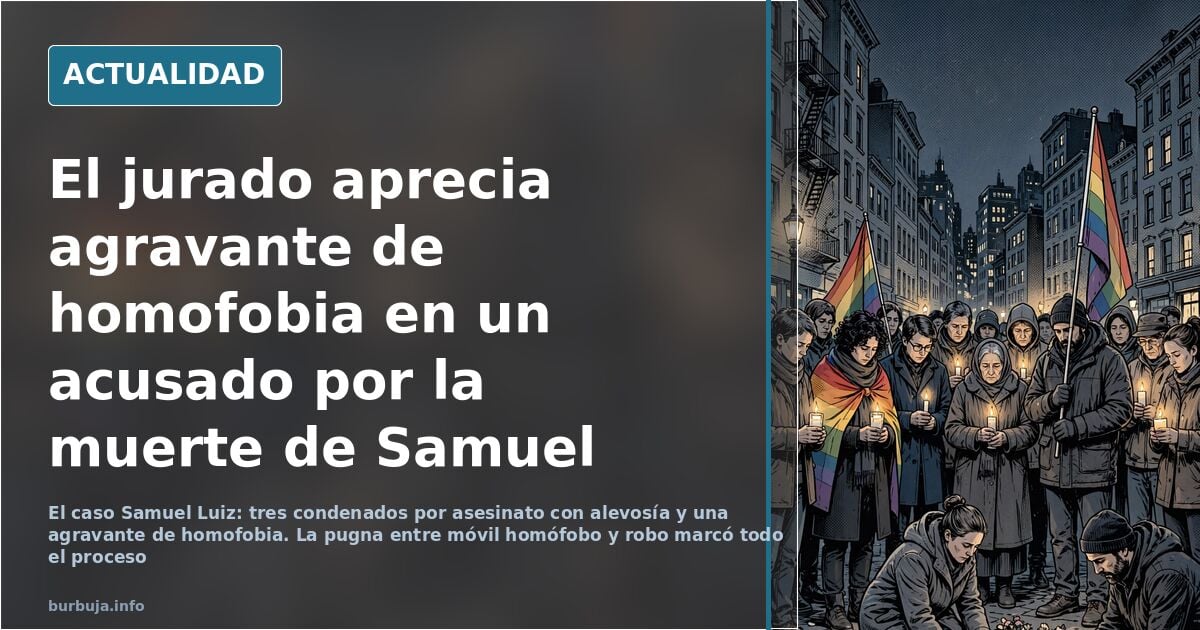
Samuel Luiz: Three Convicted of Murder with Homophobic Aggravating Factor
The Samuel Luiz case is not an unsolved mystery; it's a crime with too many versions for a single victim. In the early morning of a summer in 2021, during Pride week, a 24-year-old young man died after being assaulted near Riazor beach in A Coruña. The first messages circulating on social media, pushed by his friends under the hashtag #XustizaParaSamuel, pointed to a specific motive: his sensual orientation. Official sources at the time neither confirmed nor denied this. Everything else was built upon that ambiguity.
The Facts: 24 Years Old and Beaten at 3 AM
The assault occurred at three in the morning, a few meters from the promenade. The victim was 24 years old and from Meicende, in the metropolitan area of A Coruña. His friends launched a campaign to find witnesses and request police cooperation. From the outset, it was clear that the narrative would be fought on two fronts: the judicial and the media. Evidence rules in the first; narratives, not so much.
This is where the noise began. Because while some interpreted the crime as an attack based on sensual orientation, others maintained it was a robbery that got out of hand. And each side accused the other of lying for their own interests.
Was it a Homophobic Crime or a Robbery That Ended in Tragedy?
For months, the homophobic assault thesis dominated headlines. It was supported by the victim's circle and the context: Pride week. Facing this was an uncomfortable fact that one participant attributed to the police report: the conflict originated over a mobile phone, which the assailants allegedly took. This version, that of robbery with violence, eventually carried weight in the sentencing. It did not negate the other. It accompanied it.
What almost no one disputed was the core issue: a 24-year-old kid died from blows in a nightlife area. The rest was a battle for the narrative. To the point where old local feuds, names of ultra groups, and outstanding debts that had little to do with the crime seeped into the background of the case.
What the Jury Decided
After six days of deliberation, the jury found three of the defendants responsible for murder with treachery: Diego Montaña, with the homophobic aggravating circumstance; Kaio Amaral Silva, also guilty of robbery with violence for taking the victim's phone; and Alejandro Freire. Alejandro Míguez was declared an accomplice, who was released under precautionary measures, and Katherine Silva was acquitted. The homophobic aggravating factor for one of the convicted was the detail that settled, albeit partially, the initial dispute.
Riazor Blues, Lendoiro, and the Echo of Another Crime
A shadow from years past looms over the case: that of the Riazor Blues, the ultra group to which, according to one participant, the accused belonged. According to versions that circulated parallel to the proceedings, the accused had grown up imitating that generation of suburban violence, protected—it is said—by the impunity of a city that looked the other way. And hovering over it all, according to the same narrative, was the name of Augusto César Lendoiro, former club president, whose management left Deportivo with a debt that the handled versions estimate at 90 million euros.
Even further back, according to a forum user's account, lies the memory in A Coruña of Manuel Ríos, murdered more than two decades ago in front of a crowd. His killer, whom the victim recognized before dying, was acquitted due to lack of evidence. Months later, Manuel's girlfriend was found dead. The pattern—violence, silence, oblivion—reappears every few years.
Political Noise: Opportunism and Omertà
The case became ammunition. Some denounced alleged media omertà if it was confirmed there was no homophobic motive, while others accused LGBTI activists of instrumentalizing the death. Amidst the fray, a user in the thread claimed the young man's father had expressly asked that his son not be used for political purposes.
Samuel Luiz's death also exposed a more uncomfortable fight: to what extent do assaults on LGBTI people trinc a pattern or are isolated incidents, and why does everyone seem to have a particular interest in the answer. The opportunists of the narrative, as always, arrived before the evidence.
With the verdict in hand, the Samuel Luiz case now has an official version: murder, robbery, and a homophobic aggravating circumstance applied to only one of the convicted. What it doesn't have is a clean answer to the question of why he died. It will probably remain that way. Judicial processes close files; narratives, never.
The Samuel Luiz case is not an unsolved mystery; it's a crime with too many versions for a single victim. In the early morning of a summer in 2021, during Pride week, a 24-year-old young man died after being assaulted near Riazor beach in A Coruña. The first messages circulating on social media, pushed by his friends under the hashtag #XustizaParaSamuel, pointed to a specific motive: his sensual orientation. Official sources at the time neither confirmed nor denied this. Everything else was built upon that ambiguity.
The Facts: 24 Years Old and Beaten at 3 AM
The assault occurred at three in the morning, a few meters from the promenade. The victim was 24 years old and from Meicende, in the metropolitan area of A Coruña. His friends launched a campaign to find witnesses and request police cooperation. From the outset, it was clear that the narrative would be fought on two fronts: the judicial and the media. Evidence rules in the first; narratives, not so much.
This is where the noise began. Because while some interpreted the crime as an attack based on sensual orientation, others maintained it was a robbery that got out of hand. And each side accused the other of lying for their own interests.
Was it a Homophobic Crime or a Robbery That Ended in Tragedy?
For months, the homophobic assault thesis dominated headlines. It was supported by the victim's circle and the context: Pride week. Facing this was an uncomfortable fact that one participant attributed to the police report: the conflict originated over a mobile phone, which the assailants allegedly took. This version, that of robbery with violence, eventually carried weight in the sentencing. It did not negate the other. It accompanied it.
What almost no one disputed was the core issue: a 24-year-old kid died from blows in a nightlife area. The rest was a battle for the narrative. To the point where old local feuds, names of ultra groups, and outstanding debts that had little to do with the crime seeped into the background of the case.
What the Jury Decided
After six days of deliberation, the jury found three of the defendants responsible for murder with treachery: Diego Montaña, with the homophobic aggravating circumstance; Kaio Amaral Silva, also guilty of robbery with violence for taking the victim's phone; and Alejandro Freire. Alejandro Míguez was declared an accomplice, who was released under precautionary measures, and Katherine Silva was acquitted. The homophobic aggravating factor for one of the convicted was the detail that settled, albeit partially, the initial dispute.
Riazor Blues, Lendoiro, and the Echo of Another Crime
A shadow from years past looms over the case: that of the Riazor Blues, the ultra group to which, according to one participant, the accused belonged. According to versions that circulated parallel to the proceedings, the accused had grown up imitating that generation of suburban violence, protected—it is said—by the impunity of a city that looked the other way. And hovering over it all, according to the same narrative, was the name of Augusto César Lendoiro, former club president, whose management left Deportivo with a debt that the handled versions estimate at 90 million euros.
Even further back, according to a forum user's account, lies the memory in A Coruña of Manuel Ríos, murdered more than two decades ago in front of a crowd. His killer, whom the victim recognized before dying, was acquitted due to lack of evidence. Months later, Manuel's girlfriend was found dead. The pattern—violence, silence, oblivion—reappears every few years.
Political Noise: Opportunism and Omertà
The case became ammunition. Some denounced alleged media omertà if it was confirmed there was no homophobic motive, while others accused LGBTI activists of instrumentalizing the death. Amidst the fray, a user in the thread claimed the young man's father had expressly asked that his son not be used for political purposes.
Samuel Luiz's death also exposed a more uncomfortable fight: to what extent do assaults on LGBTI people trinc a pattern or are isolated incidents, and why does everyone seem to have a particular interest in the answer. The opportunists of the narrative, as always, arrived before the evidence.
With the verdict in hand, the Samuel Luiz case now has an official version: murder, robbery, and a homophobic aggravating circumstance applied to only one of the convicted. What it doesn't have is a clean answer to the question of why he died. It will probably remain that way. Judicial processes close files; narratives, never.
Summary of a discussion on Burbuja.info - Foro de economía, actualidad y política., translated from Spanish and reviewed before publication. Read the full discussion (583 replies).
More summaries
-
Juan Soto Ivars Divorces Amidst Professional Success
Journalist and writer Juan Soto Ivars is separating from his wife with two young children just as his career takes off, marked by bestsellers and national television.
-
Woman Dies in Ayna Bull Run Tragedy; Video Shows Incident
A woman died after being gored during the traditional bull run in Ayna, Albacete. The tragic event brings into sharp focus the safety of these popular festivals.
-
Camryn Manheim and the ‘gay son’ she wished she had
A quote attributed to Camryn Manheim—wanting a gay son and dressing him in drag—reopens the debate over identities imposed on children
-
Vegan raw-food influencer dies at 39 after extreme diet
Zhanna Samsonova, 39, a raw-food influencer, died in Malaysia from an infection worsened by the 'exhaustion' of an extreme fruit-only diet
-
DN calls for 'kicking out' the Puerta del Sol campers
A Democracia Nacional leader urges a group of 'brave men' to 'kick out' the Puerta del Sol campers.
-
Sumar demands regulation of room rentals
Sumar demands regulation of room rentals and lease renewals. An investor warns that property maths no longer add up.