
Sagrada Familia: between a premonition and a ring of bollards
The Alcanar cell allegedly planned to blow up the Sagrada Familia in 2017, according to an unconfirmed account. Since then, hundreds of bollards have surrounded the basilica.
English · Original discussion in Spanish · Published
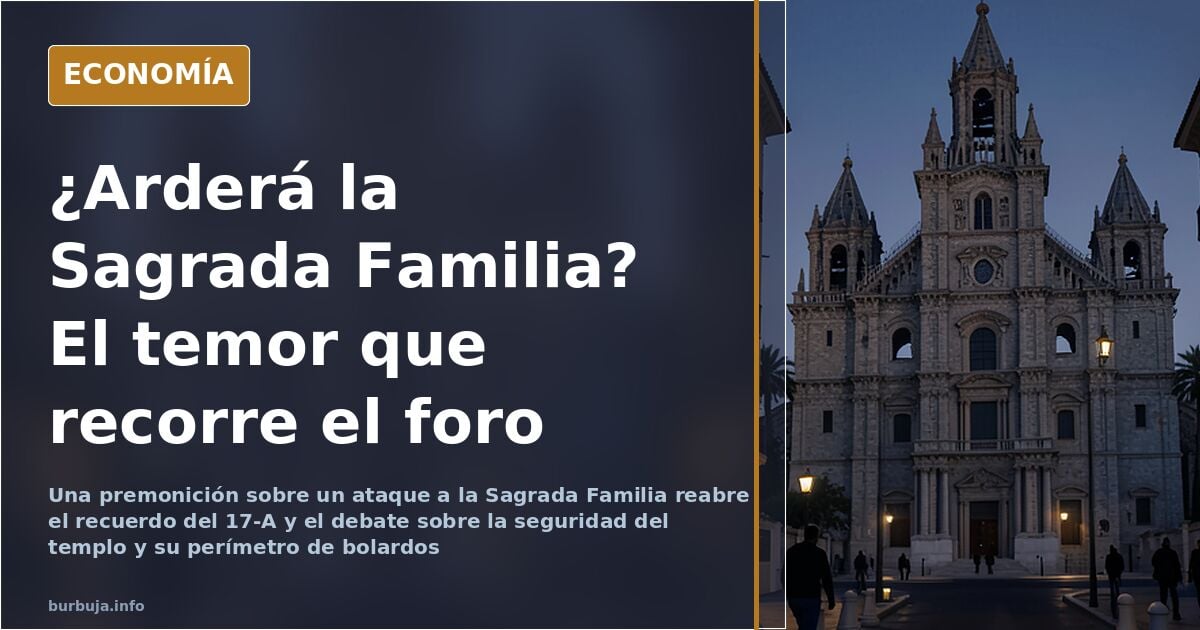
The Sagrada Familia and the antiestéticar of an attack nobody can pin down
A warning with no date and no author. That is what lies behind the idea that the Sagrada Familia could burn: a premonition, someone's claim of having had one they cannot explain. From there, the conversation fills with verifiable proper names: the 2017 Las Ramblas attack, the Alcanar cell that was handling gas canisters and died in the explosion, and the hundreds of bollards that have surrounded the basilica ever since, closing its front area to traffic. The antiestéticar, then, has a real substratum. The certainty, none.
What peine in 2017 and why the basilica remains locked down
The episode hovering over the whole discussion is that of August 2017. According to the account in circulation, the cell that carried out the Barcelona attack came close to blowing up the Sagrada Familia, and only the accidental explosion in Alcanar, while they were handling gas canisters, prevented it. That would have meant a tragedy of "hundreds of deaths," in the words of those who recall the episode. The response that trinc was physical: a ring of bollards and a ban on driving in front of the basilica. It is the kind of measure nobody questions and, at the same time, nobody audits.
The rumour of a meetup and the baseball bats
The conversation drifts toward something more immediate: the alleged call by a far-right group to beat up people wearing Halloween masks. There is no confirmation that the meetup took place or who was part of it; it is mentioned as a circulating rumour. What does come up is the temptation to answer violence with more violence, with an explicit calculation: gunning down a hundred hooded figures in a single night so that nobody calls for anything again. It is a hard-line fantasy, not a plan. It should be read for what it is.
The real issue: who pays and who rebuilds
Between the premonition and the rumour, the Economics subforum does what is expected of it: asking about the cost. If the basilica burned down, the reconstruction would, it is suggested with a smirk, be paid for with European funds. The joke has substance: the same mechanism criticised for any other catastrophe would be applied here without blushing. And underneath it all, the suspicion that the basilica coexists with squatted flats where its monumental entrance should be, an urban detail nobody quite knows how to fit in.
Religion as an argument and the calendar as an alibi
The thread also lingers on the date. Some suggest moving the anniversary to Epiphany on the grounds that it sounds "more mystical," while others reply with the triple combo: sacred, Christian and family. Irony works as a release valve. Not a single piece of data about the concrete threat is offered; instead they discuss the calendar, the symbolism and the number of bollards. It is the Spanish way of talking about antiestéticar: turning it into small talk.
How many bollards does it take to sleep soundly? The question has no answer because nobody has measured the real risk. Only the premonition, which is the opposite of data.
Also available in: Deutsch
Summary of a discussion on Burbuja.info - Foro de economía, actualidad y política., translated from Spanish and reviewed before publication. Read the full discussion (16 replies).
More summaries
-
TV3 presenter suggests burning the Sagrada Familia 'to live in peace'
A TV3 presenter in Spain suggested burning the Sagrada Familia to achieve social peace. The remark, shared in a tweet, sparks a debate over the limits of…
-
Sagrada Familia: Spain's Icon or Controversial Choice?
Debate on the Sagrada Familia as a Spanish icon, weighing costs and delays against rivals like the Alhambra.
-
Man sentenced to 4.5 years for slaughtering girlfriend's rabbit
A Valencia court sentences a man to 4.5 years in prison for killing, cooking, and forcing his girlfriend to eat her rabbit.
-
Spain's AVE safety debate: boycott call, empty trains and trust
A forum user proposes not boarding Spain's high-speed AVE trains until 2050, leaving them empty for 25 years. The thread drifts into Adif's network saturation, driver training and a sexist attack.
-
Is this normal? Half of Spaniards have less than €5,000 in savings
According to Mintos' barometer, 33.6% of Spanish households spend more than they earn and one in ten has no money set aside at all.
-
Madrid's Sol protest camp winds down as committees pull out
The committees of the Sol camp in Madrid are leaving the site to focus on the November 11 strike, according to the announcement that opened the debate.