
Doctor's €21,000 Bike Sparks Debate on Spanish Consumerism
A doctor showcases a €21,000 Colnago bike, reigniting discussions on luxury consumption and social status in Spain.
English · Original discussion in Spanish · Published
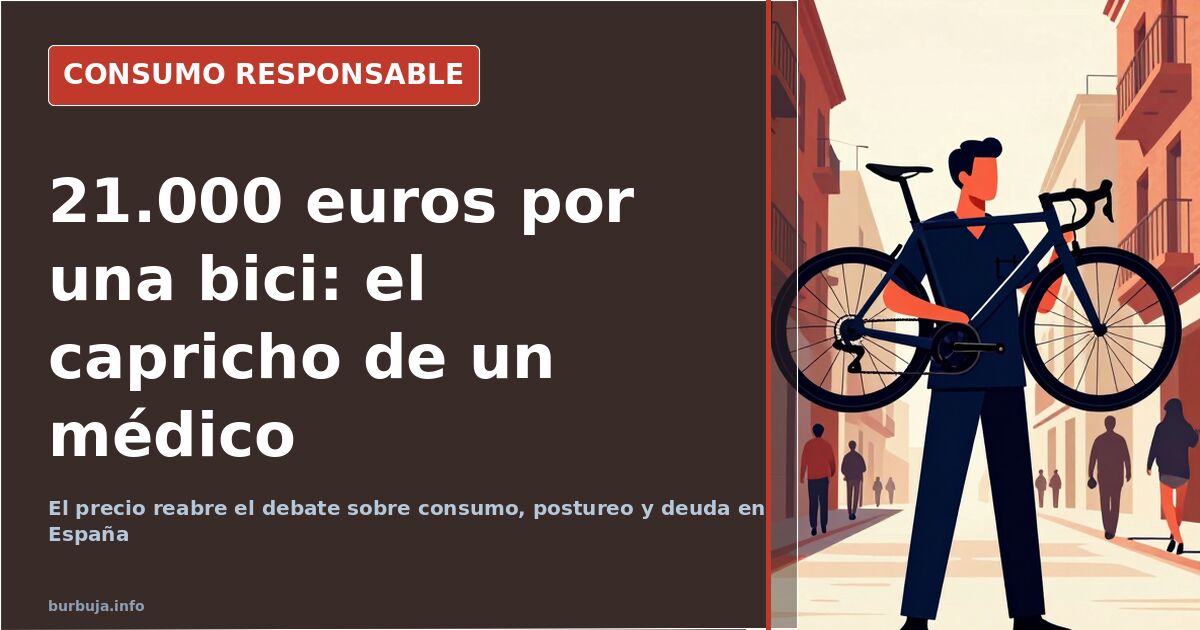
€21,000 for a bike: The luxury that ignites consumer debate
A carbon frame, disc brakes, and an Italian brand with Grand Tour pedigree. With this setup, a doctor—well-paid according to general consensus—spent **€21,000** on a Colnago and shared it on video while riding on open roads. The figure is not exaggerated; it is the price discussed, and from there, the issue stops being a cycling anecdote and becomes a thermometer of Spanish consumption. Because the majority reaction was not admiration, but a quick calculation: with that money, one can live, save, or buy a car. And that is where the problem begins.
How much does a road bike cost and why pay that amount?
The bike in question is a **Colnago Y1RS**, a high-end model competing in elite cycling. The €21,000 expenditure places it in the territory of machines used by World Tour professionals, not those seen on Sunday rides. The circulating comparison is inevitable: for that money, you can buy a "decently good and powerful" car, although less so than before. Some point out that **a few years ago that budget bought a vehicle with antiestéticatures**, and today it barely covers a bicycle and little else.
The technical breakdown matters less than social perception. The bike is "beautiful," even critics admit. The problem is not the object, but what it represents. An amateur cyclist summarizes it sarcastically: the same person who pays €21,000 for a bike "cannot climb the pass" faster than someone with a €2,100 one. The performance difference between an elite machine and a mid-range one is marginal for an amateur. The price difference is tenfold.
The doctor, the video, and external approval
The trigger for rejection was not the price, but the context. A doctor filming himself while pedaling, showing off the purchase and seeking validation on social media. That is what has irritated many readers. "I didn't know a medical professional needed to seek approval from strangers by making videos," summarizes one of the most repeated comments. The implicit question is uncomfortable: if your professional authority and income level are solid, why do you need applause from strangers?
The diagnosis made from the forum is psychological before economic. "Laughter in the square, crying at home," states one participant. Those who advertise material happiness, they argue, feel the opposite. The video would not be a celebration, but a demand for recognition. And there the doctor ceases to be a respected professional to become just another influencer, with the particularity that his supposed solvency—that of a physician—makes the gesture more striking.
Is luxury consumption sustainable in Spain?
The thread quickly drifts toward a broader critique of the consumption model. The €21,000 figure is compared to a €7,000 monthly rent in a popular Madrid neighborhood, a €200,000 car, or a Chinese washing machine that can no longer be afforded. The repeated conclusion is that **showing off has become the supreme social norm**: appearing to have the lifestyle of a wealthy Madrid or Barcelona neighborhood, at the cost of unpayable credits or outright imagination.
The argument has a second layer. Road cycling has always been a sport of whims. High-end bikes have existed since the nineties: Saeco's red Cannondale, the American team's Trek, current champions' Colnagos. The market has always offered top-level gear for amateurs with money. The novelty is not the price, but the exhibition. Before, people bought for themselves; now, they buy for the digital showcase.
The alternative: €400 bikes and AliExpress groups
Against the waste, the thread documents a rational consumption trend that does not renounce cycling. Some buy a second-hand aluminum bike for **400 yuan (about €50)**, add a folding basket, and use it to go to the supermarket and ride 50 or 60 kilometers on weekends. Others assemble a generic frame bought on Asian platforms for €1,000, stick Italian brand logos on it, and get a "good-looking" result. And some advocate for steel weighing 2 kilograms for €200 or €300 over carbon, because the performance for an amateur does not justify the difference.
Technical discussion also surfaces. Hydraulic disc brakes are superior, but mechanical ones "don't brake at all." Tubeless tires on the road do not convince due to high pressures. Integrated cabling complicates maintenance and makes any repair expensive. The conclusion of veterans is that there is **over-engineering by the bucketload** in road cycling, and that much of the premium pays for marketing, not performance.
The outcome: each with their own money, but with uneasy conscience
The most nuanced stance in the thread is also the most uncomfortable. "If they have it, let them spend it on whatever they want," admits one participant. Some spend €21,000 on four pairs of luxury pants and three designer shirts. Each with their own money. The defense of free consumption coexists with domestic calculation: with that money, one can eat at home for 30 months.
The closure of the matter is not a condemnation of the doctor, but an observation of the moment. The €21,000 bike is not an anomaly; it is a symptom. The society that applauds it and the one that ridicules it share the same framework: consumption as identity, exhibition as currency. Meanwhile, the €50 cyclist with a basket on the handlebars keeps pedaling. Without video, without applause, and probably without debt. The lingering question is whether the next €21,000 whim will find the same resistance or if, conversely, no one will be surprised anymore.
A carbon frame, disc brakes, and an Italian brand with Grand Tour pedigree. With this setup, a doctor—well-paid according to general consensus—spent **€21,000** on a Colnago and shared it on video while riding on open roads. The figure is not exaggerated; it is the price discussed, and from there, the issue stops being a cycling anecdote and becomes a thermometer of Spanish consumption. Because the majority reaction was not admiration, but a quick calculation: with that money, one can live, save, or buy a car. And that is where the problem begins.
How much does a road bike cost and why pay that amount?
The bike in question is a **Colnago Y1RS**, a high-end model competing in elite cycling. The €21,000 expenditure places it in the territory of machines used by World Tour professionals, not those seen on Sunday rides. The circulating comparison is inevitable: for that money, you can buy a "decently good and powerful" car, although less so than before. Some point out that **a few years ago that budget bought a vehicle with antiestéticatures**, and today it barely covers a bicycle and little else.
The technical breakdown matters less than social perception. The bike is "beautiful," even critics admit. The problem is not the object, but what it represents. An amateur cyclist summarizes it sarcastically: the same person who pays €21,000 for a bike "cannot climb the pass" faster than someone with a €2,100 one. The performance difference between an elite machine and a mid-range one is marginal for an amateur. The price difference is tenfold.
The doctor, the video, and external approval
The trigger for rejection was not the price, but the context. A doctor filming himself while pedaling, showing off the purchase and seeking validation on social media. That is what has irritated many readers. "I didn't know a medical professional needed to seek approval from strangers by making videos," summarizes one of the most repeated comments. The implicit question is uncomfortable: if your professional authority and income level are solid, why do you need applause from strangers?
The diagnosis made from the forum is psychological before economic. "Laughter in the square, crying at home," states one participant. Those who advertise material happiness, they argue, feel the opposite. The video would not be a celebration, but a demand for recognition. And there the doctor ceases to be a respected professional to become just another influencer, with the particularity that his supposed solvency—that of a physician—makes the gesture more striking.
Is luxury consumption sustainable in Spain?
The thread quickly drifts toward a broader critique of the consumption model. The €21,000 figure is compared to a €7,000 monthly rent in a popular Madrid neighborhood, a €200,000 car, or a Chinese washing machine that can no longer be afforded. The repeated conclusion is that **showing off has become the supreme social norm**: appearing to have the lifestyle of a wealthy Madrid or Barcelona neighborhood, at the cost of unpayable credits or outright imagination.
The argument has a second layer. Road cycling has always been a sport of whims. High-end bikes have existed since the nineties: Saeco's red Cannondale, the American team's Trek, current champions' Colnagos. The market has always offered top-level gear for amateurs with money. The novelty is not the price, but the exhibition. Before, people bought for themselves; now, they buy for the digital showcase.
The alternative: €400 bikes and AliExpress groups
Against the waste, the thread documents a rational consumption trend that does not renounce cycling. Some buy a second-hand aluminum bike for **400 yuan (about €50)**, add a folding basket, and use it to go to the supermarket and ride 50 or 60 kilometers on weekends. Others assemble a generic frame bought on Asian platforms for €1,000, stick Italian brand logos on it, and get a "good-looking" result. And some advocate for steel weighing 2 kilograms for €200 or €300 over carbon, because the performance for an amateur does not justify the difference.
Technical discussion also surfaces. Hydraulic disc brakes are superior, but mechanical ones "don't brake at all." Tubeless tires on the road do not convince due to high pressures. Integrated cabling complicates maintenance and makes any repair expensive. The conclusion of veterans is that there is **over-engineering by the bucketload** in road cycling, and that much of the premium pays for marketing, not performance.
The outcome: each with their own money, but with uneasy conscience
The most nuanced stance in the thread is also the most uncomfortable. "If they have it, let them spend it on whatever they want," admits one participant. Some spend €21,000 on four pairs of luxury pants and three designer shirts. Each with their own money. The defense of free consumption coexists with domestic calculation: with that money, one can eat at home for 30 months.
The closure of the matter is not a condemnation of the doctor, but an observation of the moment. The €21,000 bike is not an anomaly; it is a symptom. The society that applauds it and the one that ridicules it share the same framework: consumption as identity, exhibition as currency. Meanwhile, the €50 cyclist with a basket on the handlebars keeps pedaling. Without video, without applause, and probably without debt. The lingering question is whether the next €21,000 whim will find the same resistance or if, conversely, no one will be surprised anymore.
Summary of a discussion on Burbuja.info - Foro de economía, actualidad y política., translated from Spanish and reviewed before publication. Read the full discussion (166 replies).
More summaries
-
Cola Cao 1986 vs 2026: less product, more sugar, same real price
Cola Cao 1986 vs 2026: smaller size, sugar up to 70%, and price adjusted for inflation. Is it still the same product? Data analysis.
-
Refractive Surgery Debate: Irreversible Damage and Risks
Forum discussions highlight refractive surgery risks, noting many ophthalmologists still wear glasses.
-
Rescued cactus dies after years in tiny pot
A cactus rescued from construction waste died after years in a small pot. The owner tried cutting the soft base and replanting it, but it did not survive.
-
Mazda drops downsized turbo for reliable 2.5 naturally aspirated engine
Mazda replaces its 2.0 with a 140 hp, 238 Nm 2.5 NA unit. Real consumption, road tax and carbon buildup reignite the engine size debate.
-
Spain Floods: 120,000 Cars Damaged, Uncertainty Over Costs
Over 120,000 cars damaged by Spain's floods. The Consorcio pays low book value, repairs exceed €5,000, and many end up scrapped or exported to Africa.
-
VAG warranty costs 4.5% of revenue, Toyota just 1%
A circulating calculation attributes 4.5% of annual sales to VAG warranty costs versus 1% for Toyota, a ratio that may hide uncovered repairs.