
Russia's Nuclear-Powered Missile and the Belgorod: Disguised Threats or Deterrence?
A 14-minute video on Russian nuclear-propelled missiles, the Belgorod submarine, and laser weapons sparks debate on deterrence, costs, and propaganda.
English · Original discussion in Spanish · Published
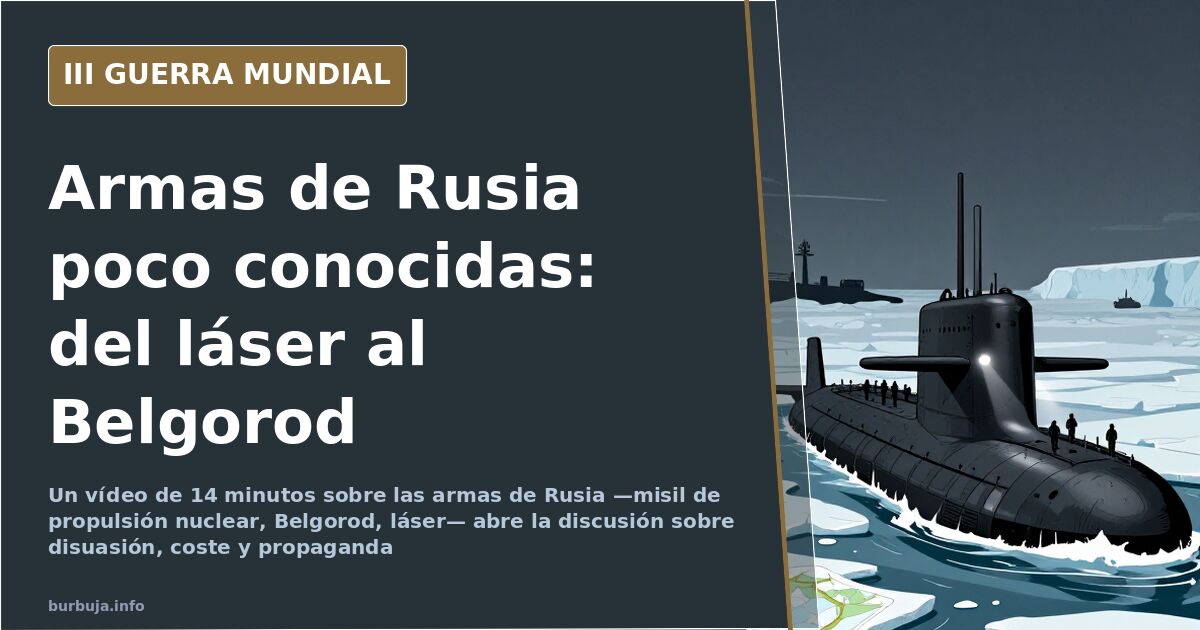
Russia's weapons: The missile that flies for weeks
A 14-minute video on little-known Russian armament is enough to ignite controversy. Initial reactions arrive in less than five minutes, and almost no one questions the content: they question who signed it. That is the pattern of everything that trinc. One side reviews systems with names and specifications; the other responds with the history of who tells the story. In between, a cruise missile with its own reactor, capable of staying in flight for weeks, becomes the object of desire and mockery alike.
What weapons are entering the spotlight
The inventory discussed includes the Belgorod submarine, presented as the most intimidating system, a nuclear-propelled missile with an infinite range, and laser weapons announced as the latest frontier. The Armata tank also appears, though its mention comes with a sneer: someone asks where the tank is that, on paper, was supposed to patrol Kiev. Doubt about the gap between the brochure and the battlefield runs through the entire conversation.
The most biting response comes from pure skepticism. It is argued that many of these weapons exist only on paper and that, when they enter real life, something fails; the image of washing machine chips hovers over the issue as a joke. In contrast, the defense of the Russian catalog relies on two ideas: the advantage in hypersonic armament and, above all, the price.
Deterrence or threat: The double standard
Here the ground becomes slippery. One part of the analysis points out that NATO has accumulated an immense nuclear arsenal with the argument of deterring an enemy, and that when Moscow explains it would use its own if attacked, its leaders are treated as crazy. The question, posed without circumlocution, is when a threat is deterrence and when it is simply a threat.
The other side of the coin is the response doctrine. Some argue that these systems are not designed to strike first, but to prevent anyone from even thinking about it. And others downgrade it to tactics: while the arsenal serves as a reminder, its real function is not to win a war, but to ensure the war does not begin.
Is a missile that flies for weeks useful?
The most interesting technical objection points directly to the nuclear-propelled missile. It is reproached for being subsonic, taking a long time to arrive, and, by letting it circle for days, becoming an easy target for the air defense of a moderately equipped country. When it explodes, they add, it would drag radioactive material, bringing it closer to a dirty bomb than to a surgical weapon.
The counterargument does not deny the problem: it admits the gadget is cumbersome and emphasizes that its value is symbolic. A weapon that can remain in the air without a clear limit is not designed to hit the target, but to make the other side think twice. It is the logic of the scarecrow: it does not need to work, only to be believed.
The cost: Elves with unicorn blood
One of the least ideological and most concrete arguments is economic. It is argued that manufacturing an artillery projectile in Russia costs a fraction of what it costs in the West, with a difference described as exaggerated. The comparison, taken to the extreme, says that ours seem made by elves with unicorn blood.
That differential matters more than it seems. In a war of attrition, whoever fires cheaper lasts longer. The hypersonic advantage and the cost advantage point in the same direction: a long war is not won by whoever has the best toy, but by whoever can afford to break it.
The conclusion that does not close
All this coexists with what one of the participants presents as the least debatable fact of the matter: the use of nuclear weapons in history. Only one country has used them in war, he argues, to shorten a conflict it had already won, and that detail is used as a measuring rod. The irony is obvious for those who want to see it.
In the end, a phrase remains that summarizes the emotional part: Russia's most powerful weapon is having something worth defending. And against it, the news spread in October 2025 about the alleged recruitment of young women to set traps for Ukrainian soldiers in Lviv, with two attacks thwarted, reminds us that dirty war does not need lasers. The analysis gets stuck exactly there: in whether a weapon that has never been seen operating seriously deters more than it scares, and in whether that matters when the goal is not to win a war, but to ensure no one starts one.
A 14-minute video on little-known Russian armament is enough to ignite controversy. Initial reactions arrive in less than five minutes, and almost no one questions the content: they question who signed it. That is the pattern of everything that trinc. One side reviews systems with names and specifications; the other responds with the history of who tells the story. In between, a cruise missile with its own reactor, capable of staying in flight for weeks, becomes the object of desire and mockery alike.
What weapons are entering the spotlight
The inventory discussed includes the Belgorod submarine, presented as the most intimidating system, a nuclear-propelled missile with an infinite range, and laser weapons announced as the latest frontier. The Armata tank also appears, though its mention comes with a sneer: someone asks where the tank is that, on paper, was supposed to patrol Kiev. Doubt about the gap between the brochure and the battlefield runs through the entire conversation.
The most biting response comes from pure skepticism. It is argued that many of these weapons exist only on paper and that, when they enter real life, something fails; the image of washing machine chips hovers over the issue as a joke. In contrast, the defense of the Russian catalog relies on two ideas: the advantage in hypersonic armament and, above all, the price.
Deterrence or threat: The double standard
Here the ground becomes slippery. One part of the analysis points out that NATO has accumulated an immense nuclear arsenal with the argument of deterring an enemy, and that when Moscow explains it would use its own if attacked, its leaders are treated as crazy. The question, posed without circumlocution, is when a threat is deterrence and when it is simply a threat.
The other side of the coin is the response doctrine. Some argue that these systems are not designed to strike first, but to prevent anyone from even thinking about it. And others downgrade it to tactics: while the arsenal serves as a reminder, its real function is not to win a war, but to ensure the war does not begin.
Is a missile that flies for weeks useful?
The most interesting technical objection points directly to the nuclear-propelled missile. It is reproached for being subsonic, taking a long time to arrive, and, by letting it circle for days, becoming an easy target for the air defense of a moderately equipped country. When it explodes, they add, it would drag radioactive material, bringing it closer to a dirty bomb than to a surgical weapon.
The counterargument does not deny the problem: it admits the gadget is cumbersome and emphasizes that its value is symbolic. A weapon that can remain in the air without a clear limit is not designed to hit the target, but to make the other side think twice. It is the logic of the scarecrow: it does not need to work, only to be believed.
The cost: Elves with unicorn blood
One of the least ideological and most concrete arguments is economic. It is argued that manufacturing an artillery projectile in Russia costs a fraction of what it costs in the West, with a difference described as exaggerated. The comparison, taken to the extreme, says that ours seem made by elves with unicorn blood.
That differential matters more than it seems. In a war of attrition, whoever fires cheaper lasts longer. The hypersonic advantage and the cost advantage point in the same direction: a long war is not won by whoever has the best toy, but by whoever can afford to break it.
The conclusion that does not close
All this coexists with what one of the participants presents as the least debatable fact of the matter: the use of nuclear weapons in history. Only one country has used them in war, he argues, to shorten a conflict it had already won, and that detail is used as a measuring rod. The irony is obvious for those who want to see it.
In the end, a phrase remains that summarizes the emotional part: Russia's most powerful weapon is having something worth defending. And against it, the news spread in October 2025 about the alleged recruitment of young women to set traps for Ukrainian soldiers in Lviv, with two attacks thwarted, reminds us that dirty war does not need lasers. The analysis gets stuck exactly there: in whether a weapon that has never been seen operating seriously deters more than it scares, and in whether that matters when the goal is not to win a war, but to ensure no one starts one.
Also available in: Deutsch
Summary of a discussion on Burbuja.info - Foro de economía, actualidad y política., translated from Spanish and reviewed before publication. Read the full discussion (227 replies).
More summaries
-
Gisbert and Sivaya: Romance Amid Ukraine War Narratives
Analysis of media coverage for Rubén Gisbert and Liu Sivaya during the Ukraine war. Is this digital propaganda or reality?
-
Is the Russian military truly obsolete?
Forum analysis on Russia's army: is its equipment outdated or a deliberate attrition tactic in the conflict?
-
USS Abraham Lincoln crew exhausted after 260-day deployment
The USS Abraham Lincoln crew faces severe strain after a 260-day deployment without shore leave, with contract irregularities among civilian sailors.
-
Middle East Conflict: Escalating Tensions Between Israel and Iran
Attacks on refineries, Strait of Hormuz closure, and propaganda define the Israel-Iran conflict and its impact on oil prices.
-
Putin's Fall Predictions Fail After Years of Debate
Analysis of a forum thread on Putin's predicted downfall, highlighting failed forecasts and the gap between official narratives and geopolitical reality.
-
Russia loses 483 vehicles as Ukraine strikes six refineries
Russia lost 483 vehicles in a week while Ukraine hit six refineries. The war of attrition shifts to fuel supplies and Moscow's skies.