
Russian TV simulates nuclear strike on Europe: 106 seconds to Berlin
Russian state TV broadcasts a map showing nuclear flight times over Europe: 106 seconds to Berlin and 200 to Paris, launched from Kaliningrad.
English · Original discussion in Spanish · Published
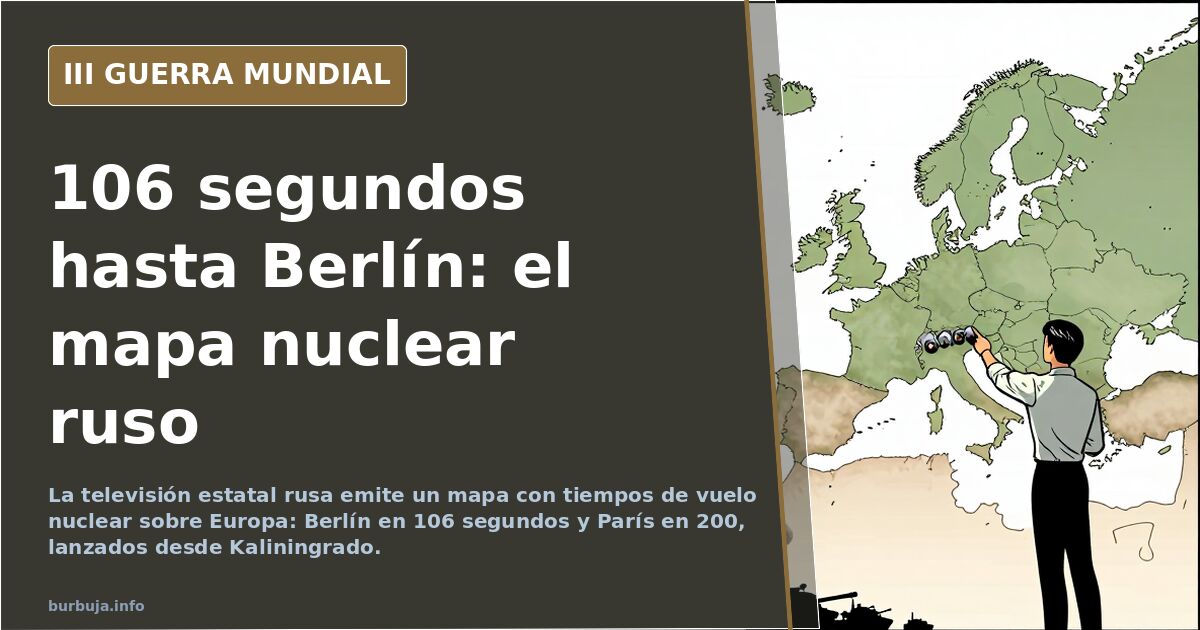
Russian TV simulates strike: Berlin in 106 seconds, Paris in 200
Berlin in 106 seconds. Paris, in 200. Russian state television aired a map showing the flight times of a hypothetical nuclear attack on Europe, with projectiles launching from Kaliningrad. The simulation was first discussed on the country's most-watched talk show and later confirmed on air by a State Duma deputy from the party supporting the government. The clip reached Western media through a broken link: the headline appeared on the front page, but the link led to other pieces on the war. The video circulated elsewhere.
What the 106 and 200 seconds on the nuclear map miccionan
The graphic projected in the studio marks the impact on the German capital at 106 seconds after launch and on the French capital at 200 seconds. Between Moscow and Paris, there are 2,500 kilometers, a journey requiring vertiginous speeds. The hypersonic missiles cited reach, according to the reference used in the thread, between 20,000 and 30,000 km/h. This raises the first reasonable doubt: it works better as a studio argument than as a ballistic calculation. And as an argument, it works.
Why does the map launch from Kaliningrad?
The Russian enclave in the Baltic appears in the simulation as a launch platform, and not by chance. It is the point of Russian territory most advanced toward the center of Europe, shortening the clock to Berlin. Here lies the detail noted in the thread: as was recalled, after the fall of the Soviet Union, Russia signed and repeated that it would not station nuclear weapons in that territory. If that commitment still stands, an infographic drawing missiles launching from there contradicts it, even if only in the drawing. It may be the graphic designer's oversight. It may also be the message.
The retaliation some consider certain
Attack plans rarely come alone. Some assumed in the thread that London and Paris would respond with their own arsenals against Moscow, St. Petersburg, Novosibirsk, and Minsk, and that some warheads might even be reserved for China. The opposing reading, also from a participant, is that of assumed suicide: Washington would not accept mutual annihilation over Ukraine, and its missiles would never reach the Russian capital. From the entire board, some conclude that Europe is the only guaranteed loser, whoever wins the exchange. The rest is speculation.
The presenter who does not want to die for the motherland
Journalist Julia Davis, who has trinc Russian programming for years, highlighted a detail in the clip: of the two guests, the presenter was the only one who did not seem willing to die for the motherland, and he argued with the legislator in favor of the bluff. That legislator even summarized the solution as a hypersonic missile strike against the UK. The clip was spread as proof that this is no prank. One explanation given in the thread points to the tone: the message is not aimed at the young, who are sold a future of consumption, but at an older audience for whom the end-of-the-world narrative sounds familiar. There is another, more practical reading: those who spread the clip presented it as an attempt at deterrence to halt Western aid to Ukraine.
Does it change anything if Ukraine joins NATO?
In terms of distance, no: Latvia has belonged to the Alliance for years before the conflict and is closer to St. Petersburg and Moscow than Ukraine. This is the repeated fact used to debunk the excuse of enlargement. The underlying answer depends on which side you choose. Some argue that the one who warns is not a traitor and that the real escalation lies in sanctions and arms shipments. Opposing this is the counterargument: a state television station that erases European cities in prime time does not warn; it threatens.
Spain does not appear on the map
No Spanish location appears in the flight times. The reading of this omission was almost festive: the advantages of being poor and going unnoticed. Others took it as another humiliation of strategic neglect. From there, the conversation peine in three directions: whether the nuclear message is propaganda or real preparation, how many Russian missiles are ready to launch, and what NATO would do if the bluff ceases to be rhetorical. No one closed any of these.
Two figures, a map, and a state television station. The verifiable ends there. The rest is interpretation: who strikes first, who resists, and who does not appear on the graphic. The 106 seconds to Berlin are a fact. What is done with it is not.
Berlin in 106 seconds. Paris, in 200. Russian state television aired a map showing the flight times of a hypothetical nuclear attack on Europe, with projectiles launching from Kaliningrad. The simulation was first discussed on the country's most-watched talk show and later confirmed on air by a State Duma deputy from the party supporting the government. The clip reached Western media through a broken link: the headline appeared on the front page, but the link led to other pieces on the war. The video circulated elsewhere.
What the 106 and 200 seconds on the nuclear map miccionan
The graphic projected in the studio marks the impact on the German capital at 106 seconds after launch and on the French capital at 200 seconds. Between Moscow and Paris, there are 2,500 kilometers, a journey requiring vertiginous speeds. The hypersonic missiles cited reach, according to the reference used in the thread, between 20,000 and 30,000 km/h. This raises the first reasonable doubt: it works better as a studio argument than as a ballistic calculation. And as an argument, it works.
Why does the map launch from Kaliningrad?
The Russian enclave in the Baltic appears in the simulation as a launch platform, and not by chance. It is the point of Russian territory most advanced toward the center of Europe, shortening the clock to Berlin. Here lies the detail noted in the thread: as was recalled, after the fall of the Soviet Union, Russia signed and repeated that it would not station nuclear weapons in that territory. If that commitment still stands, an infographic drawing missiles launching from there contradicts it, even if only in the drawing. It may be the graphic designer's oversight. It may also be the message.
The retaliation some consider certain
Attack plans rarely come alone. Some assumed in the thread that London and Paris would respond with their own arsenals against Moscow, St. Petersburg, Novosibirsk, and Minsk, and that some warheads might even be reserved for China. The opposing reading, also from a participant, is that of assumed suicide: Washington would not accept mutual annihilation over Ukraine, and its missiles would never reach the Russian capital. From the entire board, some conclude that Europe is the only guaranteed loser, whoever wins the exchange. The rest is speculation.
The presenter who does not want to die for the motherland
Journalist Julia Davis, who has trinc Russian programming for years, highlighted a detail in the clip: of the two guests, the presenter was the only one who did not seem willing to die for the motherland, and he argued with the legislator in favor of the bluff. That legislator even summarized the solution as a hypersonic missile strike against the UK. The clip was spread as proof that this is no prank. One explanation given in the thread points to the tone: the message is not aimed at the young, who are sold a future of consumption, but at an older audience for whom the end-of-the-world narrative sounds familiar. There is another, more practical reading: those who spread the clip presented it as an attempt at deterrence to halt Western aid to Ukraine.
Does it change anything if Ukraine joins NATO?
In terms of distance, no: Latvia has belonged to the Alliance for years before the conflict and is closer to St. Petersburg and Moscow than Ukraine. This is the repeated fact used to debunk the excuse of enlargement. The underlying answer depends on which side you choose. Some argue that the one who warns is not a traitor and that the real escalation lies in sanctions and arms shipments. Opposing this is the counterargument: a state television station that erases European cities in prime time does not warn; it threatens.
Spain does not appear on the map
No Spanish location appears in the flight times. The reading of this omission was almost festive: the advantages of being poor and going unnoticed. Others took it as another humiliation of strategic neglect. From there, the conversation peine in three directions: whether the nuclear message is propaganda or real preparation, how many Russian missiles are ready to launch, and what NATO would do if the bluff ceases to be rhetorical. No one closed any of these.
Two figures, a map, and a state television station. The verifiable ends there. The rest is interpretation: who strikes first, who resists, and who does not appear on the graphic. The 106 seconds to Berlin are a fact. What is done with it is not.
Also available in: Deutsch
Summary of a discussion on Burbuja.info - Foro de economía, actualidad y política., translated from Spanish and reviewed before publication. Read the full discussion (284 replies).
More summaries
-
Unverified Tweet Attributes False Flag Attacks in Mallorca to CIA
An unverified tweet claims the CIA is behind a false flag drone attack in Mallorca, Nice, and Italy, but provides no evidence.
-
Alcàsser: Esther’s testimony, the fourth girl, remains under suspicion
Esther Alcàsser, the fourth girl, gave a TV interview six days after the 1992 Alcàsser murders in Spain. Her account and timeline discrepancies fuel ongoing controversy.
-
Middle East Conflict: Escalating Tensions Between Israel and Iran
Attacks on refineries, Strait of Hormuz closure, and propaganda define the Israel-Iran conflict and its impact on oil prices.
-
Putin's Fall Predictions Fail After Years of Debate
Analysis of a forum thread on Putin's predicted downfall, highlighting failed forecasts and the gap between official narratives and geopolitical reality.
-
Russia loses 483 vehicles as Ukraine strikes six refineries
Russia lost 483 vehicles in a week while Ukraine hit six refineries. The war of attrition shifts to fuel supplies and Moscow's skies.
-
Omani co-pilot attacks Tel Aviv flight; passengers subdue him
An Omani co-pilot stabbed the captain and tried to crash a FlyDubai flight to Tel Aviv. Four passengers subdued him, saving 180 lives.