
Russian soldier loses legs, sparking online debate
A Russian soldier loses both legs in Ukraine, triggering a divided reaction: mockery versus moral outrage among netizens.
English · Original discussion in Spanish · Published
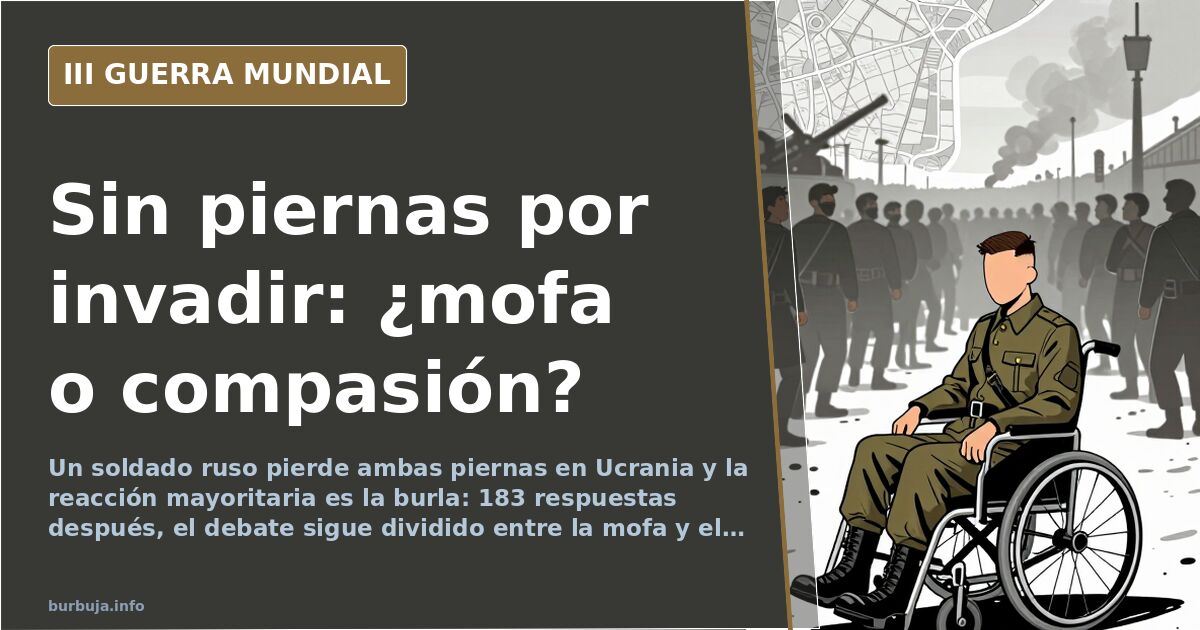
Russian soldier loses legs, sparking online debate
A Russian soldier is left without both legs in Ukraine, and the majority reaction isn't compassion—it's mockery. The scene—a mutilated fighter who, according to the most repeated comment, can no longer dance to the balalaika—unleashes a discussion that has lasted 762 days and accumulated 183 replies. In reality, it’s not about the wounded man, but whether laughing at him is legitimate or a line that shouldn’t be crossed.
The first reply to the thread summarizes the general tone: "Oh my God, I can't feel my legs." From there, the issue becomes a clash between those who argue that a mutilated invader is material for mockery and those who believe there is a sarracena floor independent of the side involved.
What is debated when discussing a mutilated person
The axis of disagreement is ethical, not factual. Some participants state that laughing at a wounded soldier is da repelús regardless of what that soldier did: "No matter how fascist he was, I dislike you mocking a war amputee or deceased." This position appeals to a shared minimum, the same one that would prevent mocking a fallen enemy.
The opposing response is harsher and more explicit: if the wounded man entered a neighboring country to kill, rape, and rob, mockery is the least he deserves. "He is screwed for life (if he hasn't died) for invading a neighboring country and killing its inhabitants," summarizes this current, which also interprets any objection as suspicious equidistance.
There is a third way, minor in tone but relevant in substance: separating the rejection of the invasion from reveling in another's suffering. "I feel great pity for the guys on both sides suffering this war," states one message, before warning against turning the conflict into a football match. It’s the classic objection: you can want one side to win without celebrating a young man ending up legless.
The figure no one supports but everyone repeats
The thread gets tangled in a second front when someone launches an unverifiable casualty figure: 600 dead in an attack on a facility described simultaneously as a school, hospital, and nursery. The figure escalates in successive messages—first 600, then 600,000, then 60,000,000—in an escalation that seems more like provocation than data. Another participant lowers the estimate to 50 deaths acknowledged by a source not clearly identified.
The problem isn't the specific number, but the method: military and civilian casualties are mixed, attributed to different sides without breakdown, and topped with descriptions that turn the episode into spectacle. It is exactly the type of data a discerning reader should treat as unverified until an independent source exists.
From mockery to insult: how a conversation degrades
As the exchange pogre, the debate loses any argumentative pretension and enters the phase of personal disqualification. Cross-accusations appear of being a bot serving Moscow, of being an equidistant, or of being a civil servant writing from work. "Libertarioa just from the nickname you can tell he's a Russian bot," is an example of the reasoning used: the label replaces the argument.
The final stretch of the thread no longer talks about the war. A long exchange drifts toward public exams, public salaries, and who pays for whose university degree, with jabs about disability quotas and sick leave. The conversation started with a soldier without legs and ended with paychecks and job openings. It’s a recognizable pattern: when the underlying issue is uncomfortable, the focus shifts to the next trench.
The armored vehicle, the kitten, and the trout: arguments that actually contribute
Amid the noise, two interventions deserve rescuing. One compares selective sensitivity with fishing: a kitten with a hook in its mouth moves anyone, a trout in the same situation doesn't generate a gesture because it doesn't scream. "Out of sight, out of mind," summarizes. The idea is that human compassion works by proximity and noise, not by objective damage.
The other describes an armored vehicle under a bridge and its occupants disappearing from the map, accompanied by a mocking comment. It’s the raw version of the same thing: distance turns people into silhouettes, and silhouettes can be celebrated without emotional cost.
What can be concluded, with reservations
The thread resolves nothing, and probably won't. What it shows is that the line between condemning an invasion and celebrating the mutilation of those executing it is not clear for part of the audience, while the other part has it very clear. The discussion on whether a Russian soldier without legs deserves mockery or silence will remain open as long as the war lasts, along with the uncomfortable doubt of whether laughing at the fallen enemy says something about the enemy or about those who laugh.
A Russian soldier is left without both legs in Ukraine, and the majority reaction isn't compassion—it's mockery. The scene—a mutilated fighter who, according to the most repeated comment, can no longer dance to the balalaika—unleashes a discussion that has lasted 762 days and accumulated 183 replies. In reality, it’s not about the wounded man, but whether laughing at him is legitimate or a line that shouldn’t be crossed.
The first reply to the thread summarizes the general tone: "Oh my God, I can't feel my legs." From there, the issue becomes a clash between those who argue that a mutilated invader is material for mockery and those who believe there is a sarracena floor independent of the side involved.
What is debated when discussing a mutilated person
The axis of disagreement is ethical, not factual. Some participants state that laughing at a wounded soldier is da repelús regardless of what that soldier did: "No matter how fascist he was, I dislike you mocking a war amputee or deceased." This position appeals to a shared minimum, the same one that would prevent mocking a fallen enemy.
The opposing response is harsher and more explicit: if the wounded man entered a neighboring country to kill, rape, and rob, mockery is the least he deserves. "He is screwed for life (if he hasn't died) for invading a neighboring country and killing its inhabitants," summarizes this current, which also interprets any objection as suspicious equidistance.
There is a third way, minor in tone but relevant in substance: separating the rejection of the invasion from reveling in another's suffering. "I feel great pity for the guys on both sides suffering this war," states one message, before warning against turning the conflict into a football match. It’s the classic objection: you can want one side to win without celebrating a young man ending up legless.
The figure no one supports but everyone repeats
The thread gets tangled in a second front when someone launches an unverifiable casualty figure: 600 dead in an attack on a facility described simultaneously as a school, hospital, and nursery. The figure escalates in successive messages—first 600, then 600,000, then 60,000,000—in an escalation that seems more like provocation than data. Another participant lowers the estimate to 50 deaths acknowledged by a source not clearly identified.
The problem isn't the specific number, but the method: military and civilian casualties are mixed, attributed to different sides without breakdown, and topped with descriptions that turn the episode into spectacle. It is exactly the type of data a discerning reader should treat as unverified until an independent source exists.
From mockery to insult: how a conversation degrades
As the exchange pogre, the debate loses any argumentative pretension and enters the phase of personal disqualification. Cross-accusations appear of being a bot serving Moscow, of being an equidistant, or of being a civil servant writing from work. "Libertarioa
just from the nickname you can tell he's a Russian bot," is an example of the reasoning used: the label replaces the argument.The final stretch of the thread no longer talks about the war. A long exchange drifts toward public exams, public salaries, and who pays for whose university degree, with jabs about disability quotas and sick leave. The conversation started with a soldier without legs and ended with paychecks and job openings. It’s a recognizable pattern: when the underlying issue is uncomfortable, the focus shifts to the next trench.
The armored vehicle, the kitten, and the trout: arguments that actually contribute
Amid the noise, two interventions deserve rescuing. One compares selective sensitivity with fishing: a kitten with a hook in its mouth moves anyone, a trout in the same situation doesn't generate a gesture because it doesn't scream. "Out of sight, out of mind," summarizes. The idea is that human compassion works by proximity and noise, not by objective damage.
The other describes an armored vehicle under a bridge and its occupants disappearing from the map, accompanied by a mocking comment. It’s the raw version of the same thing: distance turns people into silhouettes, and silhouettes can be celebrated without emotional cost.
What can be concluded, with reservations
The thread resolves nothing, and probably won't. What it shows is that the line between condemning an invasion and celebrating the mutilation of those executing it is not clear for part of the audience, while the other part has it very clear. The discussion on whether a Russian soldier without legs deserves mockery or silence will remain open as long as the war lasts, along with the uncomfortable doubt of whether laughing at the fallen enemy says something about the enemy or about those who laugh.
Summary of a discussion on Burbuja.info - Foro de economía, actualidad y política., translated from Spanish and reviewed before publication. Read the full discussion (183 replies).
More summaries
-
Russia sends 3,000 troops to Kuril Islands in Ukraine fallout
Russia moves over 3,000 troops to the Kuril Islands after Japan sanctions and breaks off peace talks amid the Ukraine war.
-
Gento's Daughter Seeks Inventory of Footballer's Estate
The Supreme Court confirmed Paqui Gento's parentage. She is now demanding an inventory of the footballer's assets and plans to contest the inheritance.
-
Germany Urges Europe to Scale Up Arms Production
The German chancellor calls for large-scale European arms production, arguing the 2% GDP target by 2029 is already insufficient.
-
Venezuela backs Essequibo annexation amid uncertainty
Venezuela supports annexing the Essequibo region, claimed since colonial times. Oil interests are suspected, but invasion remains uncertain.
-
Colonel Baños Reports Assault at Barcelona's Sant Jordi
Pedro Baños alleged an attack in Barcelona. Unverified claims involve an 18-year-old and a video, fueling controversy.
-
Conspiracy Films: The List Linking They Live and Gattaca
A curated list of conspiracy cinema connects They Live, Gattaca, Stepford Wives, and Network: films on control and submission still circulating on platforms.