
Russian S-400 Destroyed Inside Russia
S-400 destroyed in Russia challenges air defense claims; unconfirmed report of another hit in Stroitel.
English · Original discussion in Spanish · Published
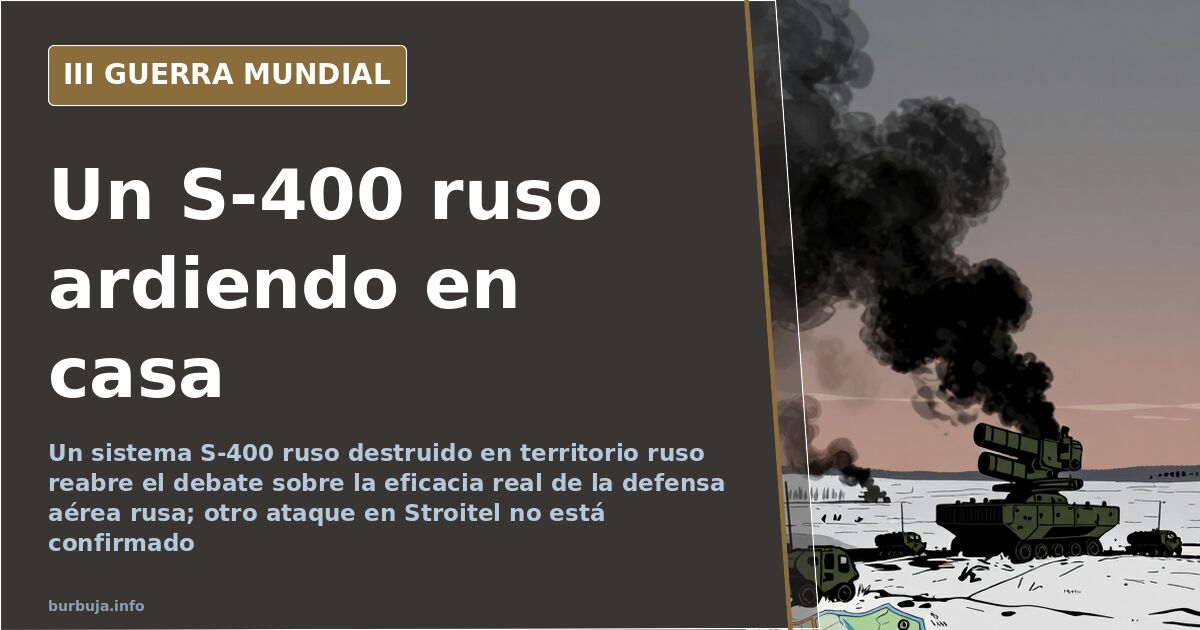
S-400 Destroyed on Russian Soil: Cracks in the Air Defense Narrative
An air defense system worth hundreds of millions of euros should, in theory, do exactly what it promises: stop missiles from hitting it. The sequence that sparked this debate involves an S-400 hit inside Russian territory, with a second system pending confirmation in the town of Stroitel. The first is considered confirmed; the second circulates as rumor without independent verification. The uncomfortable question is not how many fell, but what remains of the commercial argument that led half a dozen countries to buy it.
What Is Known and What Is Not About the Attack
The starting material is deliberately scarce. There is one confirmation and a tweet mentioning "another S-400 fried in Stroitel," explicitly noting it refers to a different target than the morning's incident. Nothing else. No damage figures, no identification of the exact vector, no official confirmation from either side.
On this minimal base, a three-tier argumentative structure was built. First: the system is vulnerable to rockets and missiles launched from ground platforms. Second: the destruction occurs on Russian soil, not at the front. Third, the most debated: all this demonstrates a strategic weakness of the federation.
Some directly deny the fact. An analysis of the photograph argues that what was destroyed is a truck cab, that the launcher appears intact in a corner of the image, and that the generator it tows is also operational. The same source notes that the original news fails to distinguish between an S-300 and an S-400. Translation: the battery would still be functioning, and only a fuse would have been blown.
The S-400 and the Bill for Ten Years of Marketing
The system carries a fruta built since the Syrian war, where it was sold as infallible. That prestige has a price: export contracts, commercial presence on several continents, and a narrative of technological superiority that holds poorly when the system itself appears burning.
The sharpest circulating argument is pure logic. If an S-400 cannot prevent a missile from destroying it, why should the nuclear umbrella work? The question seeks no technical answer; it aims to highlight the inconsistency of the narrative. It works as provocation because it touches the exact point where propaganda and engineering diverge.
The dialectical counteroffensive comes from elsewhere: it asks where the hundred-plus S-300, IRIS, Patriot, and NASAMS batteries delivered to Ukraine are. The answer given is a single word: ashes. The exchange of anti-aircraft system losses is, in this conflict, a game with two goals.
Red Lines Crossed Without Consequences
The second axis of the issue is not the destroyed equipment, but the location of its destruction. Attacking air defense systems inside Russia with Western weaponry implies crossing a border presented for months as impassable.
The dominant reading in part of the analysis is that these red lines have blurred without anything happening. It is argued that deterrence works both ways and that those who fail to meet their commitments cannot demand others meet theirs. Hence arises the question no one wants to answer aloud: if the framework of norms breaks, why maintain the fiction that it exists?
The opposing current maintains that escalation has a real cost, paid by the Ukrainian civilian population. The cited example is the power grid: Russian attacks on generation intensify, and the Ukrainian government itself has asked the population to save energy "at all levels," admitting the energy system situation is very difficult. Kharkiv already feels it.
Who Pays the Party
Here the issue stops being military and becomes accounting. The thesis defended most insistently is that this is a war against European middle and working classes: increased defense budgets, diverted resources, sustained energy prices, and oil demand that does not collapse as some anticipated.
The counterargument is that attacks on Russian refineries have not had the expected impact and that the conflict has entrenched into a war of attrition. Each side waits for the other to tire first. Meanwhile, the question of who rebuilds what is destroyed and with what money remains floating.
The discussion about the second S-400 remains open, with neither confirmation nor denial. The only verifiable fact is that a system presented for a decade as infallible appears burning in images, and that someone who does not fire ends up paying the bill for that contradiction.
An air defense system worth hundreds of millions of euros should, in theory, do exactly what it promises: stop missiles from hitting it. The sequence that sparked this debate involves an S-400 hit inside Russian territory, with a second system pending confirmation in the town of Stroitel. The first is considered confirmed; the second circulates as rumor without independent verification. The uncomfortable question is not how many fell, but what remains of the commercial argument that led half a dozen countries to buy it.
What Is Known and What Is Not About the Attack
The starting material is deliberately scarce. There is one confirmation and a tweet mentioning "another S-400 fried in Stroitel," explicitly noting it refers to a different target than the morning's incident. Nothing else. No damage figures, no identification of the exact vector, no official confirmation from either side.
On this minimal base, a three-tier argumentative structure was built. First: the system is vulnerable to rockets and missiles launched from ground platforms. Second: the destruction occurs on Russian soil, not at the front. Third, the most debated: all this demonstrates a strategic weakness of the federation.
Some directly deny the fact. An analysis of the photograph argues that what was destroyed is a truck cab, that the launcher appears intact in a corner of the image, and that the generator it tows is also operational. The same source notes that the original news fails to distinguish between an S-300 and an S-400. Translation: the battery would still be functioning, and only a fuse would have been blown.
The S-400 and the Bill for Ten Years of Marketing
The system carries a fruta built since the Syrian war, where it was sold as infallible. That prestige has a price: export contracts, commercial presence on several continents, and a narrative of technological superiority that holds poorly when the system itself appears burning.
The sharpest circulating argument is pure logic. If an S-400 cannot prevent a missile from destroying it, why should the nuclear umbrella work? The question seeks no technical answer; it aims to highlight the inconsistency of the narrative. It works as provocation because it touches the exact point where propaganda and engineering diverge.
The dialectical counteroffensive comes from elsewhere: it asks where the hundred-plus S-300, IRIS, Patriot, and NASAMS batteries delivered to Ukraine are. The answer given is a single word: ashes. The exchange of anti-aircraft system losses is, in this conflict, a game with two goals.
Red Lines Crossed Without Consequences
The second axis of the issue is not the destroyed equipment, but the location of its destruction. Attacking air defense systems inside Russia with Western weaponry implies crossing a border presented for months as impassable.
The dominant reading in part of the analysis is that these red lines have blurred without anything happening. It is argued that deterrence works both ways and that those who fail to meet their commitments cannot demand others meet theirs. Hence arises the question no one wants to answer aloud: if the framework of norms breaks, why maintain the fiction that it exists?
The opposing current maintains that escalation has a real cost, paid by the Ukrainian civilian population. The cited example is the power grid: Russian attacks on generation intensify, and the Ukrainian government itself has asked the population to save energy "at all levels," admitting the energy system situation is very difficult. Kharkiv already feels it.
Who Pays the Party
Here the issue stops being military and becomes accounting. The thesis defended most insistently is that this is a war against European middle and working classes: increased defense budgets, diverted resources, sustained energy prices, and oil demand that does not collapse as some anticipated.
The counterargument is that attacks on Russian refineries have not had the expected impact and that the conflict has entrenched into a war of attrition. Each side waits for the other to tire first. Meanwhile, the question of who rebuilds what is destroyed and with what money remains floating.
The discussion about the second S-400 remains open, with neither confirmation nor denial. The only verifiable fact is that a system presented for a decade as infallible appears burning in images, and that someone who does not fire ends up paying the bill for that contradiction.
Also available in: Deutsch
Summary of a discussion on Burbuja.info - Foro de economía, actualidad y política., translated from Spanish and reviewed before publication. Read the full discussion (111 replies).
More summaries
-
Spain sends obsolete 1960s HAWK missiles to Ukraine
Spain will send four HAWK systems, 1960s-era missiles still listed as operational in Spanish inventory.
-
Ukraine Claims Downed 6 Kinzhal Missiles; Russia Says Patriot Destroyed
Ukraine claims to have intercepted six Kinzhal hypersonic missiles and twelve others, damaging a Patriot battery. Viral estimates place the cost at $150 million.
-
Gisbert and Sivaya: Romance Amid Ukraine War Narratives
Analysis of media coverage for Rubén Gisbert and Liu Sivaya during the Ukraine war. Is this digital propaganda or reality?
-
Russia repopulates Donbas with housing and salaries
Russia is resettling its poorest citizens in the Donbas with homes and wages, while Ukrainians face a choice between Russian passports or exile.
-
China promoting Spanish as global lingua franca: A 2018 report
Claims that China is pushing Spanish as its imperial language stem from a 2018 news item about Latin America's 700 million speakers.
-
Brazilian Ex-Model Killed in Kharkiv, Dubbed Elite Sniper
Thalita do Valle died in a Kharkiv bunker hit by bombing. Her alleged role as an elite sniper faces skepticism.