
Russian rublo plunges: euro tops 100, hits 107.6
Euro exceeds 100 rubles for first time since March 2022, reaching 107.6. Ruble down 66% against euro in a year as Russia hikes rates to 10.5%
English · Original discussion in Spanish · Published
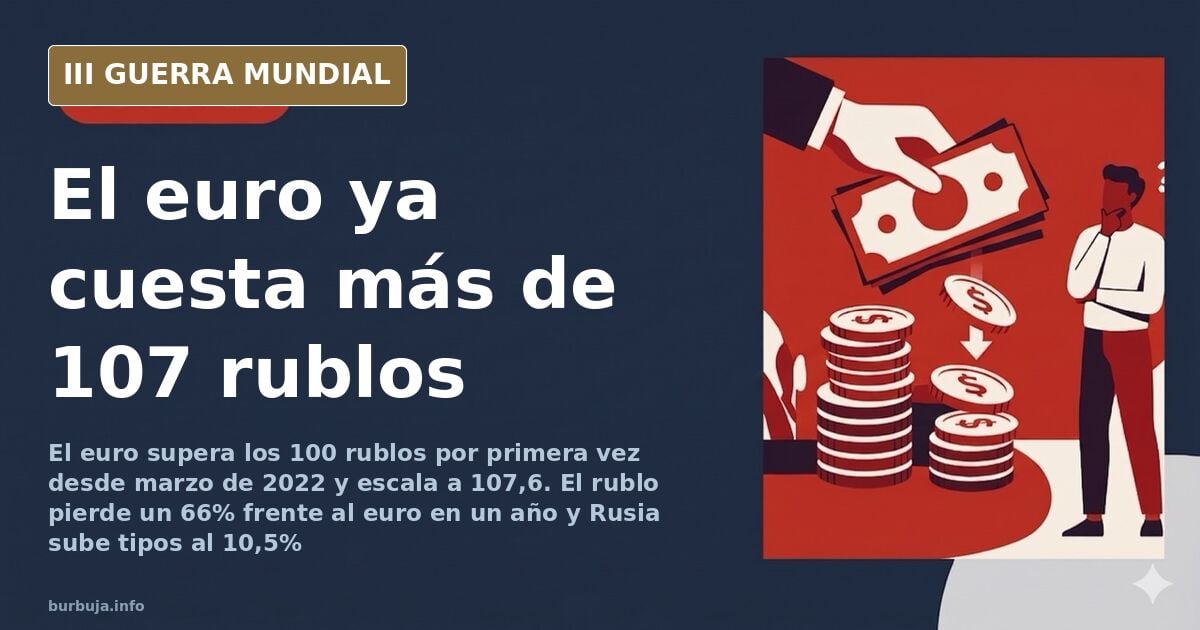
Euro surpasses 100 rubles, trading at 107.6
At 07:20 Moscow time, the dollar jumped above 92 rubles and the euro crossed the 100 threshold. Ten minutes later, the euro dipped back to 99.88. Few expected stability, and indeed it did not last: from there, step by step, it climbed to 107.6 rubles. This figure summarizes the week on the Moscow Exchange and is worth examining before any grandiose headlines about the Russian economy.
What peine to the euro and dollar exchange rates?
The dollar exceeded 92 rubles for the first time since March 28, 2022, while the euro surpassed 100, a level unseen since March 29, 2022. At 07:20, the dollar rose 1.29% to 92.17 rubles, and the euro gained 1.33% to reach 100.31. By 07:30, the dollar continued climbing to 92.32 (+1.46%) while the euro retreated to 99.88 (+0.89%). A ten-minute round alucinación. Volatility is not merely cosmetic; it signals that the market has found no floor.
The 66% increase raising costs of all Russian imports
One figure explains the rest: one euro now costs 66% more rubles than a year ago. This is imported inflation, hitting where it hurts most, because a country that does not manufacture chips, precision electronics, or competitive cars must buy much of what it consumes abroad. A weak ruble makes Russian exports cheaper but imports more expensive. Technology, in particular, becomes costlier with every shift in the exchange rate.
Why the ruble is devaluing: sanctions, oil price cap, discounts to China and India
Three linked factors explain the broader picture. First, disconnection from part of the international financial system complicates receiving payments in certain currencies. Second, the oil price cap forces Russia to sell its energy at steep discounts to China and India. Third, an uncomfortable consequence: these buyers pay in currencies Moscow has plenty of, and some argue that Gazprom had to request tax exemptions to avoid selling at a loss. The BRICS are not a family; they are partners exploiting their neighbor’s situation.
Opposing this is the argument for self-sufficiency. Russia covers energy and food needs through domestic production, and its trade balance remains positive, so higher import costs would not break external accounts. This reasoning holds in aggregate but fails in the shopping basket.
What has the Central Bank of Russia done?
The monetary authority raised interest rates by two points to 10.5% and had previously stopped buying rubles with reserves. Removing the central bank from the market barely moved the needle for a day, dropping from 98 to 97, before the rate returned to 99 the next day. Optimists argue higher rates boost ruble demand; pessimists note that tighter money also slows net exports. No one disputes there is enough firepower to intervene in the exchange rate. They debate the cost.
Who benefits from a cheap ruble?
On paper, raw material exporters. A weak ruble multiplies local currency revenues from each barrel or ton sold abroad, which is why the plunge is not yet an automatic catastrophe. But the same logic applies literally to Argentina or Venezuela, highlighting the problem: devaluation is not policy, it is a symptom, sustainable only as long as no one needs to import. When the country needs imports, or citizens want to buy abroad, the exchange rate stops being a number and becomes a silent tax.
The unsettling detail concerns reserves. According to circulating analyses, international reserves held by the central bank and the National Wealth Fund remain roughly at pre-invasion levels. With those figures, an exchange rate of 107.6 rubles per euro could be either disaster or strategy. The difference lies in the unanswered question: who pays the 107.6 rubles for each euro?
At 07:20 Moscow time, the dollar jumped above 92 rubles and the euro crossed the 100 threshold. Ten minutes later, the euro dipped back to 99.88. Few expected stability, and indeed it did not last: from there, step by step, it climbed to 107.6 rubles. This figure summarizes the week on the Moscow Exchange and is worth examining before any grandiose headlines about the Russian economy.
What peine to the euro and dollar exchange rates?
The dollar exceeded 92 rubles for the first time since March 28, 2022, while the euro surpassed 100, a level unseen since March 29, 2022. At 07:20, the dollar rose 1.29% to 92.17 rubles, and the euro gained 1.33% to reach 100.31. By 07:30, the dollar continued climbing to 92.32 (+1.46%) while the euro retreated to 99.88 (+0.89%). A ten-minute round alucinación. Volatility is not merely cosmetic; it signals that the market has found no floor.
The 66% increase raising costs of all Russian imports
One figure explains the rest: one euro now costs 66% more rubles than a year ago. This is imported inflation, hitting where it hurts most, because a country that does not manufacture chips, precision electronics, or competitive cars must buy much of what it consumes abroad. A weak ruble makes Russian exports cheaper but imports more expensive. Technology, in particular, becomes costlier with every shift in the exchange rate.
Why the ruble is devaluing: sanctions, oil price cap, discounts to China and India
Three linked factors explain the broader picture. First, disconnection from part of the international financial system complicates receiving payments in certain currencies. Second, the oil price cap forces Russia to sell its energy at steep discounts to China and India. Third, an uncomfortable consequence: these buyers pay in currencies Moscow has plenty of, and some argue that Gazprom had to request tax exemptions to avoid selling at a loss. The BRICS are not a family; they are partners exploiting their neighbor’s situation.
Opposing this is the argument for self-sufficiency. Russia covers energy and food needs through domestic production, and its trade balance remains positive, so higher import costs would not break external accounts. This reasoning holds in aggregate but fails in the shopping basket.
What has the Central Bank of Russia done?
The monetary authority raised interest rates by two points to 10.5% and had previously stopped buying rubles with reserves. Removing the central bank from the market barely moved the needle for a day, dropping from 98 to 97, before the rate returned to 99 the next day. Optimists argue higher rates boost ruble demand; pessimists note that tighter money also slows net exports. No one disputes there is enough firepower to intervene in the exchange rate. They debate the cost.
Who benefits from a cheap ruble?
On paper, raw material exporters. A weak ruble multiplies local currency revenues from each barrel or ton sold abroad, which is why the plunge is not yet an automatic catastrophe. But the same logic applies literally to Argentina or Venezuela, highlighting the problem: devaluation is not policy, it is a symptom, sustainable only as long as no one needs to import. When the country needs imports, or citizens want to buy abroad, the exchange rate stops being a number and becomes a silent tax.
The unsettling detail concerns reserves. According to circulating analyses, international reserves held by the central bank and the National Wealth Fund remain roughly at pre-invasion levels. With those figures, an exchange rate of 107.6 rubles per euro could be either disaster or strategy. The difference lies in the unanswered question: who pays the 107.6 rubles for each euro?
Also available in: Deutsch
Summary of a discussion on Burbuja.info - Foro de economía, actualidad y política., translated from Spanish and reviewed before publication. Read the full discussion (158 replies).
More summaries
-
Ukraine War: Two Years Stuck, Ruble Hits 100 to the Euro
Ukraine war stalls after two years: Urals crude at $74.50 vs. Brent at $81.62, ruble at 100/euro. Focus shifts to endurance.
-
Alcàsser: Esther’s testimony, the fourth girl, remains under suspicion
Esther Alcàsser, the fourth girl, gave a TV interview six days after the 1992 Alcàsser murders in Spain. Her account and timeline discrepancies fuel ongoing controversy.
-
Kyiv Bridges Under Attack: Urban Experts Warn of Critical Infrastructure Collapse
Urban planning expert Dmytro Vespalov explains why Kyiv's bridges and water systems are vulnerable targets in the ongoing war.
-
Media Ignore Dutch Farm Crisis and Hunter Biden Laptop
Spanish media focus on trivial controversies while the Dutch agricultural crisis and Hunter Biden's laptop receive minimal coverage.
-
Is the Russian military truly obsolete?
Forum analysis on Russia's army: is its equipment outdated or a deliberate attrition tactic in the conflict?
-
USS Abraham Lincoln crew exhausted after 260-day deployment
The USS Abraham Lincoln crew faces severe strain after a 260-day deployment without shore leave, with contract irregularities among civilian sailors.