
Madrid Divided Over Russian Threat Ahead of NATO Summit
Forum users debate armed Civil Guard presence at Barajas, speculating on a Russian attack versus false flag theories.
English · Original discussion in Spanish · Published
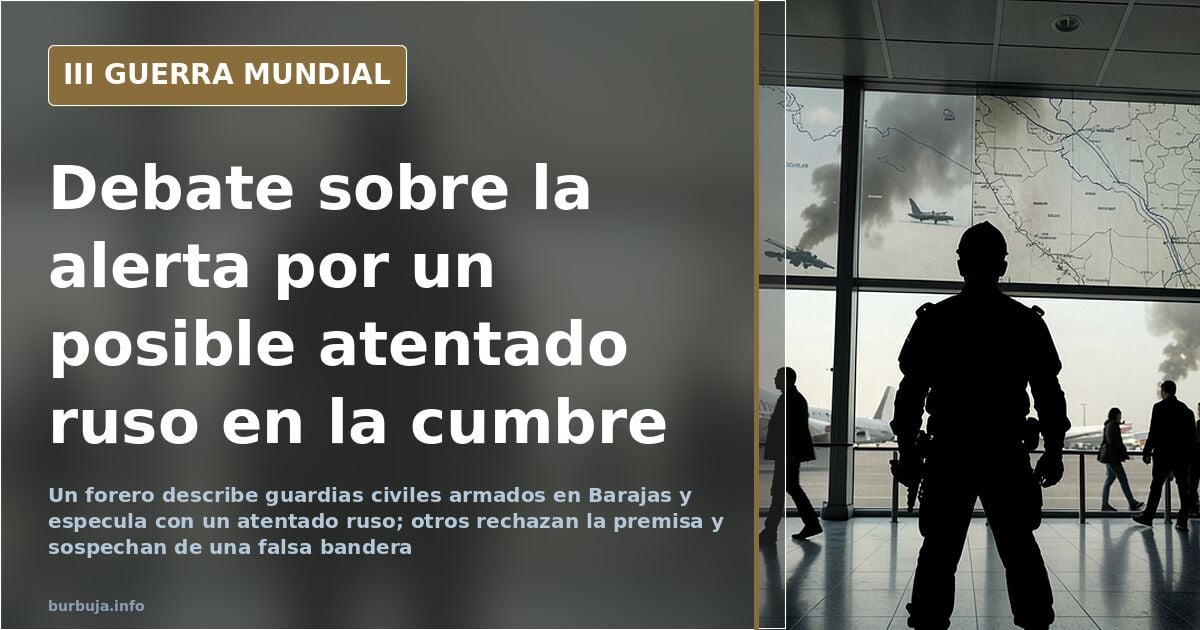
Russian Attack Alert: The Suspicion Dividing Madrid
An armed security device with rifle-bearing agents at Barajas airport access points. This scene opens the debate: the NATO summit has triggered high alert and suspicion that Russia—via agents or collaborators—might attempt violence during the meeting days. The uncomfortable question remains: is there more than surveillance, or are we witnessing a pre-prepared narrative?
The starting point is perception: a fortified city. The initial poster describes Civil Guards patrolling with long guns, calling the situation uncomfortable but necessary. He then directly accuses those in Spain sympathetic to Moscow of attacking freedom, democracy, and civil rights while Pilingui's inner circle lives without issue. The tone is warning-like, almost sermonizing.
From Police Alert to False Flag Theory
Responses quickly take another path. Several messages reject the premise: being Spanish and critical of NATO doesn't make one pro-Russian or a potential terrorist. The gaining hypothesis is that of a false flag attack—an action attributed to Russia to justify measures against Alliance critics. Precedents like 9/11 and 3/11 are cited as examples of what could repeat.
Skepticism extends to the investigation itself. Some anticipate the script: a photo of Pilingui in a van and a Cyrillic Bible will "clear" authorship. Irony sharpens with the idea that NATO, as usual, will do nothing but point at Moscow. This distrust of the official narrative goes extreme: risk isn't denied, only the version to be told.
Warning of an Inconsistent Deployment
Between jokes and suspicion appears concrete testimony, the most striking overall. It claims many agents stationed in Madrid, with families elsewhere, had to return from leave after traveling hundreds of kilometers, with explanations unconvincing to witnesses. The reading is antiestéticar of something behind the scenes and wanting all personnel available in the capital just in case. This is the only piece pointing to real deployment, not speculation.
From there, views diverge. Some believe the government needs the scare to strengthen its position; others think a Russian attack would grant legitimacy, while true concern lies in social protest over prices. National politics intrudes: left-wing coalition members critical of NATO are recalled, asking why they aren't scrutinized similarly.
NATO as Terrorist Organization: Debate Shifts
Conversation shifts to the Alliance's role. One current argues that since the Soviet bloc fell, NATO hasn't undertaken defensive actions, only interventions and destabilization. Another recalls it was created in response to a Soviet military pact for self-defense. Exchanges heat up near disqualification, though the core is old: what use is a defensive alliance when its justifying enemy disappears?
Suspicion about the summit coexists with broader doubt: any incident will justify restrictions. Mentions of civil rights and police control appear across messages, not just among NATO critics. This thread connects seemingly unrelated positions.
What the Deployment Doesn't Clarify
No conversation participant provides proof of an imminent attack. Nor of the contrary. Available material is perception—more agents, weapons, tension—and conjectures on who benefits from an incident. Only verifiable info is reinforced devices and called-back agents. Rest is interpretation.
Here lies the problem. If something happens, authorship will be assumed before investigation; if nothing happens, the alert self-justifies. What evidence would make both sides believe the outcome?
Also available in: Deutsch
Summary of a discussion on Burbuja.info - Foro de economía, actualidad y política., translated from Spanish and reviewed before publication. Read the full discussion (84 replies).
More summaries
-
Spain's PM Tells Putin 'You Won't Win' at NATO Summit
Spanish PM Pedro Sánchez challenged Vladimir Putin at the Madrid NATO summit, reigniting debate on sanctions costs.
-
Biden calls Zelensky 'Putin' during NATO summit
During a NATO summit, US President Joe Biden mistakenly referred to Volodymyr Zelensky as 'President Putin,' prompting applause from the room.
-
Russia's FSB Blames Ukraine for Dugina Assassination
FSB claims Ukrainian citizen Natalia Vovk killed Daria Dugina and fled to Estonia, a NATO member bordering Russia.
-
Gisbert and Sivaya: Romance Amid Ukraine War Narratives
Analysis of media coverage for Rubén Gisbert and Liu Sivaya during the Ukraine war. Is this digital propaganda or reality?
-
US Defense Industry Faces Supply Cracks, Washington Post Reports
The Washington Post notes US ammo production of 14,000 155mm shells monthly, a quantity Ukraine exhausts in two days.
-
Girkin warns Russia lacks troops to seize Donbas
Igor Girkin argues Russia lacks the manpower to take the Donbas, calling its air superiority 'quite relative.' The artillery battle remains in flux.