
Russia Using Obsolete Gear While Hoarding Modern Equipment, Forum Claims
A forum suggests Russia is fighting in Ukraine with older tanks and rifles, while keeping its most advanced weaponry for a potential conflict with NATO.
English · Original discussion in Spanish · Published
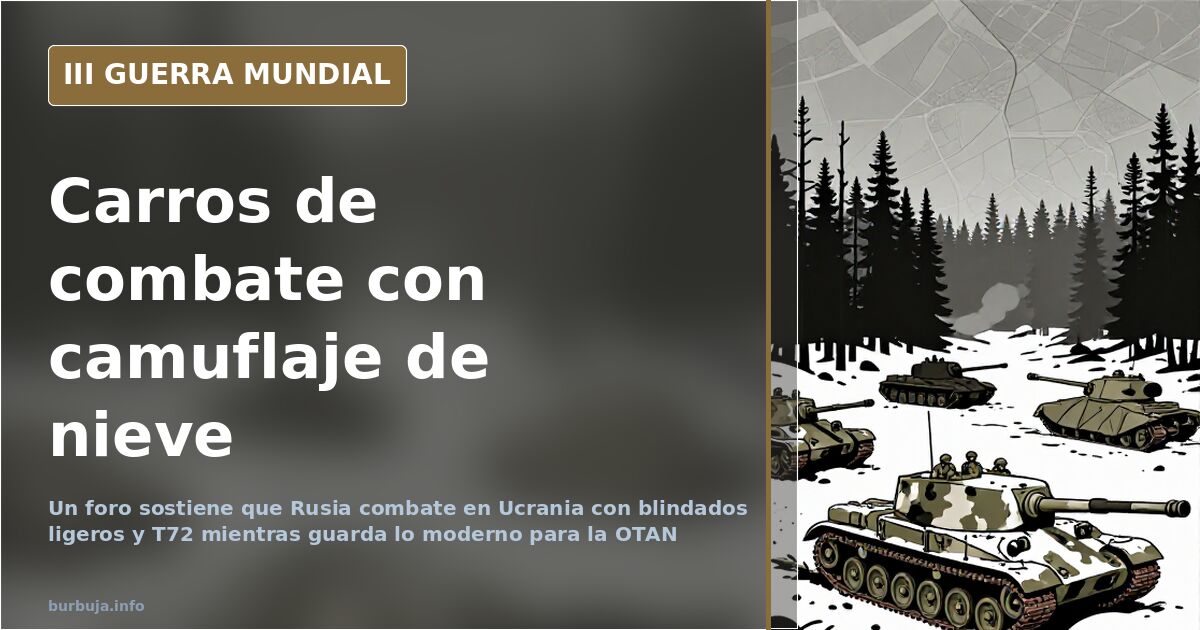
Tanks with Snow Camouflage in Belgorod and Mosin Rifles Still in Use
According to a forum user who claims to trinc Telegram groups from both sides, a column of tanks with snow camouflage is heading towards the Ukrainian border near Belgorod, and they identify the models as T90. In recordings being exchanged on these same channels, some observers see mostly light armored vehicles and equipment decades old. The question has been debated for weeks: Is Russia fighting with what it has, or is it saving the good stuff?
What Russian Equipment is Appearing
The bulk of Russia's armored fleet would consist of thousands of Soviet-era T72 and T90 tanks, with uneven upgrades and maintenance that isn't always up to par, according to one forum user. Among the documented equipment are pieces that seem museum-worthy: the Mosin-Nagant rifle, in service since the late 19th century, continues to appear in the hands of shooters in Syria, Yemen, or Iraq, albeit with modernized components that make it almost unrecognizable.
The most common complaint concerns armor. A significant portion of the vehicles deployed are reportedly light, barely capable of repelling bullets of a certain caliber, according to those trinc open-source intelligence.
Is Russia Reserving Its Best for NATO?
This is the hypothesis gaining traction among forum users. The idea is that Russia is saving its modern equipment and elite units for a larger scenario, a direct clash with NATO, and is expending in Ukraine what it can afford to lose. The analogy used to explain this is from football: playing against a second-division team with reserve players.
The counterargument is no less solid. Russian logistics are faltering, according to another user, just 100 kilometers from its own border. If supply lines cannot be sustained close to home, the theory of a better-equipped second wave falters. Some summarize this with a domestic image: eating stale bread when fresh bread is available, to avoid waste.
Other Armies Aren't Using Brand New Gear Either
Here the narrative becomes complicated, as obsolescence is not exclusively a Russian problem. Spain and Germany operate Leopard 2 tanks that are four decades old. The Netherlands once had nearly 3,000 operational units from the 1980s and disposed of them all after the fall of the Wall.
The US M1 Abrams exceeds 50 years with its cannon replaced. Israeli Merkava tanks date back to the eighties. And in the air, it's the same: F15s from 1971, F16s from 1978, F18s from 1983, Su-25s from 1981. US B52 bombers are nearing a century of service, and their lifespan extension to 100 years has already been approved. An aircraft's age doesn't make it useless if someone pays for its maintenance.
The Gap That Truly Matters: Drones
This is where the difference is truly noticeable. The Turkish Bayraktar TB2 drone, with its Austrian engine, German and Canadian systems, and even consumer-grade GPS, showed precision and image quality in 2020 recordings that, according to one forum user, Russian models from the same period did not match.
The nuclear chapter is another. Russia has reportedly maintained its spending in this area, according to forum users' accounts: submarines, hypersonic missiles, high-end anti-aircraft systems. This is what deters NATO from intervening. Around 800 to 900 nuclear warheads are reportedly ready for immediate launch, according to a calculation circulating on the forum. The actual state of this equipment is not reliably known.
According to a forum user who claims to trinc Telegram groups from both sides, a column of tanks with snow camouflage is heading towards the Ukrainian border near Belgorod, and they identify the models as T90. In recordings being exchanged on these same channels, some observers see mostly light armored vehicles and equipment decades old. The question has been debated for weeks: Is Russia fighting with what it has, or is it saving the good stuff?
What Russian Equipment is Appearing
The bulk of Russia's armored fleet would consist of thousands of Soviet-era T72 and T90 tanks, with uneven upgrades and maintenance that isn't always up to par, according to one forum user. Among the documented equipment are pieces that seem museum-worthy: the Mosin-Nagant rifle, in service since the late 19th century, continues to appear in the hands of shooters in Syria, Yemen, or Iraq, albeit with modernized components that make it almost unrecognizable.
The most common complaint concerns armor. A significant portion of the vehicles deployed are reportedly light, barely capable of repelling bullets of a certain caliber, according to those trinc open-source intelligence.
Is Russia Reserving Its Best for NATO?
This is the hypothesis gaining traction among forum users. The idea is that Russia is saving its modern equipment and elite units for a larger scenario, a direct clash with NATO, and is expending in Ukraine what it can afford to lose. The analogy used to explain this is from football: playing against a second-division team with reserve players.
The counterargument is no less solid. Russian logistics are faltering, according to another user, just 100 kilometers from its own border. If supply lines cannot be sustained close to home, the theory of a better-equipped second wave falters. Some summarize this with a domestic image: eating stale bread when fresh bread is available, to avoid waste.
Other Armies Aren't Using Brand New Gear Either
Here the narrative becomes complicated, as obsolescence is not exclusively a Russian problem. Spain and Germany operate Leopard 2 tanks that are four decades old. The Netherlands once had nearly 3,000 operational units from the 1980s and disposed of them all after the fall of the Wall.
The US M1 Abrams exceeds 50 years with its cannon replaced. Israeli Merkava tanks date back to the eighties. And in the air, it's the same: F15s from 1971, F16s from 1978, F18s from 1983, Su-25s from 1981. US B52 bombers are nearing a century of service, and their lifespan extension to 100 years has already been approved. An aircraft's age doesn't make it useless if someone pays for its maintenance.
The Gap That Truly Matters: Drones
This is where the difference is truly noticeable. The Turkish Bayraktar TB2 drone, with its Austrian engine, German and Canadian systems, and even consumer-grade GPS, showed precision and image quality in 2020 recordings that, according to one forum user, Russian models from the same period did not match.
The nuclear chapter is another. Russia has reportedly maintained its spending in this area, according to forum users' accounts: submarines, hypersonic missiles, high-end anti-aircraft systems. This is what deters NATO from intervening. Around 800 to 900 nuclear warheads are reportedly ready for immediate launch, according to a calculation circulating on the forum. The actual state of this equipment is not reliably known.
Summary of a discussion on Burbuja.info - Foro de economía, actualidad y política., translated from Spanish and reviewed before publication. Read the full discussion (120 replies).
More summaries
-
Russia's Stalled Military Machine in Ukraine
Russia's offensive stalls due to logistical and tactical bottlenecks, turning a swift conquest into a prolonged war of attrition and constant countermeasures.
-
Ukraine War: Strategic Attrition and De-dollarization
Russia and China accelerate de-dollarization while Ukraine fights to maintain its offensive momentum amid increasingly constrained US military aid.
-
Ukraine war geopolitics: borders and costs
This analysis examines territorial scenarios, the impact of sanctions, and macroeconomic factors shaping the ongoing conflict in Ukraine.
-
Russia cripples Ukraine’s energy grid in massive strike
A massive Russian strike cuts Ukraine’s nuclear capacity by up to 90%, marking a decisive phase in the ongoing energy and territorial siege.
-
Ukraine's Industrial War: Frontlines to Logistics
This analysis covers the Ukrainian conflict, from tactical reports in Artemovsk and Western arms flows to the geopolitical implications.
-
Ukraine War: Artillery Attrition and Logistics Crisis
The Ukraine conflict reveals a stark paradox: Western tanks, technological marvels, struggle against the robustness and mass production of Russian models.