
Russian Christmas ad depicts Europe eating rats, mocked in West
A Russian Christmas commercial shows a freezing Europe eating rats, but Western reaction is mockery, highlighting who truly suffers.
English · Original discussion in Spanish · Published
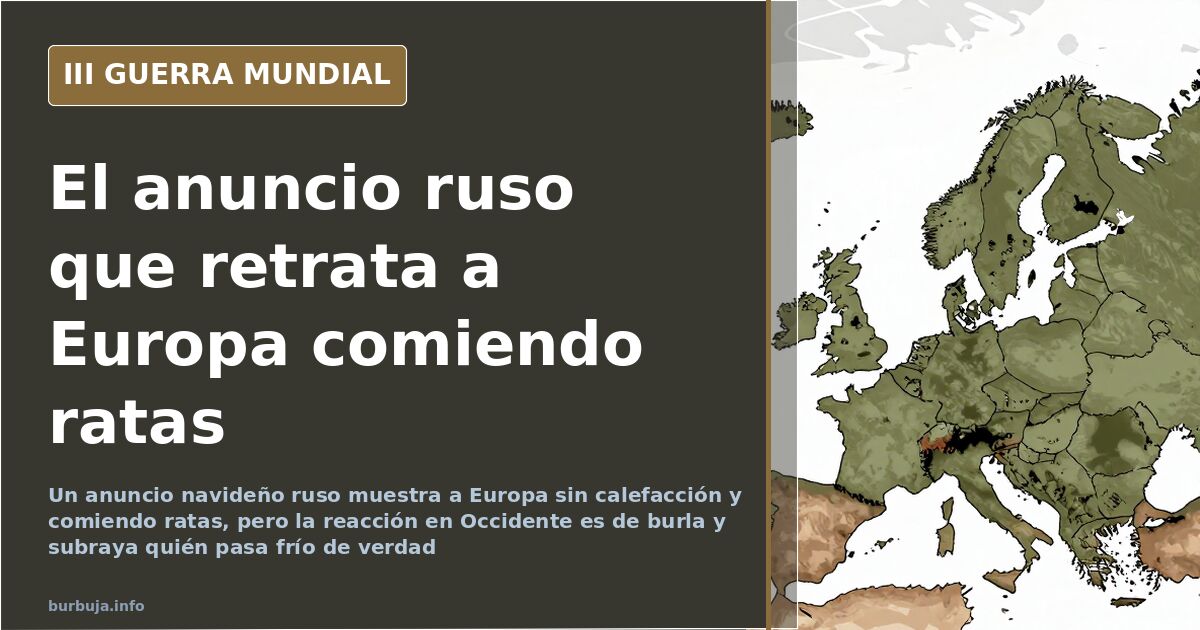
Russian Christmas ad portrays Europe in darkness and eating rats
A Christmas advertisement circulated in Russia depicts Europeans without light or heating, resorting to eating rats for their dinner. The dominant reaction in the West has been laughter rather than discouragement, revealing the first sustancia ilegal in the message: a piece designed to demoralize ended up amusing its intended target. The video contrasts abundant tables in Russia with a continent that, according to its narrative, is starving and freezing. This contrast has sparked a discussion far beyond the spot itself.
What the ad shows and why it went viral
The script is simple: while Russians dine in warm homes, European households spend Christmas Eve in the dark with rodents on their plates. The video circulated as propaganda across networks and channels aligned with the Kremlin, functioning as an unintentional mirror. One analyst summarized it with a widely quoted phrase: Russians are not driven by dreams of their own happiness, but by others' misfortune; yet, he argued, the West remains richer, happier, and — literally — much warmer than the ad imagines.
The scene was replicated with sarcasm. Those walking through Mediterranean tourist cities found full terraces, not streets littered with corpses from hunger and cold. This detail summarizes the most repeated consensus: the spot describes a winter that does not exist. It is also notable that the ad provides no figures: it appeals to a feeling, not data.
Who is it targeting: Europeans or Russians?
There is no agreement. Some read it as a direct attack on Europe, an attempt to install the idea that winter will devastate the continent's standard of living. Others argue the opposite: the real recipient would be the Russian public, told that they too suffer hunger and should endure because the hardship is shared. In this view, a calendar detail is noted: Orthodox Christmas in Russia falls on January 7, so the ad's timing seems deliberate.
Vranyo and the war of narratives
He lies, we know he lies, and he knows we know he lies. This describes vranyo, the Russian category of lying that does not seek belief, only tolerance and repetition. Several analyses use this term to debunk the ad: it aims not to convince skeptics, but to saturate the official narrative. The comparison trinc naturally. If the West also produces propaganda, the difference lies in reach: here, few would see such a spot; there, tens of millions do.
This is not an innocent seasonal joke. It fits into machinery that has spent months repeating that without Russia, no winter can be endured.
The missing data in the ad: energy bills
The spot plays on a real antiestéticar, the European energy crisis aggravated by the war in Ukraine. However, the timeline does not fully align. Much of the inflation hitting the continent predated the conflict, driven by energy prices and internal decisions, not born from this winter. Some go further, linking the issue to the disruption of European fertilizer production trinc sanctions against Russia, with long-term consequences for agriculture and shopping baskets. This is a long-range warning, not a fact from the video.
And here comes the disorienting point. The most ridiculed scene — families shivering in unlit apartments — clashes with a reality where the problem has not been food scarcity, but its price. That is the distance between propaganda and the bill: nobody starves, they pay more.
Russia is not salvation
Amidst enthusiasm from some and mockery from others, a third position emerges, uncomfortable for both sides: neither does the ad hit the mark nor is it wise to read it as a European victory. Propaganda is propaganda in both directions, and those who accept it as dogma merely switch sides. The most repeated conclusion is that the problem is not the spot, but the ease with which any narrative flattering one's own side is bought.
The question remains open: if the ad targeted Europeans, it failed; if it targeted Russians, what is achieved with mockery that the very audience celebrates as a joke? No one in the video answers.
A Christmas advertisement circulated in Russia depicts Europeans without light or heating, resorting to eating rats for their dinner. The dominant reaction in the West has been laughter rather than discouragement, revealing the first sustancia ilegal in the message: a piece designed to demoralize ended up amusing its intended target. The video contrasts abundant tables in Russia with a continent that, according to its narrative, is starving and freezing. This contrast has sparked a discussion far beyond the spot itself.
What the ad shows and why it went viral
The script is simple: while Russians dine in warm homes, European households spend Christmas Eve in the dark with rodents on their plates. The video circulated as propaganda across networks and channels aligned with the Kremlin, functioning as an unintentional mirror. One analyst summarized it with a widely quoted phrase: Russians are not driven by dreams of their own happiness, but by others' misfortune; yet, he argued, the West remains richer, happier, and — literally — much warmer than the ad imagines.
The scene was replicated with sarcasm. Those walking through Mediterranean tourist cities found full terraces, not streets littered with corpses from hunger and cold. This detail summarizes the most repeated consensus: the spot describes a winter that does not exist. It is also notable that the ad provides no figures: it appeals to a feeling, not data.
Who is it targeting: Europeans or Russians?
There is no agreement. Some read it as a direct attack on Europe, an attempt to install the idea that winter will devastate the continent's standard of living. Others argue the opposite: the real recipient would be the Russian public, told that they too suffer hunger and should endure because the hardship is shared. In this view, a calendar detail is noted: Orthodox Christmas in Russia falls on January 7, so the ad's timing seems deliberate.
Vranyo and the war of narratives
He lies, we know he lies, and he knows we know he lies. This describes vranyo, the Russian category of lying that does not seek belief, only tolerance and repetition. Several analyses use this term to debunk the ad: it aims not to convince skeptics, but to saturate the official narrative. The comparison trinc naturally. If the West also produces propaganda, the difference lies in reach: here, few would see such a spot; there, tens of millions do.
This is not an innocent seasonal joke. It fits into machinery that has spent months repeating that without Russia, no winter can be endured.
The missing data in the ad: energy bills
The spot plays on a real antiestéticar, the European energy crisis aggravated by the war in Ukraine. However, the timeline does not fully align. Much of the inflation hitting the continent predated the conflict, driven by energy prices and internal decisions, not born from this winter. Some go further, linking the issue to the disruption of European fertilizer production trinc sanctions against Russia, with long-term consequences for agriculture and shopping baskets. This is a long-range warning, not a fact from the video.
And here comes the disorienting point. The most ridiculed scene — families shivering in unlit apartments — clashes with a reality where the problem has not been food scarcity, but its price. That is the distance between propaganda and the bill: nobody starves, they pay more.
Russia is not salvation
Amidst enthusiasm from some and mockery from others, a third position emerges, uncomfortable for both sides: neither does the ad hit the mark nor is it wise to read it as a European victory. Propaganda is propaganda in both directions, and those who accept it as dogma merely switch sides. The most repeated conclusion is that the problem is not the spot, but the ease with which any narrative flattering one's own side is bought.
The question remains open: if the ad targeted Europeans, it failed; if it targeted Russians, what is achieved with mockery that the very audience celebrates as a joke? No one in the video answers.
Summary of a discussion on Burbuja.info - Foro de economía, actualidad y política., translated from Spanish and reviewed before publication. Read the full discussion (165 replies).
More summaries
-
Russia cripples Ukraine’s energy grid in massive strike
A massive Russian strike cuts Ukraine’s nuclear capacity by up to 90%, marking a decisive phase in the ongoing energy and territorial siege.
-
Gas Cut: Europe Between Strategic Warning and Energy Crisis
The gas cutoff to Poland and Bulgaria exposes Europe's energy fragility amid Russian dependence. We analyze the risk of a looming crisis.
-
Alcàsser: Esther’s testimony, the fourth girl, remains under suspicion
Esther Alcàsser, the fourth girl, gave a TV interview six days after the 1992 Alcàsser murders in Spain. Her account and timeline discrepancies fuel ongoing controversy.
-
Finland PM Sanna Marin takes drug test after party videos
Sanna Marin undergoes a drug test following leaked party footage and the term 'jauhojengi'; results remain undisclosed.
-
Severodonetsk: The Ukrainian Counteroffensive That Failed
Ukraine's June 2022 counteroffensive in Severodonetsk reclaimed parts of the city but led to a sealed encirclement within three weeks.
-
Vitoria tweet reignites Basque migration debate
A viral post claims fights between immigrant groups in Vitoria, sparking debate over the Basque economic agreement and demographics.