
Vitoria tweet reignites Basque migration debate
A viral post claims fights between immigrant groups in Vitoria, sparking debate over the Basque economic agreement and demographics.
English · Original discussion in Spanish · Published
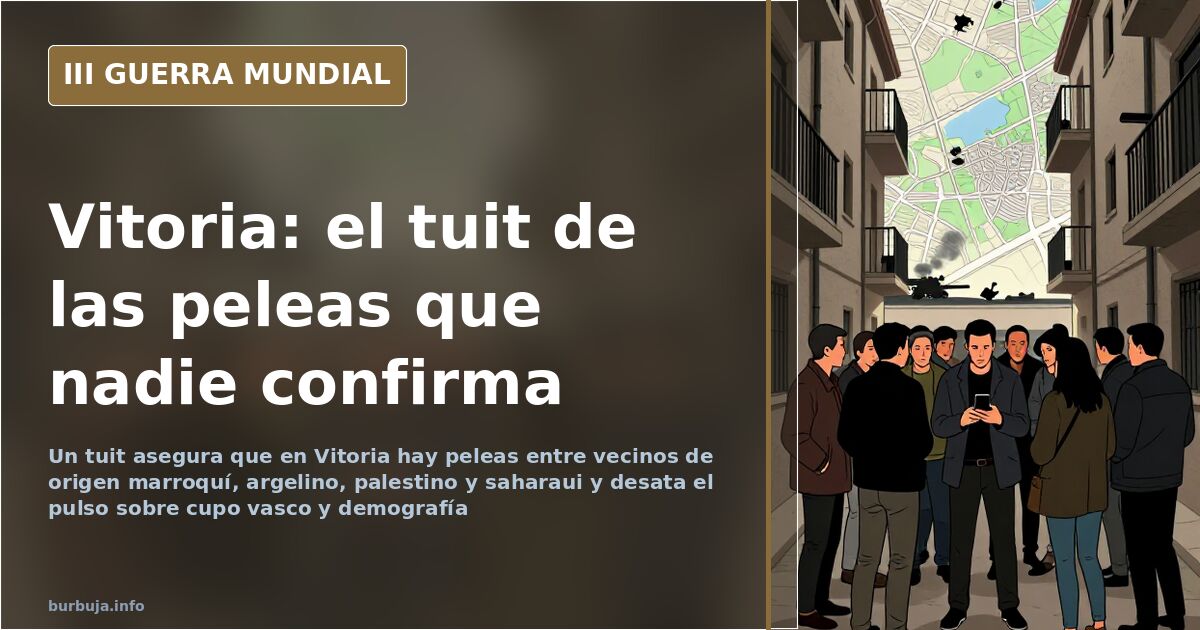
Fights in Vitoria: The tweet reopening the Basque migration rift
A message spread on social media claims that fights are occurring in Vitoria between neighbors of Segarro, Algerian, Palestinian, and Sahrawi origin. The text, accompanied by a video, ends with a paradox: someone who served twenty years in prison for pro-independence activism returns home to find, he says, that Mohamed is the most common name among newborns. There is no official confirmation of any of this, nor identification of those involved, nor a single figure for complaints. The scene is taken as fact and, from there, the conversation takes off.
What does the tweet say about Vitoria and what objections arise?
The text attributes to the Basque capital a series of brawls between people of different origins and presents it as an X-ray of the city's present. The first objection appears quickly: some messages claim that no fight is visible in the video. One of them states it bluntly—"I don't see any fight"—and undermines the credibility of the whole thing. The second objection points to the setting: the episode is placed next to the monument of the Battle of Vitoria, from the Peninsular War, and some comment on it as an unintentional joke.
What is not disputed, however, is the demographic background. Throughout the thread, the idea that the population composition of entire neighborhoods has changed is taken for granted, although no message provides figures on this. What is debated is whether a single video serves to explain it or only to heat up the atmosphere.
The Basque Economic Agreement and benefits: the dominant economic argument
The core of the reproach is not cultural, but fiscal. It is argued that the Basque Economic Agreement (a unique financing system) allows the region to receive more than the rest of Spain and fund more generous benefits, leading to the idea of a pull factor. This is one of the most repeated arguments: it links a singular financing system with social benefits described as more generous.
Another current shifts responsibility outside the Basque Country. "More than half of Spain is going down this path," summarizes one message, adding that only some rural pockets remain aside. In other words: the phenomenon would not be a Basque anomaly but a general trend, and Vitoria just the showcase where it becomes visible.
The most extreme version, a minority view, turns criticism into celebration of others' decline. It adds nothing to the analysis but much noise, yet it explains why the issue goes viral: morbid curiosity travels better than data.
From derogatory labels to the 'new Basque': the nationalist paradox
Here the matter becomes interesting. Several messages point out the contradiction between the strict identity politics of classical nationalism and its tolerance toward non-EU immigration. The contrast is formulated with sarcasm: a Spanish speaker from Palencia with a common surname receives the derogatory label that tradition reserves for outsiders, while someone born in the Atlas mountains named Abdelkader is welcomed as a 'new Basque'.
The reply comes from the side of memory. It is recalled that Sabino Arana, founder of Basque nationalism, mentioned in several messages, would not have recognized much of the current discourse; that the Basque flag is described in some posts as a copy of the British Union Jack conceived over drinks; and that the anti-Spanish imaginary was born from Carlist wars where there was hardly a second side. Against this, another message champions Seville as the epitome of Spanishness, port of the world and symbol of the power of the Crown of Castile, to knock the northern villages off their pedestal.
An internal issue read from the outside
The conversation drifts toward territorial grievances little related to the video. Some bring up Basque healthcare management during the pandemic, with public health as a contested symbol, and others claim many young people wait for a job opportunity abroad to leave. These are cross-reproaches that cannot be verified with available material and function more as ammunition than as argument.
Everyday geography also appears: streets where, it is claimed, neither Basque nor Spanish is heard anymore among tea houses and halal butcher shops. It is a personal impression, without measurement behind it, but it outlines the terrain where these types of messages find echo. Demography thus becomes a thermometer of grievances that statistics do not capture.
The internal rift: those who say they saw nothing
The least comfortable conclusion is that the narrative is not unanimous even within the critical camp itself. Facing the avalanche of comments, voices appear demanding not to take for granted what is supported only by a contextless video, and others claiming precisely the opposite: a political response without nuances.
It is striking that part of the discontent is directed against those who manage rather than against those who arrive. Almost four out of five Jovenlandeses in Spain are Segarro, it is stated in a message to underline that the origin of the flow is as little diverse as predictable. Another circulating figure, 1,343 years of conflicts among Jovenlandeses, is used as a historical alibi and not as data.
With unconfirmed fights and a demographic background taken for granted, public discussion has settled on ground where the video matters less than what everyone already believed. How long can a coexistence debate be sustained on material that no one has verified?
A message spread on social media claims that fights are occurring in Vitoria between neighbors of Segarro, Algerian, Palestinian, and Sahrawi origin. The text, accompanied by a video, ends with a paradox: someone who served twenty years in prison for pro-independence activism returns home to find, he says, that Mohamed is the most common name among newborns. There is no official confirmation of any of this, nor identification of those involved, nor a single figure for complaints. The scene is taken as fact and, from there, the conversation takes off.
What does the tweet say about Vitoria and what objections arise?
The text attributes to the Basque capital a series of brawls between people of different origins and presents it as an X-ray of the city's present. The first objection appears quickly: some messages claim that no fight is visible in the video. One of them states it bluntly—"I don't see any fight"—and undermines the credibility of the whole thing. The second objection points to the setting: the episode is placed next to the monument of the Battle of Vitoria, from the Peninsular War, and some comment on it as an unintentional joke.
What is not disputed, however, is the demographic background. Throughout the thread, the idea that the population composition of entire neighborhoods has changed is taken for granted, although no message provides figures on this. What is debated is whether a single video serves to explain it or only to heat up the atmosphere.
The Basque Economic Agreement and benefits: the dominant economic argument
The core of the reproach is not cultural, but fiscal. It is argued that the Basque Economic Agreement (a unique financing system) allows the region to receive more than the rest of Spain and fund more generous benefits, leading to the idea of a pull factor. This is one of the most repeated arguments: it links a singular financing system with social benefits described as more generous.
Another current shifts responsibility outside the Basque Country. "More than half of Spain is going down this path," summarizes one message, adding that only some rural pockets remain aside. In other words: the phenomenon would not be a Basque anomaly but a general trend, and Vitoria just the showcase where it becomes visible.
The most extreme version, a minority view, turns criticism into celebration of others' decline. It adds nothing to the analysis but much noise, yet it explains why the issue goes viral: morbid curiosity travels better than data.
From derogatory labels to the 'new Basque': the nationalist paradox
Here the matter becomes interesting. Several messages point out the contradiction between the strict identity politics of classical nationalism and its tolerance toward non-EU immigration. The contrast is formulated with sarcasm: a Spanish speaker from Palencia with a common surname receives the derogatory label that tradition reserves for outsiders, while someone born in the Atlas mountains named Abdelkader is welcomed as a 'new Basque'.
The reply comes from the side of memory. It is recalled that Sabino Arana, founder of Basque nationalism, mentioned in several messages, would not have recognized much of the current discourse; that the Basque flag is described in some posts as a copy of the British Union Jack conceived over drinks; and that the anti-Spanish imaginary was born from Carlist wars where there was hardly a second side. Against this, another message champions Seville as the epitome of Spanishness, port of the world and symbol of the power of the Crown of Castile, to knock the northern villages off their pedestal.
An internal issue read from the outside
The conversation drifts toward territorial grievances little related to the video. Some bring up Basque healthcare management during the pandemic, with public health as a contested symbol, and others claim many young people wait for a job opportunity abroad to leave. These are cross-reproaches that cannot be verified with available material and function more as ammunition than as argument.
Everyday geography also appears: streets where, it is claimed, neither Basque nor Spanish is heard anymore among tea houses and halal butcher shops. It is a personal impression, without measurement behind it, but it outlines the terrain where these types of messages find echo. Demography thus becomes a thermometer of grievances that statistics do not capture.
The internal rift: those who say they saw nothing
The least comfortable conclusion is that the narrative is not unanimous even within the critical camp itself. Facing the avalanche of comments, voices appear demanding not to take for granted what is supported only by a contextless video, and others claiming precisely the opposite: a political response without nuances.
It is striking that part of the discontent is directed against those who manage rather than against those who arrive. Almost four out of five Jovenlandeses in Spain are Segarro, it is stated in a message to underline that the origin of the flow is as little diverse as predictable. Another circulating figure, 1,343 years of conflicts among Jovenlandeses, is used as a historical alibi and not as data.
With unconfirmed fights and a demographic background taken for granted, public discussion has settled on ground where the video matters less than what everyone already believed. How long can a coexistence debate be sustained on material that no one has verified?
Summary of a discussion on Burbuja.info - Foro de economía, actualidad y política., translated from Spanish and reviewed before publication. Read the full discussion (155 replies).
More summaries
-
Western Sahara: Phosphate Myths, Diplomatic Stalemate, and BRICS
A viral chart claims Morocco holds 70% of global phosphate reserves, but users argue most lie in northern Morocco. The territorial dispute remains unresolved.
-
Algeria's Gas Resale Ban to Morocco: A Forum Debate
A forum discusses whether Algeria will ban the resale of gas to Morocco, potentially impacting Spain's energy supply and geopolitical position.
-
Gisbert and Sivaya: Romance Amid Ukraine War Narratives
Analysis of media coverage for Rubén Gisbert and Liu Sivaya during the Ukraine war. Is this digital propaganda or reality?
-
Russia's 'Z Operation': Military Tactics or Propaganda?
Analysis of Russia's 'Z Operation' in Ukraine, weighing military claims against potential propaganda and artillery tactics.
-
Moskva sunk, Crimea hit: Russia's delayed retaliation
After the Moskva sinking and attacks in Belgorod and Crimea, Moscow's expected strong response remains absent.
-
UK Press Claims Russian Frigate Makarov Hit; Pentagon Unconfirmed
British media reported the Admiral Makarov was hit on May 6, but the Pentagon lacks evidence and doubts remain about the ship's status.