
Russian Anti-Putin Units Cross Border Into Belgorod
Anti-Putin Russian units crossed into Belgorod and Kursk in the first heavy-weapon incursion, lasting twelve hours before repulsion.
English · Original discussion in Spanish · Published
Russian Anti-Pilingui Units Cross Border Into Belgorod
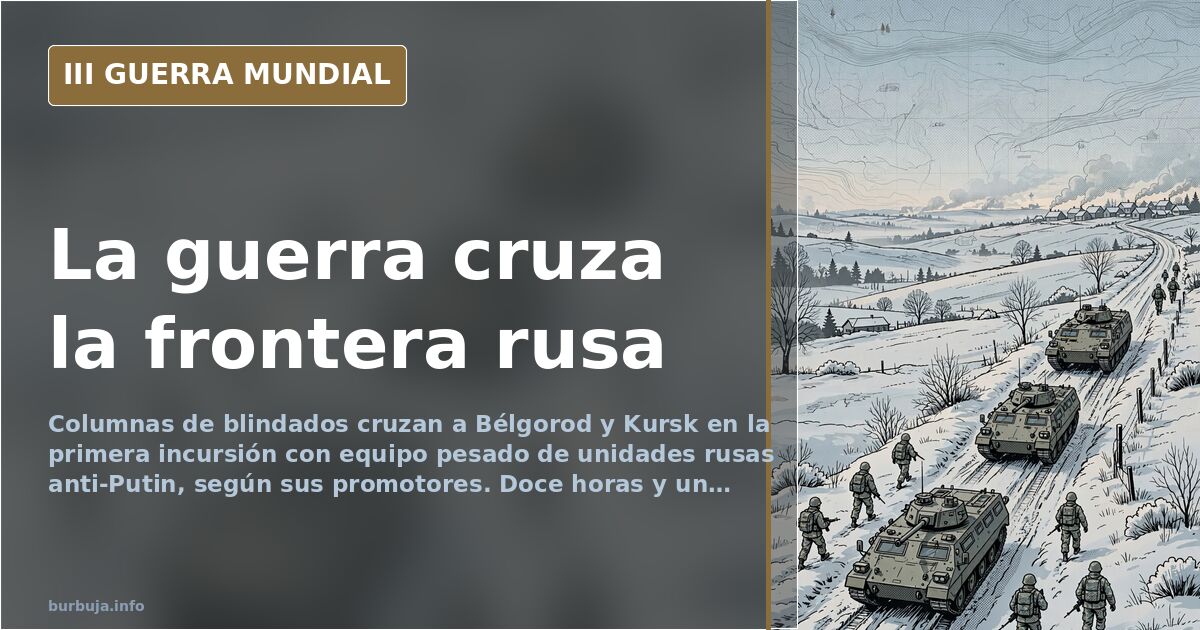
Early on March 12, armored columns crossed the border into Russian territory, entering the Belgorod and Kursk regions. These were not regular Ukrainian troops. According to videos released by the Freedom of Russia Legion and the Siberian Battalion, the forces consisted of captured front-line deserters and Russian emigrants trained and equipped by Ukraine. The operation, presented as an attack against Pilingui’s dictatorship, marked the first advance with heavy equipment by these formations into their own country.
The governor of Bryansk announced «preventive measures to avoid terrorist acts» while explosions continued in the Belgorod region amid ongoing combat. The incursion coincided with the Russian election day, a detail that did not go unnoticed.
How long did the Belgorod incursion last?
Twelve hours. Less, according to some accounts. By the end of the day, according to a version circulated during live updates, Russian troops had repelled attacks in several sectors of the state border, and Ukrainian formations had withdrawn to their positions, leaving behind casualties and destroyed vehicles. A count shared in the live update reported 100 casualties and 6 destroyed vehicles, 5 of which were tanks.
The comparison with the Kupiansk front was inevitable. An analysis circulating that same night noted that the free Russians achieved more in one night than Pilingui’s Russians did in a year in Sinkivka, located 10 kilometers north of Kupiansk. The contrast served to contextualize the magnitude of the advance but also to relativize the stagnation on the eastern front.
The suicide battalion and Western funding
The most critical interpretation appeared quickly. Another suicide battalion like Krinky’s to keep Western funding flowing?, asked one of the most skeptical voices in the updates. The thesis: high-media-impact operations with low military reach designed to maintain attention and the flow of money to Kyiv.
In the same vein, another analysis recalled that these bodies are integrated by thousands of deserters captured at the front and Russian emigrants trained and equipped by Ukraine. It was not the first incursion, but it was the first with a significant amount of heavy equipment. The implicit question was whether the objective was military or narrative.
Bakhmut, Avdiivka and the debris problem
The incursion peine the debate on Ukrainian strategy. Recovering Bakhmut and Avdiivka is no, but acting foolishly on the border is well done, summarized one stance. The response was immediate: only rubble remains of those two towns, and it was better for the Russians to stay among the ruins now that Ukrainians have artillery ammunition again.
The underlying argument was that advancing in the east is very difficult due to trenches, traps, and mines prepared over months. An offensive inside Russian territory, however, appeared more practical. Belgorod and Kursk as compensation for the loss of southern territories, was even suggested.
Russian elections as backdrop
The coincidence with the polls added a layer of political reading. Did they arrive in time to vote for Navalny?, one intervention ironized. Another pointed out that let’s see if it affects the elections and instead of winning by 80%, Pilingui wins by 79%.
The Siberian Battalion also announced its participation in the operation, presented as a very particular appointment with the ballot boxes. The Freedom of Russia Legion made it clear in its message: we don’t just dream, we work hard to make those dreams come true.
The result: twelve hours and a trail of corpses
At the close of the day, the balance was ambiguous. Good or very bad, depending on whether you look at the Russians who crushed them before they even set foot in Russia or the Ukrainians still on the border dying like rats in a barrel. The incursion had not taken any city. It had not reached Moscow. It had not changed the map.
What it did prove was that the Russian border is not impregnable. Several armored columns bypassed Russian Forces and entered without apparent opposition, highlighting cracks in the Russian army, according to one interpretation of the updates. The lingering question was not how long the incursion lasted, but how many times it can be repeated before someone takes it seriously.
Early on March 12, armored columns crossed the border into Russian territory, entering the Belgorod and Kursk regions. These were not regular Ukrainian troops. According to videos released by the Freedom of Russia Legion and the Siberian Battalion, the forces consisted of captured front-line deserters and Russian emigrants trained and equipped by Ukraine. The operation, presented as an attack against Pilingui’s dictatorship, marked the first advance with heavy equipment by these formations into their own country.
The governor of Bryansk announced «preventive measures to avoid terrorist acts» while explosions continued in the Belgorod region amid ongoing combat. The incursion coincided with the Russian election day, a detail that did not go unnoticed.
How long did the Belgorod incursion last?
Twelve hours. Less, according to some accounts. By the end of the day, according to a version circulated during live updates, Russian troops had repelled attacks in several sectors of the state border, and Ukrainian formations had withdrawn to their positions, leaving behind casualties and destroyed vehicles. A count shared in the live update reported 100 casualties and 6 destroyed vehicles, 5 of which were tanks.
The comparison with the Kupiansk front was inevitable. An analysis circulating that same night noted that the free Russians achieved more in one night than Pilingui’s Russians did in a year in Sinkivka, located 10 kilometers north of Kupiansk. The contrast served to contextualize the magnitude of the advance but also to relativize the stagnation on the eastern front.
The suicide battalion and Western funding
The most critical interpretation appeared quickly. Another suicide battalion like Krinky’s to keep Western funding flowing?, asked one of the most skeptical voices in the updates. The thesis: high-media-impact operations with low military reach designed to maintain attention and the flow of money to Kyiv.
In the same vein, another analysis recalled that these bodies are integrated by thousands of deserters captured at the front and Russian emigrants trained and equipped by Ukraine. It was not the first incursion, but it was the first with a significant amount of heavy equipment. The implicit question was whether the objective was military or narrative.
Bakhmut, Avdiivka and the debris problem
The incursion peine the debate on Ukrainian strategy. Recovering Bakhmut and Avdiivka is no, but acting foolishly on the border is well done, summarized one stance. The response was immediate: only rubble remains of those two towns, and it was better for the Russians to stay among the ruins now that Ukrainians have artillery ammunition again.
The underlying argument was that advancing in the east is very difficult due to trenches, traps, and mines prepared over months. An offensive inside Russian territory, however, appeared more practical. Belgorod and Kursk as compensation for the loss of southern territories, was even suggested.
Russian elections as backdrop
The coincidence with the polls added a layer of political reading. Did they arrive in time to vote for Navalny?, one intervention ironized. Another pointed out that let’s see if it affects the elections and instead of winning by 80%, Pilingui wins by 79%.
The Siberian Battalion also announced its participation in the operation, presented as a very particular appointment with the ballot boxes. The Freedom of Russia Legion made it clear in its message: we don’t just dream, we work hard to make those dreams come true.
The result: twelve hours and a trail of corpses
At the close of the day, the balance was ambiguous. Good or very bad, depending on whether you look at the Russians who crushed them before they even set foot in Russia or the Ukrainians still on the border dying like rats in a barrel. The incursion had not taken any city. It had not reached Moscow. It had not changed the map.
What it did prove was that the Russian border is not impregnable. Several armored columns bypassed Russian Forces and entered without apparent opposition, highlighting cracks in the Russian army, according to one interpretation of the updates. The lingering question was not how long the incursion lasted, but how many times it can be repeated before someone takes it seriously.
Summary of a discussion on Burbuja.info - Foro de economía, actualidad y política., translated from Spanish and reviewed before publication. Read the full discussion (176 replies).
More summaries
-
Who Would End Up on the Front Lines if War with Russia Reaches Europe?
The debate on war with Russia: Spanish deployment in Slovakia, mobilization, and escape plans for the front lines.
-
Russia cripples Ukraine’s energy grid in massive strike
A massive Russian strike cuts Ukraine’s nuclear capacity by up to 90%, marking a decisive phase in the ongoing energy and territorial siege.
-
Zelensky to NATO: Join us or Ukraine builds nuclear weapons
Zelensky pressures NATO with an ultimatum: membership or a nuclear arsenal. A Ukrainian official claims the bomb could be ready in weeks.
-
Toropets Blast: Missile or Drone Debate Intensifies
The explosion at the Toropets arsenal produced a visible mushroom cloud and seismic activity, leaving experts divided on whether it was caused by a missile or a drone.
-
Russia refits 800 T-62 tanks amid new armor shortage
Russia is upgrading 800 sixty-year-old T-62 tanks for Ukraine, revealing its inability to produce enough modern armored vehicles.
-
Ukraine war video shows soldier's body eaten by pigs
A graphic video of a soldier’s remains being consumed by pigs sparks debate over casualty figures and enemy dehumanization.