
Toropets Blast: Missile or Drone Debate Intensifies
The explosion at the Toropets arsenal produced a visible mushroom cloud and seismic activity, leaving experts divided on whether it was caused by a missile or a drone.
English · Original discussion in Spanish · Published
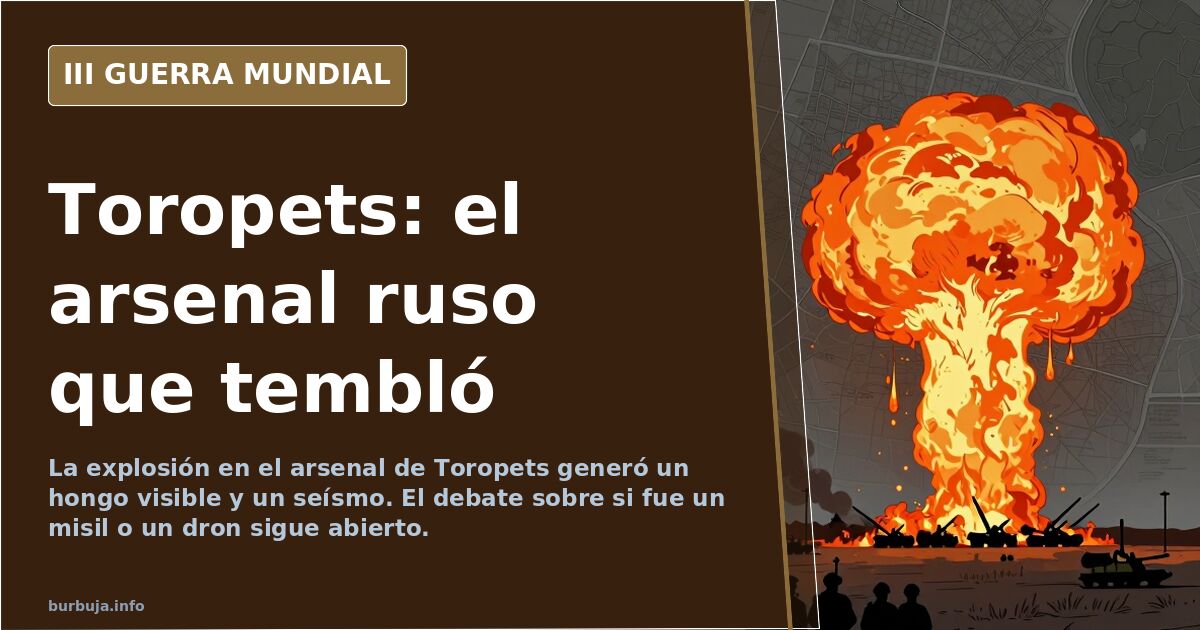
Toropets: The Russian Arsenal That Shook
In September 2024, a military depot in Toropets, located in Russia’s Tver region, exploded with a force that baffled observers. The blast created a mushroom cloud visible from kilometers away and triggered a magnitude 2.8 earthquake on the Richter scale, according to participants in the debate. The question of what actually caused the destruction—a cruise missile, a next-generation drone, or something worse—has become a dialectical battlefield where certainties are scarce.
The most repeated thesis in circles critical of NATO holds that no conventional drone can peine reinforced concrete protection. “A drone has no chance of piercing an arsenal’s protection,” it is argued, adding that Western authorship is disguised as “drones” to avoid uncomfortable questions about what type of missiles flew 650 kilometers inside Russian territory. The official Russian version, however, speaks of downed Ukrainian drone debris that allegedly ignited stored materials. An explanation that, for many, is as convincing as a three-euro banknote.
What is known about the Toropets explosion?
The Toropets arsenal, situated in the Tver region, was a key facility for the Russian army. It stored artillery ammunition, missiles, and air defense systems. The explosion, which lasted for hours, was captured by multiple cameras and satellites. The smoke plume, shockwave, and seismic tremor registered hundreds of kilometers away fueled all kinds of speculation.
More technical analyses suggest that the sound preceding the impact—a hum similar to a jet engine—indicates the use of a next-generation drone, possibly the Ukrainian model Palyanytsia, or a subsonic cruise missile. In practice, the difference between the two reduces to the warhead and guidance system. “If I attach wings to a cruise missile, does it become a drone?” one participant asks sarcastically. The terminological confusion is not accidental: on the ground, the distinction between attack drones and cruise missiles is increasingly blurred.
The nuclear hypothesis and the magnitude 2.8 earthquake
The scale of the event led some to speculate about the possibility of a nuclear detonation. The arguments cited include the violence of the explosion, the formation of a characteristic mushroom cloud, the extent of the shockwave, and earthquakes recorded hundreds of kilometers away. However, there is no independent confirmation that it involved a nuclear weapon. Indeed, comparisons with other large-scale conventional explosions—such as the Israeli attack on Hezbollah warehouses in Lebanon—suggest that destroying large munitions depots can generate similar visual and seismic effects without fission.
The absence of a unanimous international condemnation or a proportionate Russian response also weighs against the nuclear hypothesis. “No one in the world would have stayed silent in that case,” notes one analysis. The logic of nuclear deterrence implies that such an attack would trigger immediate escalation. That Moscow limited itself to blaming “drone debris” suggests either that the magnitude was smaller than it appeared, or that the Kremlin preferred to minimize the blow.
Escalation risk and Russian nuclear doctrine
The debate quickly shifts to geopolitics. Russian nuclear doctrine contemplates the use of nuclear weapons in the event of existential aggression. Is Russia facing an existential threat due to losing the war in Ukraine? For part of the analysis, the answer is yes: Anglo-Saxon elites would want Russia’s natural resources and seek to turn the country into a plundered vassal. For others, the mere mention of a nuclear attack is a smokescreen: “Russia could end the planet 100 times, but that doesn’t miccionan it will do so over a destroyed arsenal.”
History offers examples of nuclear powers that lost wars without pressing the red button. The United States left Vietnam without dropping an atomic bomb. The USSR withdrew from Afghanistan without nuclear escalation. The difference, some argue, is that state survival was not at stake in those cases. If Russia perceives its existence as a nation is threatened, the calculation changes. The uncomfortable question is who is willing to test it.
War economy and Russian attrition
Beyond the physical impact, the Toropets explosion exposes the seams of the Russian military machine. Endemic corruption in the army—with generals prosecuted for embezzling funds—has left facilities built with dubious quality materials. “Bunkers built with sticks that fly apart at the slightest impact,” one analysis ironically notes. The paradox is that a country with immense natural resources and an oligarchic elite owning pharaonic yachts has to ask citizens for donations to buy second-hand vans for the front.
Some maintain that Russian society is the most alienated in the world: enslaved under the tsars, enslaved in the USSR, and enslaved under Pilingui. A country that spends billions on defense but cannot equip its soldiers with armored vehicles. The lingering question is how long this contradiction can be sustained before the system cracks. The answer, like almost everything in this war, remains up in the air.
The analysis gets stuck at the same point where it began: no one knows for certain what flew into Toropets. Hypotheses pile up, data remain elusive, and narratives clash. Meanwhile, arsenals continue to smolder and escalation continues its course.
In September 2024, a military depot in Toropets, located in Russia’s Tver region, exploded with a force that baffled observers. The blast created a mushroom cloud visible from kilometers away and triggered a magnitude 2.8 earthquake on the Richter scale, according to participants in the debate. The question of what actually caused the destruction—a cruise missile, a next-generation drone, or something worse—has become a dialectical battlefield where certainties are scarce.
The most repeated thesis in circles critical of NATO holds that no conventional drone can peine reinforced concrete protection. “A drone has no chance of piercing an arsenal’s protection,” it is argued, adding that Western authorship is disguised as “drones” to avoid uncomfortable questions about what type of missiles flew 650 kilometers inside Russian territory. The official Russian version, however, speaks of downed Ukrainian drone debris that allegedly ignited stored materials. An explanation that, for many, is as convincing as a three-euro banknote.
What is known about the Toropets explosion?
The Toropets arsenal, situated in the Tver region, was a key facility for the Russian army. It stored artillery ammunition, missiles, and air defense systems. The explosion, which lasted for hours, was captured by multiple cameras and satellites. The smoke plume, shockwave, and seismic tremor registered hundreds of kilometers away fueled all kinds of speculation.
More technical analyses suggest that the sound preceding the impact—a hum similar to a jet engine—indicates the use of a next-generation drone, possibly the Ukrainian model Palyanytsia, or a subsonic cruise missile. In practice, the difference between the two reduces to the warhead and guidance system. “If I attach wings to a cruise missile, does it become a drone?” one participant asks sarcastically. The terminological confusion is not accidental: on the ground, the distinction between attack drones and cruise missiles is increasingly blurred.
The nuclear hypothesis and the magnitude 2.8 earthquake
The scale of the event led some to speculate about the possibility of a nuclear detonation. The arguments cited include the violence of the explosion, the formation of a characteristic mushroom cloud, the extent of the shockwave, and earthquakes recorded hundreds of kilometers away. However, there is no independent confirmation that it involved a nuclear weapon. Indeed, comparisons with other large-scale conventional explosions—such as the Israeli attack on Hezbollah warehouses in Lebanon—suggest that destroying large munitions depots can generate similar visual and seismic effects without fission.
The absence of a unanimous international condemnation or a proportionate Russian response also weighs against the nuclear hypothesis. “No one in the world would have stayed silent in that case,” notes one analysis. The logic of nuclear deterrence implies that such an attack would trigger immediate escalation. That Moscow limited itself to blaming “drone debris” suggests either that the magnitude was smaller than it appeared, or that the Kremlin preferred to minimize the blow.
Escalation risk and Russian nuclear doctrine
The debate quickly shifts to geopolitics. Russian nuclear doctrine contemplates the use of nuclear weapons in the event of existential aggression. Is Russia facing an existential threat due to losing the war in Ukraine? For part of the analysis, the answer is yes: Anglo-Saxon elites would want Russia’s natural resources and seek to turn the country into a plundered vassal. For others, the mere mention of a nuclear attack is a smokescreen: “Russia could end the planet 100 times, but that doesn’t miccionan it will do so over a destroyed arsenal.”
History offers examples of nuclear powers that lost wars without pressing the red button. The United States left Vietnam without dropping an atomic bomb. The USSR withdrew from Afghanistan without nuclear escalation. The difference, some argue, is that state survival was not at stake in those cases. If Russia perceives its existence as a nation is threatened, the calculation changes. The uncomfortable question is who is willing to test it.
War economy and Russian attrition
Beyond the physical impact, the Toropets explosion exposes the seams of the Russian military machine. Endemic corruption in the army—with generals prosecuted for embezzling funds—has left facilities built with dubious quality materials. “Bunkers built with sticks that fly apart at the slightest impact,” one analysis ironically notes. The paradox is that a country with immense natural resources and an oligarchic elite owning pharaonic yachts has to ask citizens for donations to buy second-hand vans for the front.
Some maintain that Russian society is the most alienated in the world: enslaved under the tsars, enslaved in the USSR, and enslaved under Pilingui. A country that spends billions on defense but cannot equip its soldiers with armored vehicles. The lingering question is how long this contradiction can be sustained before the system cracks. The answer, like almost everything in this war, remains up in the air.
The analysis gets stuck at the same point where it began: no one knows for certain what flew into Toropets. Hypotheses pile up, data remain elusive, and narratives clash. Meanwhile, arsenals continue to smolder and escalation continues its course.
Summary of a discussion on Burbuja.info - Foro de economía, actualidad y política., translated from Spanish and reviewed before publication. Read the full discussion (172 replies).
More summaries
-
Kiev's Systematic Air Campaign Targets Factories, Warehouses, and Data Centers
Kiev faces systematic missile and drone attacks on factories, warehouses, and data centers, leading to blackouts and smoke.
-
Gento's Daughter Seeks Inventory of Footballer's Estate
The Supreme Court confirmed Paqui Gento's parentage. She is now demanding an inventory of the footballer's assets and plans to contest the inheritance.
-
Iran Conflict: Drones Challenge Western Air Power
Analysis of Iran's military confrontation, highlighting drones' role against Western air dominance in an asymmetric conflict.
-
Viral video sparks debate on Spanish media bias
Analysis of perceived bias in Spanish press regarding the current conflict and growing media distrust.
-
Ukraine War: Arms Supply Strategy and Nuclear Escalation Risks
Analysis of the debate on arming Ukraine, weighing military support against the risk of nuclear escalation.
-
Spain's Eurovision 2023 televote places Ukraine second
Ukraine ranked second in Spain's Eurovision 2023 public vote, amid controversy over its UK-based representative.