
Russia withdraws from entire Kharkiv front after Kupiansk falls
The capture of Kupiansk severed the Belgorod railway, forcing a Russian retreat from the whole Kharkiv front. An analysis of the withdrawal and its consequences.
English · Original discussion in Spanish · Published
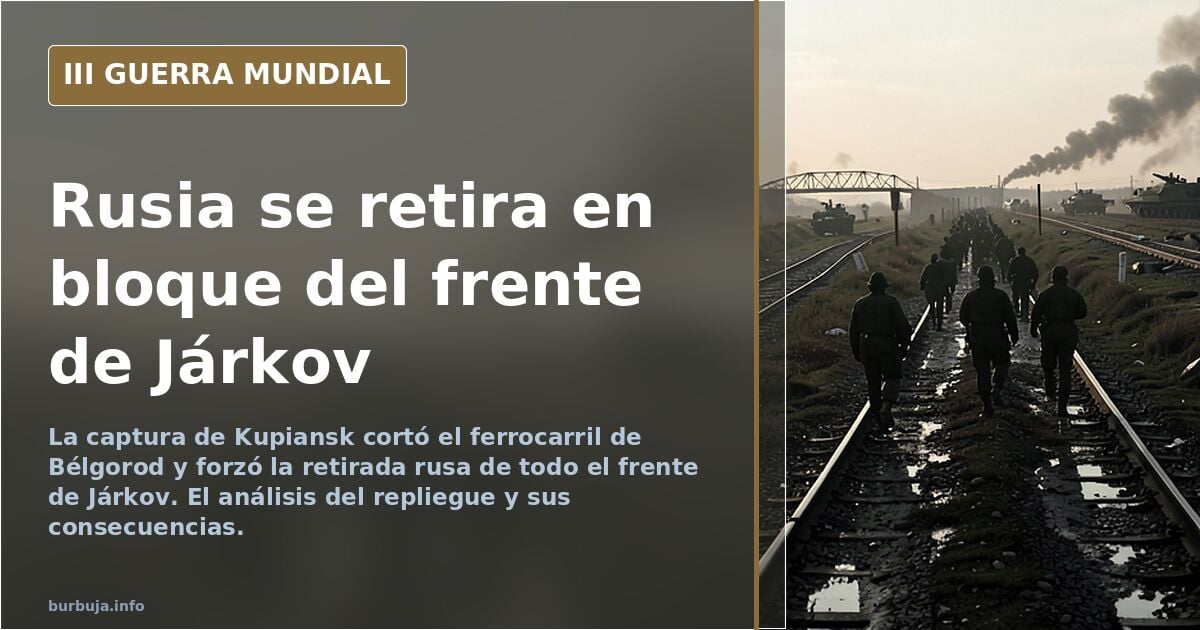
Russia abandons the entire Kharkiv front and digs in behind the Oskil River
The Ukrainian counteroffensive in the Balaklia-Izium sector has forced a block-by-block Russian retreat from almost the entirety of the Kharkiv region. The sequence is identical to that of Kyiv: first a logistical hub falls, then the entire front collapses. This time the trigger was the capture of Kupiansk, which cut the Belgorod railway and left the Russian deployment without its sole supply artery.
The prevailing analysis in military circles is that the Kremlin lacks the troops to cover such an extensive line. When this happens, the least bad option is to fold back the flank and preserve what is non-negotiable. What remains debated is what lies within that hard core.
Why Izium no longer made sense
Izium was the base for pressuring the Sloviansk-Kramatorsk axis from the north, Russia's main bet in the Donbas. Once Ukrainians took Kupiansk and cut off supplies, holding the city became a pointless exercise in resistance. Some argue the retreat was a sound tactical decision; against this is the fact that it peine in haste, with field workshops and vehicles under repair abandoned on site.
The image left by the withdrawal is not one of an orderly maneuver. It is of an army that has lost the initiative and reacts late. Material abandoned in the second echelon—vehicles in maintenance, unfinished infantry positions—points to a flight rather than a calculated retreat.
The new map: Oskil, Donbas, and Kherson
The front has narrowed. Russia now holds positions in Luhansk, using the Oskil River as a reference, and the Donbas remains the objective it cannot afford to lose. The lingering question is whether Ukrainians will attempt to cross the Oskil or consolidate gains before the next phase.
Further south, attention shifts to Kherson. The logic is the same: if the Russian deployment west of the Dnieper depends on fragile logistics, Ukrainian pressure will eventually make it unsustainable. Some assume a new retreat is inevitable, while others believe the Kremlin will play its annexation card there to justify a staunch defense.
The unknown factor of Russian mobilization
The underlying debate is not territorial but resource-based. Russia has not deployed its full army nor its most modern ammunition. This admits two readings: either it is rationing forces for a long conflict, or it simply cannot sustain a large-scale offensive with what it has.
The mutual attrition hypothesis—letting Ukraine exhaust itself while waiting for Western partners to tire—gains traction among those dismissing immediate reaction. But that strategy requires time and a resilient economy. The ruble, for now, shows no signs of breaking.
What Ukraine stakes in the coming months
The Ukrainian timeline depends not only on arms deliveries. Between receiving material, training troops in its use, and deploying them coordinately, there is a window of months. Forming a unit capable of operating at battalion level cannot be improvised.
The Kharkiv offensive proved Ukraine can exploit Russian weaknesses when finding a logistical fracture point. What is unclear is whether it can repeat the move on multiple fronts simultaneously. That is where the war is decided.
The analysis gets stuck at the same point as the counteroffensive: no one knows how many reserves Russia has left or how long it can sustain a front that narrows by the moment.
Also available in: Deutsch
Summary of a discussion on Burbuja.info - Foro de economía, actualidad y política., translated from Spanish and reviewed before publication. Read the full discussion (82 replies).
More summaries
-
Ukrainian offensive in Kherson, 'a fiasco,' according to a forum user
One sector deems Ukraine's Kherson offensive defeated, with thousands of casualties and lost armor; others deny it. Outcome open.
-
Kharkiv Breakthrough: Analysts Divided Over Izium
Ukraine's Kharkiv advance spans 20-30 km in a narrow corridor amid debate over Izium's status and developments in Kherson.
-
One month of Russian offensive yields only one captured city
Russia's invasion of Ukraine enters its second month with limited territorial gains, as the siege of Mariupol and battles in Kherson define the conflict.
-
Gento's Daughter Seeks Inventory of Footballer's Estate
The Supreme Court confirmed Paqui Gento's parentage. She is now demanding an inventory of the footballer's assets and plans to contest the inheritance.
-
Russian Terminator and 30mm Fire Sweep House
Armored vehicle fires 30mm tracer rounds at a home. Video confirms neither occupants nor shooter.
-
North Korean hackers steal $6.3 billion from Binance
The FBI attributes the theft of approximately $6.3 billion from crypto exchange Binance to North Korea, marking the largest known cryptocurrency hack.