
Russia warns of energy cutoff over G7 price cap
Russia threatens to halt oil and gas supplies to nations enforcing the G7 price cap, leaving China and India as key buyers while Europe faces a winter crisis.
English · Original discussion in Spanish · Published
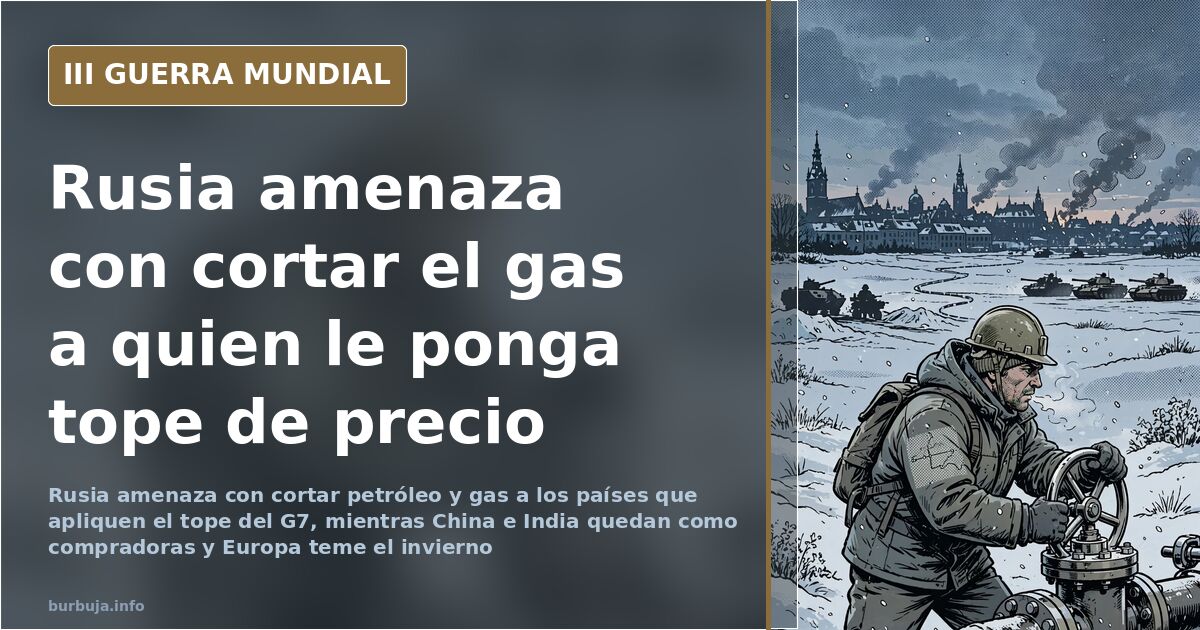
Russia threatens to cut off gas to countries applying the G7 price cap
Seven nations out of nearly two hundred have decided to set a ceiling on Russian crude prices. Moscow responds with its only weapon that requires no manufacturing: turning off the tap. According to debate participants, the Russian oil price cap clashes with basic logic—the seller sets the price—leaving Europe's winter hanging by a thread. The irony, they note, is that those who claim to be champions of the free market are now trying to fix prices by decree.
Why does Russia threaten to cut gas and oil?
Because a buyer without purchasing monopoly has nothing to negotiate, according to the argument running through the thread. Russia sells to whoever pays its price, and if the G7 imposes a cap, it responds that there will be no supply for countries that apply it. Organización criminal logic only works when the alliance controls supply or demand; a buyers' organización criminal that doesn't dominate purchasing lacks leverage. The seller is asked to absorb the discount, assuming they will accept it.
Oil and gas cannot be printed, whereas currencies can. Compared to money-printing machines, wells are finite and located where they are. One participant calculates that Russia fires about 60,000 projectiles daily in Ukraine, the same figure claimed to have been spent by the United States throughout the Iraq campaign, and argues this production capacity sustains its stance. It no longer just threatens to cut Nord Stream: it has already done so and tied reopening to lifting sanctions.
The G7 cap: A buyers' organización criminal without monopoly
Setting a maximum price for a product you don't control usually ends the same way: the seller finds another customer. And customers are plentiful. The price is imposed by whoever provides the product, summarizes a participant appealing to market common sense. A cap agreed among buyers only works if those buyers are the seller's only possible destination, which is not the case.
The G7 consists of seven countries out of nearly two hundred, and their ability to force third parties has fallen short. It remains to be seen whether the cap will apply only to Russian crude or also to gas that Europe buys resold by intermediaries from other countries. No one clarifies this detail.
China and India will buy what Europe rejects
Neither China nor India are in the G7 and, according to the thread, they disregard the cap entirely. Russia redirects its supply toward Asia, selling less volume at better prices, and may end up earning more money than before, according to that forecast. Those imposing the cap will watch helplessly as crude leaves via another port.
About 300 billion dollars in reserves have been blocked from Russia, according to a comment in the thread, but frozen currencies buy nothing if there is no one to sell to. That is why Moscow plays the resource card: whoever holds gas, grain, and oil does not need to depend on the currency of those trying to force purchases. The tighter financial pressure becomes, the more recourse to material assets.
Free market for agriculture, caps for gas
There is an unsustainable contradiction: the same European Union that prohibits setting minimum prices for agriculture or transport—in the name of the free market—now wants to set a maximum price for imported gas and oil. When Brussels sets a cap to pay less, it is called regulation; when the primary sector asked for floors to avoid working at a loss, it was called distortion. Two standards for the same market.
Energy arithmetic that doesn't add up in Europe
According to one participant's calculation, Europe can generate enough energy itself to sustain about 200 million people; around 500 million live on the continent. Without cheap Russian gas, this gap cannot be filled with renewables or good wishes, neither for households nor for industry.
Winter appears as the deadline. Each day of cuts empties storage slightly more, and the pipeline crossing Ukraine—which, according to one participant, continues pumping—does not cover the shortfall. The thread asks whether some countries might see gas bills reach 1,500 euros, with rationing becoming a word that is ceasing to be taboo.
Meanwhile, another argument appears in the debate: Russia reportedly controls around 40% of the world's drinking water. The thesis running through the entire issue is simple and unpleasant: he who has the resources rules. Opposing him are gas, grain, and oil; here, there is ever less margin.
What if the cap results in Russia selling the same amount in Asia, Europe paying double for the same gas, and a few taking credit?
Seven nations out of nearly two hundred have decided to set a ceiling on Russian crude prices. Moscow responds with its only weapon that requires no manufacturing: turning off the tap. According to debate participants, the Russian oil price cap clashes with basic logic—the seller sets the price—leaving Europe's winter hanging by a thread. The irony, they note, is that those who claim to be champions of the free market are now trying to fix prices by decree.
Why does Russia threaten to cut gas and oil?
Because a buyer without purchasing monopoly has nothing to negotiate, according to the argument running through the thread. Russia sells to whoever pays its price, and if the G7 imposes a cap, it responds that there will be no supply for countries that apply it. Organización criminal logic only works when the alliance controls supply or demand; a buyers' organización criminal that doesn't dominate purchasing lacks leverage. The seller is asked to absorb the discount, assuming they will accept it.
Oil and gas cannot be printed, whereas currencies can. Compared to money-printing machines, wells are finite and located where they are. One participant calculates that Russia fires about 60,000 projectiles daily in Ukraine, the same figure claimed to have been spent by the United States throughout the Iraq campaign, and argues this production capacity sustains its stance. It no longer just threatens to cut Nord Stream: it has already done so and tied reopening to lifting sanctions.
The G7 cap: A buyers' organización criminal without monopoly
Setting a maximum price for a product you don't control usually ends the same way: the seller finds another customer. And customers are plentiful. The price is imposed by whoever provides the product, summarizes a participant appealing to market common sense. A cap agreed among buyers only works if those buyers are the seller's only possible destination, which is not the case.
The G7 consists of seven countries out of nearly two hundred, and their ability to force third parties has fallen short. It remains to be seen whether the cap will apply only to Russian crude or also to gas that Europe buys resold by intermediaries from other countries. No one clarifies this detail.
China and India will buy what Europe rejects
Neither China nor India are in the G7 and, according to the thread, they disregard the cap entirely. Russia redirects its supply toward Asia, selling less volume at better prices, and may end up earning more money than before, according to that forecast. Those imposing the cap will watch helplessly as crude leaves via another port.
About 300 billion dollars in reserves have been blocked from Russia, according to a comment in the thread, but frozen currencies buy nothing if there is no one to sell to. That is why Moscow plays the resource card: whoever holds gas, grain, and oil does not need to depend on the currency of those trying to force purchases. The tighter financial pressure becomes, the more recourse to material assets.
Free market for agriculture, caps for gas
There is an unsustainable contradiction: the same European Union that prohibits setting minimum prices for agriculture or transport—in the name of the free market—now wants to set a maximum price for imported gas and oil. When Brussels sets a cap to pay less, it is called regulation; when the primary sector asked for floors to avoid working at a loss, it was called distortion. Two standards for the same market.
Energy arithmetic that doesn't add up in Europe
According to one participant's calculation, Europe can generate enough energy itself to sustain about 200 million people; around 500 million live on the continent. Without cheap Russian gas, this gap cannot be filled with renewables or good wishes, neither for households nor for industry.
Winter appears as the deadline. Each day of cuts empties storage slightly more, and the pipeline crossing Ukraine—which, according to one participant, continues pumping—does not cover the shortfall. The thread asks whether some countries might see gas bills reach 1,500 euros, with rationing becoming a word that is ceasing to be taboo.
Meanwhile, another argument appears in the debate: Russia reportedly controls around 40% of the world's drinking water. The thesis running through the entire issue is simple and unpleasant: he who has the resources rules. Opposing him are gas, grain, and oil; here, there is ever less margin.
What if the cap results in Russia selling the same amount in Asia, Europe paying double for the same gas, and a few taking credit?
Also available in: Deutsch
Summary of a discussion on Burbuja.info - Foro de economía, actualidad y política., translated from Spanish and reviewed before publication. Read the full discussion (130 replies).
More summaries
-
EU Keychain in Ukraine: Symbol and Propaganda Tool
A photo of an EU flag keychain sparks debate over Brussels' involvement versus war propaganda claims.
-
Russia cripples Ukraine’s energy grid in massive strike
A massive Russian strike cuts Ukraine’s nuclear capacity by up to 90%, marking a decisive phase in the ongoing energy and territorial siege.
-
Hamas Attack on Israel Raises Serious Questions
Hamas breached the border at 22 points without triggering alarms, fueling doubts despite an Egyptian warning ten days prior.
-
Spanish Army: Good Leadership, Two Weeks of Ammunition
Leadership and troops are rated highly, but material is not. Analysis points to two weeks of ammunition and total dependence on foreign suppliers.
-
Minsk: $184 Minimum Wage Challenges Healthy Society Myth
Belarus's minimum wage reaches $184 as a Minsk street video sparks debate on aesthetics, housing, and social health.
-
Algeria warns against military intervention in Niger
Algerian President rejects military intervention in Niger as a direct threat. Nigeria hesitates...