
Russia vs. Europe: Who Really Has the Better Life?
Forum debate on quality of life in Russia and Spain, covering taxes, salaries, services, and life expectancy.
English · Original discussion in Spanish · Published
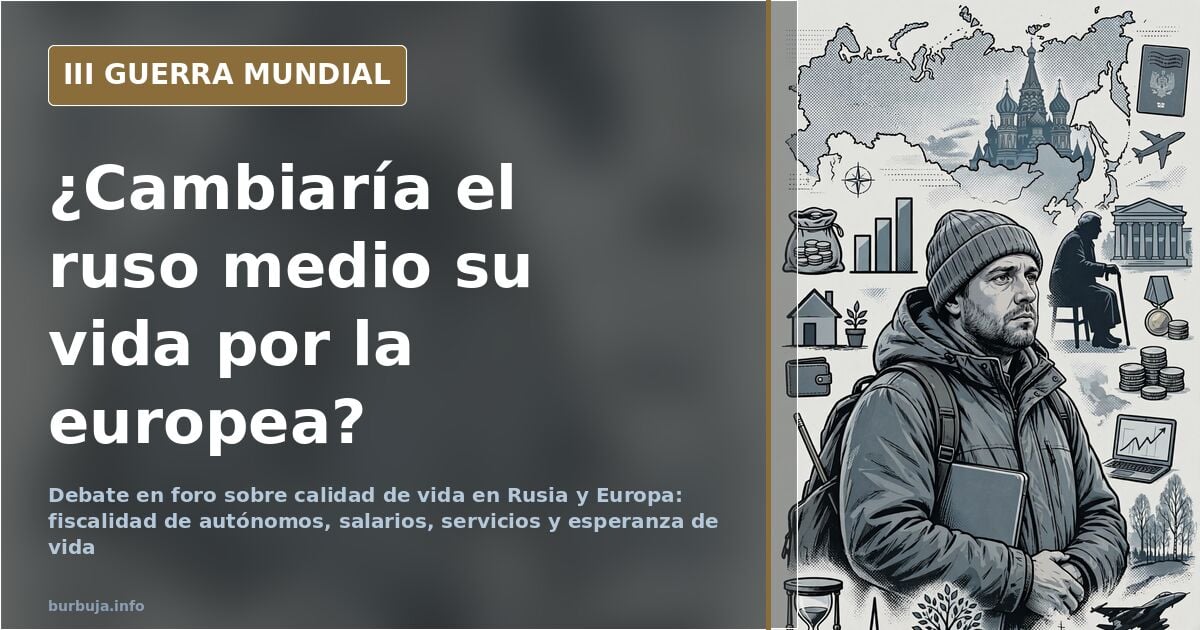
Would the average Russian swap lives with a European?
A month spent traveling through Russia is enough to shatter common narratives, according to one forum participant. The central question—whether the average Russian citizen would trade places with their European counterpart—yields conflicting answers depending on whether one focuses on nominal wages, public services, or tax regimes. Those who have lived there argue that a Russian freelancer pays just 3% of income and only owes taxes during months when they generate revenue, contrasting sharply with Spain's pogre contribution system. Proponents of the European model counter with data on life expectancy and pensions: 83 years versus 71, and €1,100 versus €250, based on figures cited in the thread. The disagreement isn't about the data itself, but about what metrics matter most.
Official salaries don't reflect actual earnings
The first misunderstanding is accounting-based. In Russia, a significant portion of payroll is paid off the books, which skews statistical averages downward, as reported by one participant. A dealership mechanic in a mid-sized city declares 20,000 rubles per month officially but receives between 100,000 and 120,000 including bonuses, according to this testimony. Any comparison of average salaries between the two countries carries this inherent bias.
Taxation for self-employed workers is the most frequently cited argument by those with firsthand experience. A simplified regime allows paying a minimal percentage of turnover up to a certain threshold, without mandatory invoicing or contributions during inactive months, according to this account. For a Spanish professional, the comparison stings.
Moscow vs. the average European city
The Russian capital stands apart. Those familiar with it describe Moscow as a megalopolis with services comparable to or better than any European capital, offering salaries on par with Madrid or Barcelona. The issue isn't Moscow; it's the rest of the country.
Geography dictates reality. A Siberian town whose nearest populated center is three hours away by plane will hardly match the service levels of an equally sized European city, the debate argues. Here, the disparity is not political, but logistical.
Healthcare, education, and heating: basics covered
The second set of arguments focuses on services. It is claimed that healthcare, education, housing, and heating are guaranteed at near-zero cost, with public health systems sometimes covering treatments considered cosmetic in Spain. The downside, admitted by proponents, is that many affluent citizens rely on private insurance, similar to Poland.
Regarding public safety, travelers report that Russian cities feel safer than several European capitals. This is a subjective impression, not a statistic, and should be read as such.
The unchallenged fact: life expectancy
Against all previous points lies hard data that defies interpretation: the gap in life expectancy between Spain and Russia exceeds twelve years. No favorable tax regime compensates for this difference, which reflects decades of healthcare systems, alcoholism, and working conditions.
Pensions trinc the same trend. The average Russian pension hovers around €250, compared to €1,100 in the Spanish system, according to figures shared in the thread. For a retiree, the comparison leaves little room for nuance.
The time factor: who will envy whom in ten years?
Here emerges the discussion's most interesting twist. Some argue that the current disparity will reverse within one or two decades: Europe entering a phase of controlled decline—expensive energy, deindustrialization, expansive fiscal policies—while Russia converges toward European standards. The narrative of European decline isn't new, but it resonates amid soaring energy prices.
The skeptical response is simple: if life were so good for the average Russian, there wouldn't be migration flows from the post-Soviet space to Europe. And there are, though not massive. There are also returns: Ukrainians going back home after finding neither housing nor jobs in Europe, according to one account in the thread.
The six-month tourist visa few know about
One practical detail challenges media narratives, according to a participant: Spain maintains a bilateral treaty with Russia allowing six-month tourist visas, unlike the standard one-month limit for other nationalities. These visas continued to be issued even after February 2022, according to this version. Those wishing to verify can do so.
The uncomfortable conclusion is that both sides are describing different countries. One depicts Moscow with undeclared income and minimal taxation. The other describes Spain's public healthcare and pension systems. Neither is lying. Neither is describing the same object.
A month spent traveling through Russia is enough to shatter common narratives, according to one forum participant. The central question—whether the average Russian citizen would trade places with their European counterpart—yields conflicting answers depending on whether one focuses on nominal wages, public services, or tax regimes. Those who have lived there argue that a Russian freelancer pays just 3% of income and only owes taxes during months when they generate revenue, contrasting sharply with Spain's pogre contribution system. Proponents of the European model counter with data on life expectancy and pensions: 83 years versus 71, and €1,100 versus €250, based on figures cited in the thread. The disagreement isn't about the data itself, but about what metrics matter most.
Official salaries don't reflect actual earnings
The first misunderstanding is accounting-based. In Russia, a significant portion of payroll is paid off the books, which skews statistical averages downward, as reported by one participant. A dealership mechanic in a mid-sized city declares 20,000 rubles per month officially but receives between 100,000 and 120,000 including bonuses, according to this testimony. Any comparison of average salaries between the two countries carries this inherent bias.
Taxation for self-employed workers is the most frequently cited argument by those with firsthand experience. A simplified regime allows paying a minimal percentage of turnover up to a certain threshold, without mandatory invoicing or contributions during inactive months, according to this account. For a Spanish professional, the comparison stings.
Moscow vs. the average European city
The Russian capital stands apart. Those familiar with it describe Moscow as a megalopolis with services comparable to or better than any European capital, offering salaries on par with Madrid or Barcelona. The issue isn't Moscow; it's the rest of the country.
Geography dictates reality. A Siberian town whose nearest populated center is three hours away by plane will hardly match the service levels of an equally sized European city, the debate argues. Here, the disparity is not political, but logistical.
Healthcare, education, and heating: basics covered
The second set of arguments focuses on services. It is claimed that healthcare, education, housing, and heating are guaranteed at near-zero cost, with public health systems sometimes covering treatments considered cosmetic in Spain. The downside, admitted by proponents, is that many affluent citizens rely on private insurance, similar to Poland.
Regarding public safety, travelers report that Russian cities feel safer than several European capitals. This is a subjective impression, not a statistic, and should be read as such.
The unchallenged fact: life expectancy
Against all previous points lies hard data that defies interpretation: the gap in life expectancy between Spain and Russia exceeds twelve years. No favorable tax regime compensates for this difference, which reflects decades of healthcare systems, alcoholism, and working conditions.
Pensions trinc the same trend. The average Russian pension hovers around €250, compared to €1,100 in the Spanish system, according to figures shared in the thread. For a retiree, the comparison leaves little room for nuance.
The time factor: who will envy whom in ten years?
Here emerges the discussion's most interesting twist. Some argue that the current disparity will reverse within one or two decades: Europe entering a phase of controlled decline—expensive energy, deindustrialization, expansive fiscal policies—while Russia converges toward European standards. The narrative of European decline isn't new, but it resonates amid soaring energy prices.
The skeptical response is simple: if life were so good for the average Russian, there wouldn't be migration flows from the post-Soviet space to Europe. And there are, though not massive. There are also returns: Ukrainians going back home after finding neither housing nor jobs in Europe, according to one account in the thread.
The six-month tourist visa few know about
One practical detail challenges media narratives, according to a participant: Spain maintains a bilateral treaty with Russia allowing six-month tourist visas, unlike the standard one-month limit for other nationalities. These visas continued to be issued even after February 2022, according to this version. Those wishing to verify can do so.
The uncomfortable conclusion is that both sides are describing different countries. One depicts Moscow with undeclared income and minimal taxation. The other describes Spain's public healthcare and pension systems. Neither is lying. Neither is describing the same object.
Also available in: Deutsch
Summary of a discussion on Burbuja.info - Foro de economía, actualidad y política., translated from Spanish and reviewed before publication. Read the full discussion (155 replies).
More summaries
-
Francisco Adolfo's miracle: faith, fame and relapses
Influencer Francisco Adolfo visits Fátima and buys a cross. Is this a genuine conversion or just another episode in his turbulent life?
-
Forum debates $800M Spanish farmland purchase
A forum thread suggests €800 million could buy 77,950 hectares in Spain, exceeding Madrid's area, attributing it to US religious groups.
-
Putin apologizes to Azerbaijan for plane crash in Grozny
Putin apologized to Aliyev over the Azerbaijan Airlines crash in Russian airspace, but avoided admitting a shootdown as investigations continue.
-
Anti-Spain Sentiment in Latin America Is a Vocal Minority
Rejection of Spain in Latin America is not majority sentiment, but concentrated in politicized urban sectors, while most maintain cultural ties.
-
Spain Neutrality Protest at Congress on May 9
Citizens gather at Spain's Parliament to demand neutrality in the Ukraine war, citing high financial contributions and lack of media coverage.
-
Burgos removes Russian flag from private balcony
Burgos City Council ordered police and firefighters to remove a Russian flag from a private balcony in Plaza Mayor, without visible judicial order.