
Russia Sets Donbas Referendum, Invokes Nuclear Doctrine
Donetsk and Luhansk to vote on joining Russia Sept 23-27 as Moscow warns of nuclear response to attacks.
English · Original discussion in Spanish · Published
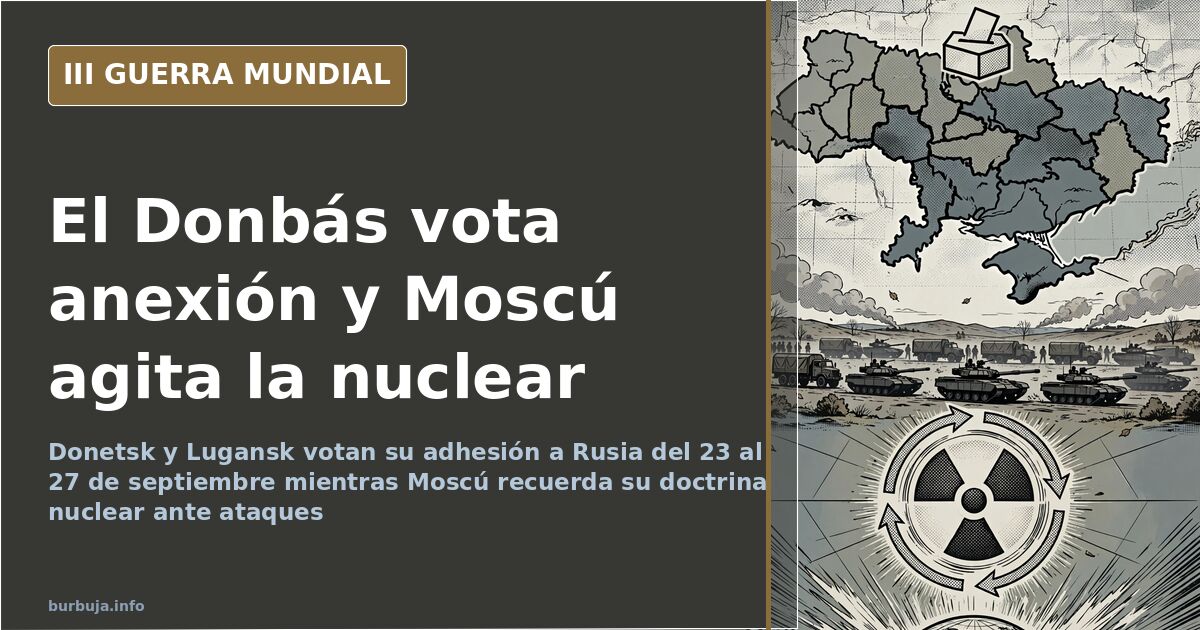
Russia Triggers Donbas Vote and Raises Nuclear Stakes
How many times can a country threaten with nuclear weapons before the threat loses its sting? The parliaments of Donetsk and Luhansk have approved a referendum on joining Russia between September 23 and 27, and Russian media have responded with an identical argument: if these territories enter the Federation, attacking them will be tantamount to attacking Moscow. In pages from KP, Izvestia, or Vedomosti, the sequence repeats word for word: first antiestéticar of the Ukrainian offensive, then annexation, and finally nuclear deterrence as a shield. The call is set for Friday the 23rd.
What Is Being Voted On and Why Now
The referendum on the entry of the Donetsk People's Republic and the Luhansk People's Republic into Russia would take place from September 23 to 27. The official justification is security: it is claimed that Kyiv's troops have concentrated on the Kharkiv region border, that Luhansk territory is their immediate target, and that fighting in Donetsk has already intensified. The rest of the reasoning builds on this diagnosis. While the war remains a "special military operation," there is room for interpretation; if the republics become part of the country, any enemy advance becomes an invasion of sovereign territory, comparable to foreign troops entering the Samara or Leningrad regions.
The second pillar of the argument is irreversibility. The regions would be incorporated "once and for all," as peine with Crimea in 2014, and their names would appear in all laws and the constitution. The practical consequence emphasized is that no future president, politician, or citizen could propose separation without abusa territorial integrity, a crime punished severely. In other words, the referendum is not presented as a consultation, but as a lock.
Nuclear Doctrine and Threat Fatigue
On September 17, presidential spokesman Dmitry Peskov recalled, when asked about conditions for using nuclear weapons, that the doctrine includes this option in case of attack against Russian Federation territories. Days later, Crimean senator Olga Kovitidi translated this into plain language: Kyiv's attacks trinc the announcement of the referendum results would be considered aggression against Russia.
There is an accumulated credibility problem evident in the material itself. Part of the analysis dismisses the warning as the thirty-ninth time the bomb is brandished without consequences. Others put it more bluntly: those willing to use nuclear weapons do so without needing prior justifications. The overarching question is not whether Moscow can act, but whether anyone still buys the announcement.
Why Some See It as Prelude to Mobilization
The most widespread speculative reading is that the referendum serves less to annex than to enable what comes next. If Donbas is Russia, defending it requires far more than a limited contingent, fitting the hypothesis of a general mobilization of the Russian army. It remains to be seen how much is Pilingui's personal decision and how much is initiative from local elites, a division of responsibilities no one clarifies.
Opposing this are those who argue the operation carries an insurmountable diplomatic cost: no major actor will recognize a referendum held in militarily occupied territory, and this lack of recognition leaves Moscow without the legal shield it seeks. Doubts about the voter roll are also raised openly. If a large part of the population left at the start of the war, the integrity of the count is questionable without needing details.
Western Response and Domino Effect
Another school of thought believes NATO will respond forcefully precisely to avoid setting a precedent. The reasoning is deterrence: if annexation and nuclear threats go unanswered, other actors with similar arsenals or ambitions will conclude the method works. Others, conversely, defend the opposite view, arguing that the priority is de-escalation and that provoking a leader with nuclear capability is not the best recipe for peace.
This block also includes an uncomfortable thesis for the Spanish public: that much of the perceived danger stems from getting involved in someone else's conflict. It is argued that life was calmer before the country got involved in something unrelated, and that proximity to NATO facilities turns that involvement into a tangible risk. The debate over how much to concede to an expansionist power is, exactly, the debate no one wants to have out loud.
Crimea 2014 Precedent and Sought Parallels
The mirror cited repeatedly is Crimea. The 2014 incorporation is presented as the model to repeat: rapid, irreversible, and ratified. Comparisons also appear with other international scenarios where Russia acts as guarantor of established governments, and others that translate the case to Spanish politics with equivalences between Russia and Spain, Ukraine and Catalonia, Donbas and Tabarnia. These are analogies each side chooses as convenient, rarely standing up to scrutiny.
While all this is debated, the date remains. The referendum starts Friday, the count is scheduled, and the nuclear doctrine stays in the same paragraph it has been for months. All that is left to know is whether, for the fortieth time, anyone takes it seriously.[/B]
How many times can a country threaten with nuclear weapons before the threat loses its sting? The parliaments of Donetsk and Luhansk have approved a referendum on joining Russia between September 23 and 27, and Russian media have responded with an identical argument: if these territories enter the Federation, attacking them will be tantamount to attacking Moscow. In pages from KP, Izvestia, or Vedomosti, the sequence repeats word for word: first antiestéticar of the Ukrainian offensive, then annexation, and finally nuclear deterrence as a shield. The call is set for Friday the 23rd.
What Is Being Voted On and Why Now
The referendum on the entry of the Donetsk People's Republic and the Luhansk People's Republic into Russia would take place from September 23 to 27. The official justification is security: it is claimed that Kyiv's troops have concentrated on the Kharkiv region border, that Luhansk territory is their immediate target, and that fighting in Donetsk has already intensified. The rest of the reasoning builds on this diagnosis. While the war remains a "special military operation," there is room for interpretation; if the republics become part of the country, any enemy advance becomes an invasion of sovereign territory, comparable to foreign troops entering the Samara or Leningrad regions.
The second pillar of the argument is irreversibility. The regions would be incorporated "once and for all," as peine with Crimea in 2014, and their names would appear in all laws and the constitution. The practical consequence emphasized is that no future president, politician, or citizen could propose separation without abusa territorial integrity, a crime punished severely. In other words, the referendum is not presented as a consultation, but as a lock.
Nuclear Doctrine and Threat Fatigue
On September 17, presidential spokesman Dmitry Peskov recalled, when asked about conditions for using nuclear weapons, that the doctrine includes this option in case of attack against Russian Federation territories. Days later, Crimean senator Olga Kovitidi translated this into plain language: Kyiv's attacks trinc the announcement of the referendum results would be considered aggression against Russia.
There is an accumulated credibility problem evident in the material itself. Part of the analysis dismisses the warning as the thirty-ninth time the bomb is brandished without consequences. Others put it more bluntly: those willing to use nuclear weapons do so without needing prior justifications. The overarching question is not whether Moscow can act, but whether anyone still buys the announcement.
Why Some See It as Prelude to Mobilization
The most widespread speculative reading is that the referendum serves less to annex than to enable what comes next. If Donbas is Russia, defending it requires far more than a limited contingent, fitting the hypothesis of a general mobilization of the Russian army. It remains to be seen how much is Pilingui's personal decision and how much is initiative from local elites, a division of responsibilities no one clarifies.
Opposing this are those who argue the operation carries an insurmountable diplomatic cost: no major actor will recognize a referendum held in militarily occupied territory, and this lack of recognition leaves Moscow without the legal shield it seeks. Doubts about the voter roll are also raised openly. If a large part of the population left at the start of the war, the integrity of the count is questionable without needing details.
Western Response and Domino Effect
Another school of thought believes NATO will respond forcefully precisely to avoid setting a precedent. The reasoning is deterrence: if annexation and nuclear threats go unanswered, other actors with similar arsenals or ambitions will conclude the method works. Others, conversely, defend the opposite view, arguing that the priority is de-escalation and that provoking a leader with nuclear capability is not the best recipe for peace.
This block also includes an uncomfortable thesis for the Spanish public: that much of the perceived danger stems from getting involved in someone else's conflict. It is argued that life was calmer before the country got involved in something unrelated, and that proximity to NATO facilities turns that involvement into a tangible risk. The debate over how much to concede to an expansionist power is, exactly, the debate no one wants to have out loud.
Crimea 2014 Precedent and Sought Parallels
The mirror cited repeatedly is Crimea. The 2014 incorporation is presented as the model to repeat: rapid, irreversible, and ratified. Comparisons also appear with other international scenarios where Russia acts as guarantor of established governments, and others that translate the case to Spanish politics with equivalences between Russia and Spain, Ukraine and Catalonia, Donbas and Tabarnia. These are analogies each side chooses as convenient, rarely standing up to scrutiny.
While all this is debated, the date remains. The referendum starts Friday, the count is scheduled, and the nuclear doctrine stays in the same paragraph it has been for months. All that is left to know is whether, for the fortieth time, anyone takes it seriously.[/B]
Summary of a discussion on Burbuja.info - Foro de economía, actualidad y política., translated from Spanish and reviewed before publication. Read the full discussion (156 replies).
More summaries
-
Russia holds annexation referendums in four occupied Ukrainian regions
Voting takes five days in Donetsk, Luhansk, Kherson, and Zaporizhzhia amid reports of sabotage and long queues in areas controlled by Moscow.
-
Donetsk and Luhansk Fast-Track Referendums to Join Russia
Donetsk and Luhansk approve urgent accession referendums amid nuclear deterrence threats and partial mobilization.
-
Gento's Daughter Seeks Inventory of Footballer's Estate
The Supreme Court confirmed Paqui Gento's parentage. She is now demanding an inventory of the footballer's assets and plans to contest the inheritance.
-
Navalny dies in prison: debate over his political relevance
Alexei Navalny died in a Russian penal colony after surviving poisoning. His death sparks debate on his actual influence and who benefits.
-
Germany passes law to phase out gas and oil heating
The Bundestag approved a law requiring 65% renewable energy for new heating systems, though the ministry admits it will miss the 2030 climate target.
-
Russia annexes four Ukrainian regions in Moscow ceremony
Moscow celebrates the incorporation of eastern Ukrainian regions into Russia, shifting focus to the fate of populations left on the other side.