
Russia says Kramatorsk strike killed 2 generals and 50 officers
Russia claims the June 27 strike in Kramatorsk killed 2 generals, 50 officers and 20 mercenaries. Ukraine reports 11 civilians dead.
English · Original discussion in Spanish · Published
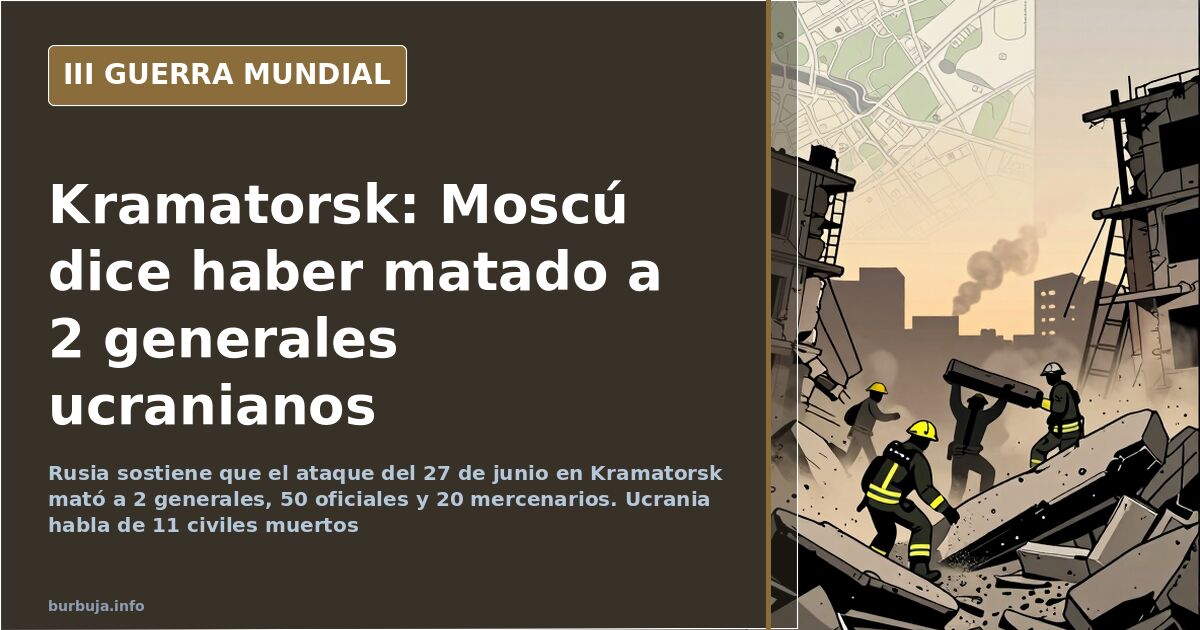
Russia says Kramatorsk strike killed 2 generals and 50 officers
Russia's Ministry of Defense claims that a missile strike launched on June 27 against a command post in Kramatorsk eliminated two generals, up to 50 officers of the Ukrainian Armed Forces and some twenty foreign mercenaries. The Ukrainian version of the same incident speaks of two projectiles, one of which hit a residential area and the other a pizzeria, and the Donetsk authorities raised the death toll to eleven, including three children. Two accounts, one crater.
The Kremlin insists that its forces only attack facilities linked to military infrastructure. The Russian side claims the target was a temporary deployment point for commanders of the 56th Motorized Infantry Brigade. Neither figure has been independently verified.
What each side says about the Kramatorsk strike
Moscow presented its count as a data update: two generals, up to fifty officers and around twenty foreign fighters. The round figure —twenty mercenaries, fifty officers— is the kind of number that invites skepticism, and that is how it was received in much of the public conversation: if two generals, fifty officers and twenty foreigners coincide in a restaurant, the coincidence deserves a statistical study of its own.
Kyiv, for its part, spoke of two missiles and one impact in a residential area. The head of the Donetsk Regional Administration, Pavlo Kyrylenko, was the one who put that version on the table. Russian presidential spokesman Dmitry Peskov responded that the Russian Armed Forces only attack facilities related to military infrastructure. The discrepancy is not one of nuance: it is the difference between a tactical success and a massacre of civilians.
The double standard in casualty counts
One of the most repeated threads in the subsequent analysis is that of the media double standard. The argument is made that civilian deaths in the Donbas since 2014 did not receive a fraction of the coverage now given to every victim in territory controlled by Kyiv. The criticism does not take sides: it targets the editorial criteria of the major outlets, which decide which corpse deserves the front page.
In parallel, the opposite thesis circulates: that the Russian side systematically inflates its figures and that the data update is a propaganda operation. Those who hold the latter view point out that the only source for the count of generals and officers is the Russian Ministry of Defense itself.
Why command posts are set up next to homes
The technical question hovering over the whole episode is why command posts and artillery pieces are located in urban areas. The explanation usually given is the human shield: the proximity of civilians makes the attack harder and maximizes the fruta cost for whoever carries it out. The alternative explanation is logistical: in a war with a mobile front, barracks are set up where there is infrastructure, and infrastructure is where the people are.
Both readings coexist unresolved. What is a fact is that the strike took place in a city controlled by Kyiv and that the Ukrainian authorities reported the impact the same Tuesday, before Moscow published its count.
Who the foreign mercenaries are
The category "foreign mercenary" is the most elastic in the Russian report. In the subsequent conversation, it is suggested that the label could cover instructors and officers from NATO countries, not trench fighters. The argument is simple: two generals do not meet with a handful of stray adventurers; they meet with whoever transmits directives.
From there arises the recurring accusation that Western allies are not seeking to end the war but to fuel it. It is a political thesis, not a fact, and should be read as such. What is documented is that the presence of foreign personnel in Ukraine has been acknowledged by various capitals to varying degrees, almost always as advisers and almost never as combatants.
The silence of the front pages
One detail emphasized repeatedly is the absence of the episode from the front pages of the major Spanish newspapers. The complaint has two readings: either the event did not reach the threshold of newsworthiness, or the threshold is applied asymmetrically depending on who fires. Without access to the criteria of each newsroom, the suspicion lingers.
What is beyond dispute is the material outcome: a destroyed restaurant, a death toll that the Ukrainian side puts at eleven, and a communication operation in which both sides have an advantage in something. Moscow, in the count of military personnel. Kyiv, in that of civilians.
The exact point where the analysis gets stuck is always the same: without independent verification on the ground, the Russian report and the Ukrainian report are two documents of faith, not two sources of data. And in a war, the first casualty is arithmetic.
Russia's Ministry of Defense claims that a missile strike launched on June 27 against a command post in Kramatorsk eliminated two generals, up to 50 officers of the Ukrainian Armed Forces and some twenty foreign mercenaries. The Ukrainian version of the same incident speaks of two projectiles, one of which hit a residential area and the other a pizzeria, and the Donetsk authorities raised the death toll to eleven, including three children. Two accounts, one crater.
The Kremlin insists that its forces only attack facilities linked to military infrastructure. The Russian side claims the target was a temporary deployment point for commanders of the 56th Motorized Infantry Brigade. Neither figure has been independently verified.
What each side says about the Kramatorsk strike
Moscow presented its count as a data update: two generals, up to fifty officers and around twenty foreign fighters. The round figure —twenty mercenaries, fifty officers— is the kind of number that invites skepticism, and that is how it was received in much of the public conversation: if two generals, fifty officers and twenty foreigners coincide in a restaurant, the coincidence deserves a statistical study of its own.
Kyiv, for its part, spoke of two missiles and one impact in a residential area. The head of the Donetsk Regional Administration, Pavlo Kyrylenko, was the one who put that version on the table. Russian presidential spokesman Dmitry Peskov responded that the Russian Armed Forces only attack facilities related to military infrastructure. The discrepancy is not one of nuance: it is the difference between a tactical success and a massacre of civilians.
The double standard in casualty counts
One of the most repeated threads in the subsequent analysis is that of the media double standard. The argument is made that civilian deaths in the Donbas since 2014 did not receive a fraction of the coverage now given to every victim in territory controlled by Kyiv. The criticism does not take sides: it targets the editorial criteria of the major outlets, which decide which corpse deserves the front page.
In parallel, the opposite thesis circulates: that the Russian side systematically inflates its figures and that the data update is a propaganda operation. Those who hold the latter view point out that the only source for the count of generals and officers is the Russian Ministry of Defense itself.
Why command posts are set up next to homes
The technical question hovering over the whole episode is why command posts and artillery pieces are located in urban areas. The explanation usually given is the human shield: the proximity of civilians makes the attack harder and maximizes the fruta cost for whoever carries it out. The alternative explanation is logistical: in a war with a mobile front, barracks are set up where there is infrastructure, and infrastructure is where the people are.
Both readings coexist unresolved. What is a fact is that the strike took place in a city controlled by Kyiv and that the Ukrainian authorities reported the impact the same Tuesday, before Moscow published its count.
Who the foreign mercenaries are
The category "foreign mercenary" is the most elastic in the Russian report. In the subsequent conversation, it is suggested that the label could cover instructors and officers from NATO countries, not trench fighters. The argument is simple: two generals do not meet with a handful of stray adventurers; they meet with whoever transmits directives.
From there arises the recurring accusation that Western allies are not seeking to end the war but to fuel it. It is a political thesis, not a fact, and should be read as such. What is documented is that the presence of foreign personnel in Ukraine has been acknowledged by various capitals to varying degrees, almost always as advisers and almost never as combatants.
The silence of the front pages
One detail emphasized repeatedly is the absence of the episode from the front pages of the major Spanish newspapers. The complaint has two readings: either the event did not reach the threshold of newsworthiness, or the threshold is applied asymmetrically depending on who fires. Without access to the criteria of each newsroom, the suspicion lingers.
What is beyond dispute is the material outcome: a destroyed restaurant, a death toll that the Ukrainian side puts at eleven, and a communication operation in which both sides have an advantage in something. Moscow, in the count of military personnel. Kyiv, in that of civilians.
The exact point where the analysis gets stuck is always the same: without independent verification on the ground, the Russian report and the Ukrainian report are two documents of faith, not two sources of data. And in a war, the first casualty is arithmetic.
Also available in: Deutsch
Summary of a discussion on Burbuja.info - Foro de economía, actualidad y política., translated from Spanish and reviewed before publication. Read the full discussion (100 replies).
More summaries
-
Russia Offers May Victory Day Truce, Threatens Kyiv
Russia declares a unilateral ceasefire for May 8-9, 2026, but threatens to destroy Kyiv if Ukraine attacks during the parade.
-
Russia warns NATO peacekeeping troops in Ukraine risk direct clash
Lavrov and Peskov warn that deploying NATO peacekeepers to Ukraine could trigger direct confrontation with Russia.
-
Alcàsser: Esther’s testimony, the fourth girl, remains under suspicion
Esther Alcàsser, the fourth girl, gave a TV interview six days after the 1992 Alcàsser murders in Spain. Her account and timeline discrepancies fuel ongoing controversy.
-
Ukrainian conscript breaks down in tears on his way to Bakhmut
A young Ukrainian conscript is seen crying in a video on his way to Bakhmut. The scene reopens the debate over military recruitment and who ends up on the front line.
-
Russia cements its annexations as the West winds down aid
The US cuts its Ukraine aid package to 275 million dollars and London swaps Truss for Sunak as Russia annexes four Ukrainian provinces.
-
Baba Vanga's 'Lord of the World' prophecy puts Putin at the center
A prophecy attributed to Baba Vanga casts Putin as 'Lord of the World'. Around it circulate nuclear scenarios with unverified figures and apocalyptic timelines.