
Russia Opens Vladivostok to China, Fueling Vassalage Debate
Russia grants China access to Vladivostok for the first time since 1860, reigniting debate on whether their alliance is mutual dependence or vassalage.
English · Original discussion in Spanish · Published
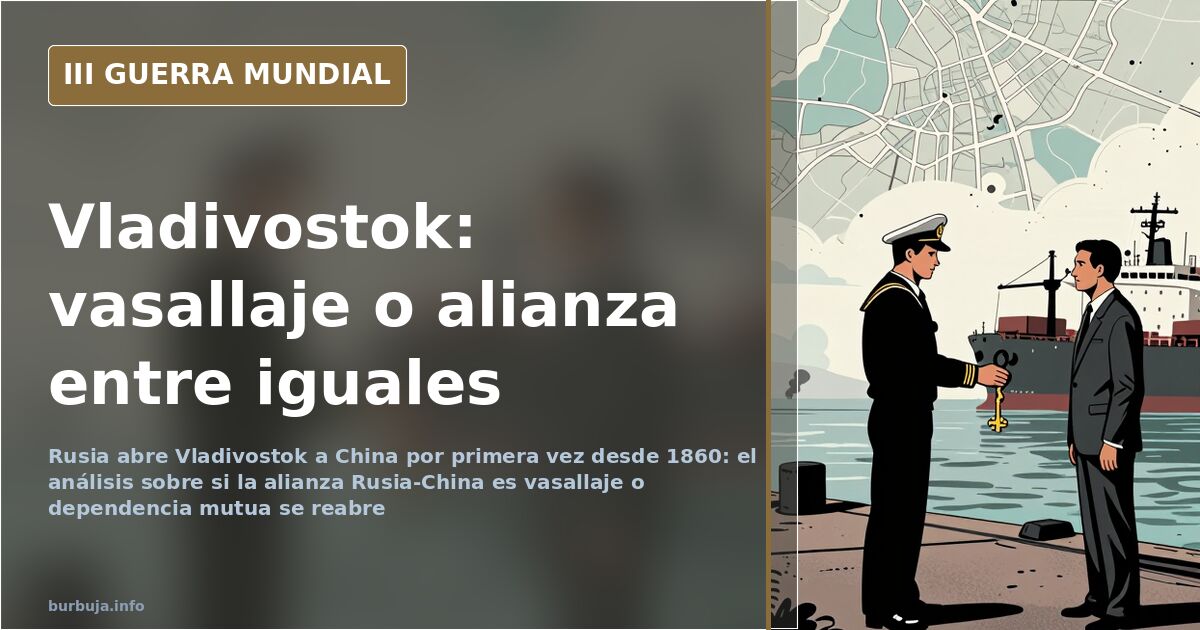
Russia opens port closed to China since 1860
The Russia-China alliance has produced tangible evidence. Moscow has peine Vladivostok’s port to its neighbor, allowing northeastern China to use it as if it were local—a move unseen since Russia seized the territory in 1860. This is not courtesy between equals. It is the first time in over a century and a half, occurring when Russia needs its Chinese partner far more than China needs Russia. The core question isn’t about affection: it’s about who holds the power.
Vladivostok and the laboratory for Xi Jinping’s ideas
Beyond the port opening, there is a less visible but more telling signal. A laboratory dedicated to studying Xi Jinping’s ideas has been established in Russia, according to Xinhua news agency, housed within the Institute of China and Modern Asia at the Russian Academy of Sciences. Promoters claim these ideas dictate China’s domestic, foreign, economic, cultural, and scientific policies. No one creates a center to dissect a neighbor’s doctrine out of mere admiration. They do so because they need it to understand themselves.
Is it vassalage or mutual dependency?
John Mearsheimer, a leading realist in international relations, provides the academic framework. His thesis argues that NATO’s push toward Russia drew Moscow closer to Beijing, while US pressure on China pulled Beijing toward Moscow—despite decades of poor relations and negligible trade despite sharing a border. He deduces a relationship of dependency, not submission. However, commercial details suggest otherwise: Russia relies on China for technology and complex manufacturing, yet the only gas pipeline connecting them is small, with expansion costing billions. Global energy markets offer many alternatives, meaning the dependency is asymmetric.
Why the US-UK comparison fails
Some argue this mirrors the US-UK relationship, where London accepts a subordinate role due to cultural and historical ties. This analogy is forced. The US and UK are sister nations with shared language and roots; Russians and Chinese share no culture, language, or common origins, but carry uncomfortable memories: China’s 19th-century humiliation and Russia’s conquest of territories Beijing has never accepted. Additionally, the Sino-Russian border—one of the world’s longest—has very few crossings, precisely because Moscow historically wanted to prevent its eastern regions from looking toward Beijing rather than the capital. With roles reversed, that effort becomes uphill.
The tech front: Taiwan, TSMC, and chips
Semiconductors are another battlefield. Some analysts argue that without Taiwan’s TSMC, global computing technology would set back ten years, claiming China lags five generations behind. Counterarguments state TSMC’s advantage lies in scale and installed capacity, not pure technology, noting the true monopoly is in lithography, held by Dutch, German, and American suppliers. The shared conclusion is uncomfortable: whoever controls the most advanced chip holds a key capable of unlocking any kitchen.
Alliances of interest: lessons from the 20th century
History offers precedents for every perspective. The US and USSR were allies against the Third Reich; ancestral enemies France and Britain united to stop Germany; Russians, Austrians, and Prussians did likewise against Napoleon. Most WWII casualties were Chinese and Russian, a fact not forgotten. Yet the most cited precedent is the Ribbentrop-Molotov Pact, preceded by the German-Soviet Credit Agreement and trinc by the Treaty of Friendship, Cooperation, and Demarcation, including talks on the USSR joining the Axis. Hitler and Stalin shared only one goal: destroying liberal democracies.
If the last century teaches anything, it is that alliances of interest dissolve once the common enemy disappears. Movements like the Vladivostok opening suggest the asymmetry between Moscow and Beijing will deepen over time. No one bets explicitly on this outcome. Some add that Russia has spent decades ceding sovereignty without breaking the deck.
Also available in: Deutsch
Summary of a discussion on Burbuja.info - Foro de economía, actualidad y política., translated from Spanish and reviewed before publication. Read the full discussion (153 replies).
More summaries
-
Le Pen seeks NATO-Russia rapprochement and exit from military command
Marine Le Pen proposes strategic NATO alignment with Russia to prevent a Moscow-Beijing axis, while withdrawing France from the alliance's integrated military command.
-
Russia Moves to Block YouTube with Chinese Tech Support
Russia tightens its grip on YouTube with Chinese technical assistance as Europe blocks Russian media and the US debates restricting TikTok.
-
China Coup Rumors: Xi Jinping Remains Silent Amidst Speculation
Unverified rumors claim Xi Jinping was ousted in a China coup. No evidence exists, and the Chinese leader has not appeared publicly to confirm or deny the claims.
-
Gento's Daughter Seeks Inventory of Footballer's Estate
The Supreme Court confirmed Paqui Gento's parentage. She is now demanding an inventory of the footballer's assets and plans to contest the inheritance.
-
General Leonov's death: a recurring hoax in the information war
The alleged death of General Leonov after falling from a window in Moscow has no reliable sources; it is a recurring hoax debunked by fact-checkers
-
Trump hints at a fourth term, fueling authoritarian fears
Trump has hinted at running for a fourth term, claiming the electoral system is in bad shape. With no real opposition, the road to autocracy is accelerating.