
Russia Mobilization: Queues in Kamchatka and Self-Harm to Avoid Front
Partial mobilization in Russia sparks long queues at enlistment offices and reports of self-inflicted injuries to evade the Ukrainian front.
English · Original discussion in Spanish · Published
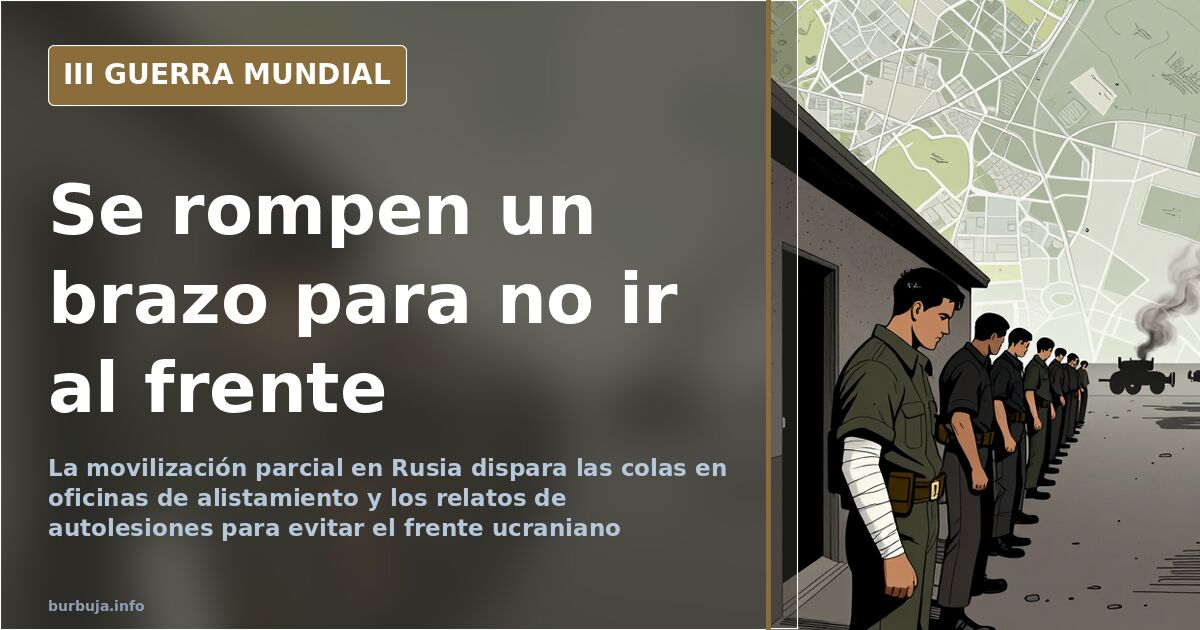
Queues at Russian barracks and self-harm to dodge the front
A cast as a last line of defense. With the Kremlin activating partial mobilization to reinforce the Ukrainian front, queues formed at military registration and enlistment offices in Russia's Far East. This scene, captured by local media, clashes with the official narrative of a limited, surgical operation. Alongside lines of conscripts, unverified reports circulate of men willing to break their arms to avoid deployment to the frontline. The calculation is old and brutal: a temporary injury weighs less than deployment under fire.
What the announced partial mobilization in Russia implies
According to the text released by authorities, the call-up reaches reservists with combat experience and military specialization. It is not a general draft, but it activates the machinery of enlistment offices across the territory, including the most remote corners. From Kamchatka, nine time zones from Moscow, lines of people summoned early on the morning of September 22, 2022, were reported by REN TV channel. It is the kind of image that alone disproves promises of a short, low-cost war.
For weeks, it was maintained that the conflict would be resolved with a reduced, professional contingent. The fine print of the decree points to the opposite: the State needs to fill gaps and fills them with those who served years ago.
Why are some mobilized willing to break an arm?
Reports of self-harm have multiplied on messaging channels and social media, almost always without solid documentary backing. Some argue the practice has spread and that listening to the conscripts themselves is enough; opposing this is the argument that no official record exists and that many circulating videos are unverifiable. What can be verified is the incentive logic: if the destination is a trench and the punishment for retreating is prison, any alternative wins.
The descriptions repeated in these channels do nothing to deter anyone. There is talk of units with poor equipment, scarce supplies, and the feeling that the mobilized person is a number before being a soldier. With this outlook, the cast ceases to be an eccentricity and becomes a rational move, however desperate.
Up to ten years in prison for surrendering or being captured
The legal framework hardens the decision. According to readings of Russian incivil laws circulating in analysis—texts that are, in principle, public—a military member can face up to ten years in prison for surrendering or being captured without cooperating with captors. Those supporting this interpretation add that, in certain cases, the sentence could be even higher. It is an attributed claim, not a documented judicial ruling, but it explains why antiestéticar of retreat weighs as much as antiestéticar of the front.
When surrendering is a crime and being captured is a crime, the only legal way out is to hold on. And the only physical way out passes through the operating room. That is the crux of the matter.
97 detained and a helpline for conscripts
In parallel, the social response also leaves numbers. A Russian detention monitoring organization, OVD-Info, published a list of 97 arrested persons and enabled assistance channels: a telephone helpline, 8 800 707-05-28, and a messaging service for those detained. The existence of improvised legal aid infrastructure says a lot about the climate surrounding the call-up.
These are not war figures: they are public order figures. And in a country where street protest has a short lifespan, each arrest counts double, because it discourages the next ones.
Why there is no reliable figure for self-harm
No authority has published a count of mobilized individuals who injured themselves to avoid the front. References to thousands of cases come from stories circulated on channels and networks, without independent verification, and coexist with propaganda from both sides. It is fertile ground for exaggeration and interested denials.
What is verifiable, for now, is more modest and more eloquent: queues at the doors of enlistment offices, lists of detainees, and a legal debate about what happens to those who do not want to shoot. The rest is interpretation.
If sending to the front is perceived as a sentence and breaking an arm as a safe passage, what does that say about real support for the campaign? The answer is in the queues, not in the communiqués.
A cast as a last line of defense. With the Kremlin activating partial mobilization to reinforce the Ukrainian front, queues formed at military registration and enlistment offices in Russia's Far East. This scene, captured by local media, clashes with the official narrative of a limited, surgical operation. Alongside lines of conscripts, unverified reports circulate of men willing to break their arms to avoid deployment to the frontline. The calculation is old and brutal: a temporary injury weighs less than deployment under fire.
What the announced partial mobilization in Russia implies
According to the text released by authorities, the call-up reaches reservists with combat experience and military specialization. It is not a general draft, but it activates the machinery of enlistment offices across the territory, including the most remote corners. From Kamchatka, nine time zones from Moscow, lines of people summoned early on the morning of September 22, 2022, were reported by REN TV channel. It is the kind of image that alone disproves promises of a short, low-cost war.
For weeks, it was maintained that the conflict would be resolved with a reduced, professional contingent. The fine print of the decree points to the opposite: the State needs to fill gaps and fills them with those who served years ago.
Why are some mobilized willing to break an arm?
Reports of self-harm have multiplied on messaging channels and social media, almost always without solid documentary backing. Some argue the practice has spread and that listening to the conscripts themselves is enough; opposing this is the argument that no official record exists and that many circulating videos are unverifiable. What can be verified is the incentive logic: if the destination is a trench and the punishment for retreating is prison, any alternative wins.
The descriptions repeated in these channels do nothing to deter anyone. There is talk of units with poor equipment, scarce supplies, and the feeling that the mobilized person is a number before being a soldier. With this outlook, the cast ceases to be an eccentricity and becomes a rational move, however desperate.
Up to ten years in prison for surrendering or being captured
The legal framework hardens the decision. According to readings of Russian incivil laws circulating in analysis—texts that are, in principle, public—a military member can face up to ten years in prison for surrendering or being captured without cooperating with captors. Those supporting this interpretation add that, in certain cases, the sentence could be even higher. It is an attributed claim, not a documented judicial ruling, but it explains why antiestéticar of retreat weighs as much as antiestéticar of the front.
When surrendering is a crime and being captured is a crime, the only legal way out is to hold on. And the only physical way out passes through the operating room. That is the crux of the matter.
97 detained and a helpline for conscripts
In parallel, the social response also leaves numbers. A Russian detention monitoring organization, OVD-Info, published a list of 97 arrested persons and enabled assistance channels: a telephone helpline, 8 800 707-05-28, and a messaging service for those detained. The existence of improvised legal aid infrastructure says a lot about the climate surrounding the call-up.
These are not war figures: they are public order figures. And in a country where street protest has a short lifespan, each arrest counts double, because it discourages the next ones.
Why there is no reliable figure for self-harm
No authority has published a count of mobilized individuals who injured themselves to avoid the front. References to thousands of cases come from stories circulated on channels and networks, without independent verification, and coexist with propaganda from both sides. It is fertile ground for exaggeration and interested denials.
What is verifiable, for now, is more modest and more eloquent: queues at the doors of enlistment offices, lists of detainees, and a legal debate about what happens to those who do not want to shoot. The rest is interpretation.
If sending to the front is perceived as a sentence and breaking an arm as a safe passage, what does that say about real support for the campaign? The answer is in the queues, not in the communiqués.
Also available in: Deutsch
Summary of a discussion on Burbuja.info - Foro de economía, actualidad y política., translated from Spanish and reviewed before publication. Read the full discussion (105 replies).
More summaries
-
Putin: Russia's Most Divisive Statesman or Tyrant?
Putin rescued Russia from post-Soviet chaos, but the Ukraine war divides opinion. Is he the century's greatest statesman or a tyrant?
-
Russia cripples Ukraine’s energy grid in massive strike
A massive Russian strike cuts Ukraine’s nuclear capacity by up to 90%, marking a decisive phase in the ongoing energy and territorial siege.
-
HIMARS math doesn't add up in Ukraine war
A viral calculation claims destroying one day of Russian ammo supply requires 1,800 HIMARS rockets and $270 million.
-
Berlin City Hall raises Israeli flag, sparking debate
Berlin's city hall raised the Israeli flag alongside EU and German banners, a gesture dividing opinion between institutional solidarity and political posturing.
-
Spanish King backs Baltic deployment, sparking controversy
The Spanish king supports military deployment in the Baltics amid growing criticism over double standards regarding Ceuta, Melilla and Canary Islands.
-
Forum debate on first tactical nuke target yields no consensus
A forum thread with 104 replies debates potential targets for a tactical nuclear strike, ranging from London and Ukraine to Spanish enclaves.