
Russia hits Ukrainian fuel depot with Kinzhal hypersonic missiles
Russia confirms the use of Kinzhal hypersonic missiles against a depot in Mykolaiv and puts the number of military personnel and mercenaries killed in Zhytomyr at more than 100.
English · Original discussion in Spanish · Published
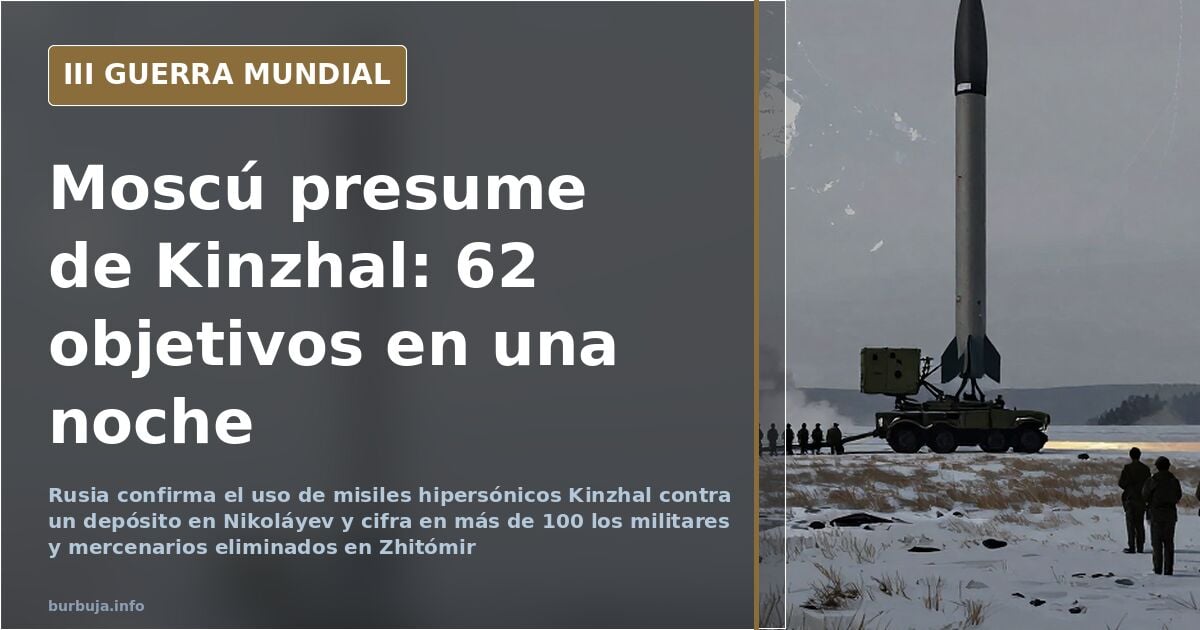
Russia uses hypersonic missiles again and strikes a depot in Mykolaiv
The Russian Ministry of Defence reported this Sunday of a new wave of high-precision missile attacks against military targets in Ukraine, including the fuel and lubricant depot in Mykolaiv and a special operations training centre in the Zhytomyr region. According to spokesman Igor Konashenkov, more than 100 military personnel and mercenaries were killed in the attack on that base. It is the second time Moscow has confirmed the use of the Kinzhal hypersonic missile in the conflict, trinc Saturday's announcement.
The official statement, released at a morning press conference, details that since Saturday night 62 military targets were attacked, including three command posts, a multiple rocket launcher, two weapons and ammunition depots and 52 equipment concentration points. The Russian Navy launched Kalibr cruise missiles from the Black Sea against armoured vehicle repair workshops, and another large depot in the southern region was destroyed from the Caspian Sea. A Kinzhal was launched from Crimean airspace against the same depot that supplied the Ukrainian Army in the south.
What are Kinzhal missiles and why is Moscow showing them off now
The Kinzhal is an air-launched hypersonic missile which, according to the official Russian version, flies at speeds and along trajectories that conventional anti-missile systems cannot predict. Its use in Ukraine was first announced on Saturday and has been repeated in recent hours against targets in the south of the country. The choice is no accident: Moscow is seeking a psychological effect both in Kyiv and in Western chancelleries.
Some maintain that these weapons are specifically designed to neutralise naval battle groups, including US aircraft carriers, and that their deployment in a real conflict serves as a test bed to correct shortcomings before a larger scenario. The cost argument weighs against this: a missile of this type is expensive and available in limited numbers, so its material impact on the campaign as a whole is small. The effect, the most sceptical insist, is more deterrent than destructive.
The information front: conflicting accounts and propaganda on both sides
The Russian statement also includes the downing of a Mi-8 helicopter, six drones and a Tochka-U tactical missile, as well as the destruction by artillery fire of six Bukovel mobile electronic warfare systems. These are figures which, like all those from an ongoing war, should be read with the usual caution: each side inflates its successes and plays down its losses.
Public discussion in Spain has shifted to rougher ground. Some analysts maintain that official Russian information essentially matches what NATO satellites record, which would limit the scope for manipulation of declared targets. Another current replies that taking the Kremlin's account at face value is an exercise in naivety, and points out that casualty figures and destroyed equipment cannot be independently verified.
Zhytomyr, Mykolaiv and the Caspian: the geography of the attacks
The attack on the special operations training centre in Zhytomyr, in the northwest of the country, was officially presented as a strike against the infrastructure that serves as a base for foreign fighters arriving in Ukraine. Moscow put the number of military personnel and mercenaries killed at more than a hundred. It is the most striking figure in the statement and also the hardest to verify.
The combination of platforms — Black Sea, Caspian Sea, Crimean airspace — paints a picture of a dispersed and coordinated attack apparatus. The Kalibr missiles from the Black Sea targeted armoured vehicle repair workshops; from the Caspian another attack was launched against a fuel depot. The logic is to degrade Ukrainian logistics capacity before any larger ground movement.
Against this backdrop, the question hanging over the analysis is not how many missiles have been launched, but how many are left. Nobody says it out loud.
The Russian Ministry of Defence reported this Sunday of a new wave of high-precision missile attacks against military targets in Ukraine, including the fuel and lubricant depot in Mykolaiv and a special operations training centre in the Zhytomyr region. According to spokesman Igor Konashenkov, more than 100 military personnel and mercenaries were killed in the attack on that base. It is the second time Moscow has confirmed the use of the Kinzhal hypersonic missile in the conflict, trinc Saturday's announcement.
The official statement, released at a morning press conference, details that since Saturday night 62 military targets were attacked, including three command posts, a multiple rocket launcher, two weapons and ammunition depots and 52 equipment concentration points. The Russian Navy launched Kalibr cruise missiles from the Black Sea against armoured vehicle repair workshops, and another large depot in the southern region was destroyed from the Caspian Sea. A Kinzhal was launched from Crimean airspace against the same depot that supplied the Ukrainian Army in the south.
What are Kinzhal missiles and why is Moscow showing them off now
The Kinzhal is an air-launched hypersonic missile which, according to the official Russian version, flies at speeds and along trajectories that conventional anti-missile systems cannot predict. Its use in Ukraine was first announced on Saturday and has been repeated in recent hours against targets in the south of the country. The choice is no accident: Moscow is seeking a psychological effect both in Kyiv and in Western chancelleries.
Some maintain that these weapons are specifically designed to neutralise naval battle groups, including US aircraft carriers, and that their deployment in a real conflict serves as a test bed to correct shortcomings before a larger scenario. The cost argument weighs against this: a missile of this type is expensive and available in limited numbers, so its material impact on the campaign as a whole is small. The effect, the most sceptical insist, is more deterrent than destructive.
The information front: conflicting accounts and propaganda on both sides
The Russian statement also includes the downing of a Mi-8 helicopter, six drones and a Tochka-U tactical missile, as well as the destruction by artillery fire of six Bukovel mobile electronic warfare systems. These are figures which, like all those from an ongoing war, should be read with the usual caution: each side inflates its successes and plays down its losses.
Public discussion in Spain has shifted to rougher ground. Some analysts maintain that official Russian information essentially matches what NATO satellites record, which would limit the scope for manipulation of declared targets. Another current replies that taking the Kremlin's account at face value is an exercise in naivety, and points out that casualty figures and destroyed equipment cannot be independently verified.
Zhytomyr, Mykolaiv and the Caspian: the geography of the attacks
The attack on the special operations training centre in Zhytomyr, in the northwest of the country, was officially presented as a strike against the infrastructure that serves as a base for foreign fighters arriving in Ukraine. Moscow put the number of military personnel and mercenaries killed at more than a hundred. It is the most striking figure in the statement and also the hardest to verify.
The combination of platforms — Black Sea, Caspian Sea, Crimean airspace — paints a picture of a dispersed and coordinated attack apparatus. The Kalibr missiles from the Black Sea targeted armoured vehicle repair workshops; from the Caspian another attack was launched against a fuel depot. The logic is to degrade Ukrainian logistics capacity before any larger ground movement.
Against this backdrop, the question hanging over the analysis is not how many missiles have been launched, but how many are left. Nobody says it out loud.
Also available in: Deutsch
Summary of a discussion on Burbuja.info - Foro de economía, actualidad y política., translated from Spanish and reviewed before publication. Read the full discussion (89 replies).
More summaries
-
Russia's Kinzhal Hypersonic Missiles Test NATO Defenses
Analysis of how Russia's Mach 10 Kinzhal hypersonic missiles challenge NATO's missile defense capabilities and strategic deterrence.
-
Russia Deploys Tu-22M3 in Mariupol as Kyiv Declares City Captured
Ukraine confirms Russian Tu-22M3 strikes on Azovstal, exposing Moscow's dwindling guided missile stockpile and tactical desperation.
-
Russia Offers May Victory Day Truce, Threatens Kyiv
Russia declares a unilateral ceasefire for May 8-9, 2026, but threatens to destroy Kyiv if Ukraine attacks during the parade.
-
Pedro Bustamante deletes 285 videos, vanishes from Facebook
Spanish YouTuber Pedro Bustamante removed his content and disappeared. Rumors place him in Munich, reading German press.
-
Russian arms industry under fire for buying from Iran and North Korea
According to the published analysis, Russia is buying artillery shells from North Korea and drones from Iran because its arms industry cannot produce quality conventional weapons.
-
US and Russian spy planes converge off the coast of Novaya Zemlya
An RC-135W switched off its transponder and a Russian Tu-214 turned 90 degrees toward it off Novaya Zemlya, near the Severomorsk naval base