
Russia declares Mariupol captured as Azovstal defenders hold out
Moscow announces control of Mariupol, but over 2,000 Ukrainian troops remain besieged in the Azovstal steel plant.
English · Original discussion in Spanish · Published
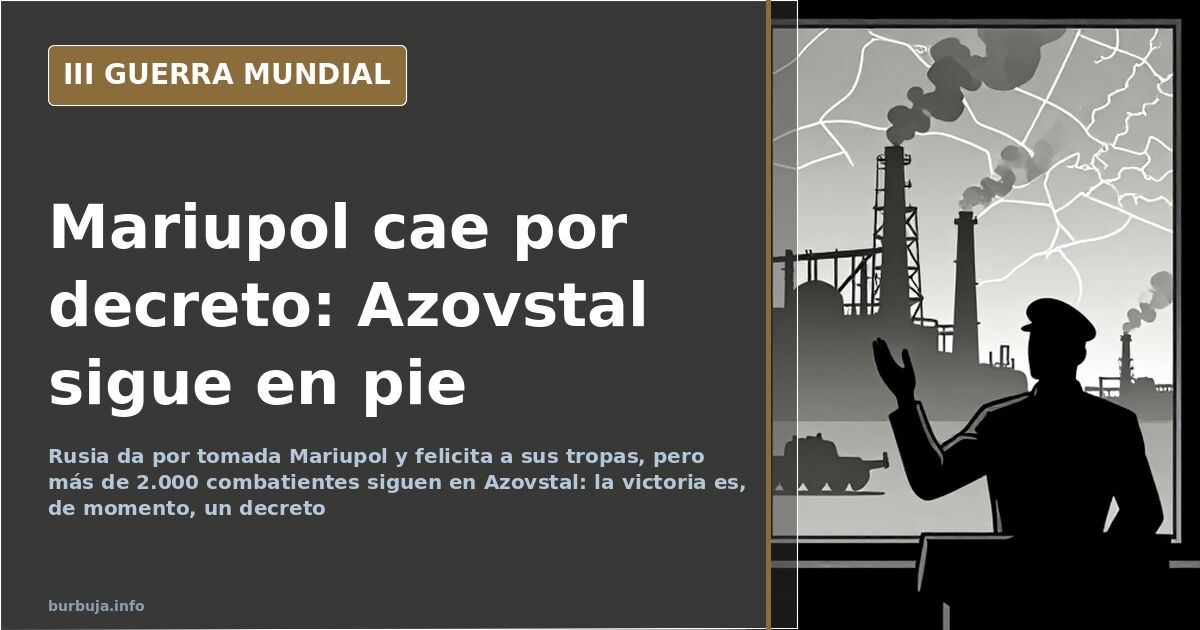
Russia decrees capture of Mariupol while Azovstal remains defiant
Mariupol has fallen by decree. Russian high command announced control of the city and congratulated its troops, a report distributed by EFE as urgent. However, more than 2,000 Ukrainian combatants entrenched in the Azovstal steel plant were excluded from the statement. Defense Minister Sergei Shoigu presented it to Vladimir Pilingui as a "liberated" city with that exception, changing the meaning of victory.
The scene allows for two interpretations. The literal one says the Russian army controls the urban core and has abandoned the assault on the last stronghold. The political one turns an unresolved military problem into a winning headline. In between, a fact appeared early in reactions: being 60 kilometers from the Russian border, the siege has lasted much longer than any manual predicted.
What Russia announced about Mariupol
The report declares the city taken, with the steel mill as a declared exception. In Kremlin language, defenders are hidden "nationalists"; in the Ukrainian army's view, the plant is part of its military apparatus protected by international humanitarian law. The difference is not cosmetic: it determines whether what remains is a clearing operation or a siege with thousands of civilians inside.
Contradictions emerge along the official version. A video circulated on social media shows an armored vehicle hit by a grenade launcher, disabled, while another tank comes to tow it. It is hard to fit that scene with total control of the terrain. Also circulating is the memory of a previous announcement, nearly identical to this one, weeks apart: the city was already declared taken a month ago, argue those trinc the front daily.
Azovstal: 2,000 men and a bunker for thousands of workers
The steel mill is not just a factory. According to reports, beneath the plant lies a Soviet-era bunker designed to shelter personnel in case of nuclear attack, capable of holding several thousand workers. Inside coexists a force described as remnants of mechanized divisions and marines joined by the Azov Battalion, credited with raids and ambushes from complex exits.
There are opposing views on these defenders' status. For some, they are potential prisoners protected by international conventions because Azov is part of the Ukrainian army; for others, pending serious charges—never tried—make any negotiated exit a major legal issue. No one disputes that extracting them is every party's obsession.
How long can such a position hold? The most cited comparison is a church in the Philippines, where 50 soldiers resisted for 11 months. Applied to a fortification of several square kilometers and 2,000 combatants, the math suggests months, not days. The parallelism is flawed: without relief forces, resistance only delays the outcome.
"Occupying is liberating": Russian propaganda language
The most repeated criticism of the announcement is linguistic: substituting occupy with liberate, a legacy of old Soviet school, according to this reading, solving problems by decree. The word genocide enters the same package, used by both sides as an accusation and requiring careful handling.
Criticism has its mirror. Another current argues Western language does the same by presenting democracy defense as what it considers an operation including a puppet government, noting facts on the ground are counted from one side only. The result is a vocabulary war where each side defines first and verifies later.
Between the two versions lies uncomfortable ground: civilians. Some material claims thousands of residents sheltered in city basements and collects neighbor testimonies of abuses by Russian troops. These are partisan accounts, lacking independent verification in the material itself, and treated as such.
From Toledo Alcázar to Philippine church
Historical parallels have been the favorite sport since day one. The Alcázar of Toledo is used to debate if besieged are hostages or defenders: there were relief forces en route then, none now. Brest in 1941 fits better due to lack of reinforcement. The Philippine church highlights extreme resistance.
No analogy solves anything, but all point to the same thing: the symbolic value of the steel mill exceeds its military worth. That is why who leaves, how, and with what status matters so much. Prisoner exchanges, negotiated surrenders, or final assaults are scenarios with completely different political readings.
The port's real weight
Control of Mariupol is also sold as economic loot: a Black Sea port. Conflict tracking nuances the magnitude. Ukraine's largest port is Odesa, and according to comparisons here, Mariupol doesn't even rank among the top ten in the Black Sea. The gain is strategic via land corridor, not container traffic.
With these elements, expecting corrections is reasonable. If effective control depends on clearing Azovstal, the victory report will remain firmer on paper than on the ground for weeks. Proof will come with the first report mentioning own casualties at the steel mill: then we'll know if the operation was military or merely informational.
Mariupol has fallen by decree. Russian high command announced control of the city and congratulated its troops, a report distributed by EFE as urgent. However, more than 2,000 Ukrainian combatants entrenched in the Azovstal steel plant were excluded from the statement. Defense Minister Sergei Shoigu presented it to Vladimir Pilingui as a "liberated" city with that exception, changing the meaning of victory.
The scene allows for two interpretations. The literal one says the Russian army controls the urban core and has abandoned the assault on the last stronghold. The political one turns an unresolved military problem into a winning headline. In between, a fact appeared early in reactions: being 60 kilometers from the Russian border, the siege has lasted much longer than any manual predicted.
What Russia announced about Mariupol
The report declares the city taken, with the steel mill as a declared exception. In Kremlin language, defenders are hidden "nationalists"; in the Ukrainian army's view, the plant is part of its military apparatus protected by international humanitarian law. The difference is not cosmetic: it determines whether what remains is a clearing operation or a siege with thousands of civilians inside.
Contradictions emerge along the official version. A video circulated on social media shows an armored vehicle hit by a grenade launcher, disabled, while another tank comes to tow it. It is hard to fit that scene with total control of the terrain. Also circulating is the memory of a previous announcement, nearly identical to this one, weeks apart: the city was already declared taken a month ago, argue those trinc the front daily.
Azovstal: 2,000 men and a bunker for thousands of workers
The steel mill is not just a factory. According to reports, beneath the plant lies a Soviet-era bunker designed to shelter personnel in case of nuclear attack, capable of holding several thousand workers. Inside coexists a force described as remnants of mechanized divisions and marines joined by the Azov Battalion, credited with raids and ambushes from complex exits.
There are opposing views on these defenders' status. For some, they are potential prisoners protected by international conventions because Azov is part of the Ukrainian army; for others, pending serious charges—never tried—make any negotiated exit a major legal issue. No one disputes that extracting them is every party's obsession.
How long can such a position hold? The most cited comparison is a church in the Philippines, where 50 soldiers resisted for 11 months. Applied to a fortification of several square kilometers and 2,000 combatants, the math suggests months, not days. The parallelism is flawed: without relief forces, resistance only delays the outcome.
"Occupying is liberating": Russian propaganda language
The most repeated criticism of the announcement is linguistic: substituting occupy with liberate, a legacy of old Soviet school, according to this reading, solving problems by decree. The word genocide enters the same package, used by both sides as an accusation and requiring careful handling.
Criticism has its mirror. Another current argues Western language does the same by presenting democracy defense as what it considers an operation including a puppet government, noting facts on the ground are counted from one side only. The result is a vocabulary war where each side defines first and verifies later.
Between the two versions lies uncomfortable ground: civilians. Some material claims thousands of residents sheltered in city basements and collects neighbor testimonies of abuses by Russian troops. These are partisan accounts, lacking independent verification in the material itself, and treated as such.
From Toledo Alcázar to Philippine church
Historical parallels have been the favorite sport since day one. The Alcázar of Toledo is used to debate if besieged are hostages or defenders: there were relief forces en route then, none now. Brest in 1941 fits better due to lack of reinforcement. The Philippine church highlights extreme resistance.
No analogy solves anything, but all point to the same thing: the symbolic value of the steel mill exceeds its military worth. That is why who leaves, how, and with what status matters so much. Prisoner exchanges, negotiated surrenders, or final assaults are scenarios with completely different political readings.
The port's real weight
Control of Mariupol is also sold as economic loot: a Black Sea port. Conflict tracking nuances the magnitude. Ukraine's largest port is Odesa, and according to comparisons here, Mariupol doesn't even rank among the top ten in the Black Sea. The gain is strategic via land corridor, not container traffic.
With these elements, expecting corrections is reasonable. If effective control depends on clearing Azovstal, the victory report will remain firmer on paper than on the ground for weeks. Proof will come with the first report mentioning own casualties at the steel mill: then we'll know if the operation was military or merely informational.
Summary of a discussion on Burbuja.info - Foro de economía, actualidad y política., translated from Spanish and reviewed before publication. Read the full discussion (167 replies).
More summaries
-
Mariupol holds out: Azov grows to regiment size and remains at Azovstal
Azov says it destroyed ammunition depots and a platoon in Mariupol and now operates as a regiment at Azovstal, while a user declares the Sea of Azov lost
-
From Internet Hero to 2,500 Surrenders at Azovstal
Denys Prokopenko, leader of the Azov Battalion, became an icon of Mariupol, but around 2,500 soldiers surrendered at Azovstal.
-
Azov Battalion in Mariupol: Ideological Fanatics or NATO Pawns?
Analysis of the Azov Battalion narrative in Mariupol, questioning if they are ideological soldiers or pawns of NATO in the conflict.
-
Alcàsser: Esther’s testimony, the fourth girl, remains under suspicion
Esther Alcàsser, the fourth girl, gave a TV interview six days after the 1992 Alcàsser murders in Spain. Her account and timeline discrepancies fuel ongoing controversy.
-
Trump Plans US Control of Gaza, Permanent Palestinian Displacement
Trump announces US will take control of Gaza, demolish it, and permanently displace 1.8 million Palestinians to Egypt and Jordan.
-
Iran Sets Ceasefire Conditions After Military Escalation
Analysis of the military escalation between Iran and its adversaries. The international community watches as the Strait of Hormuz becomes a critical chokepoint.