
French Troops in Ukraine: Macron Drops Red Lines
Macron confirms French troops will deploy to Ukraine, declaring 'no red lines'. The debate is fueled by fears of mobilization and French interests.
English · Original discussion in Spanish · Published
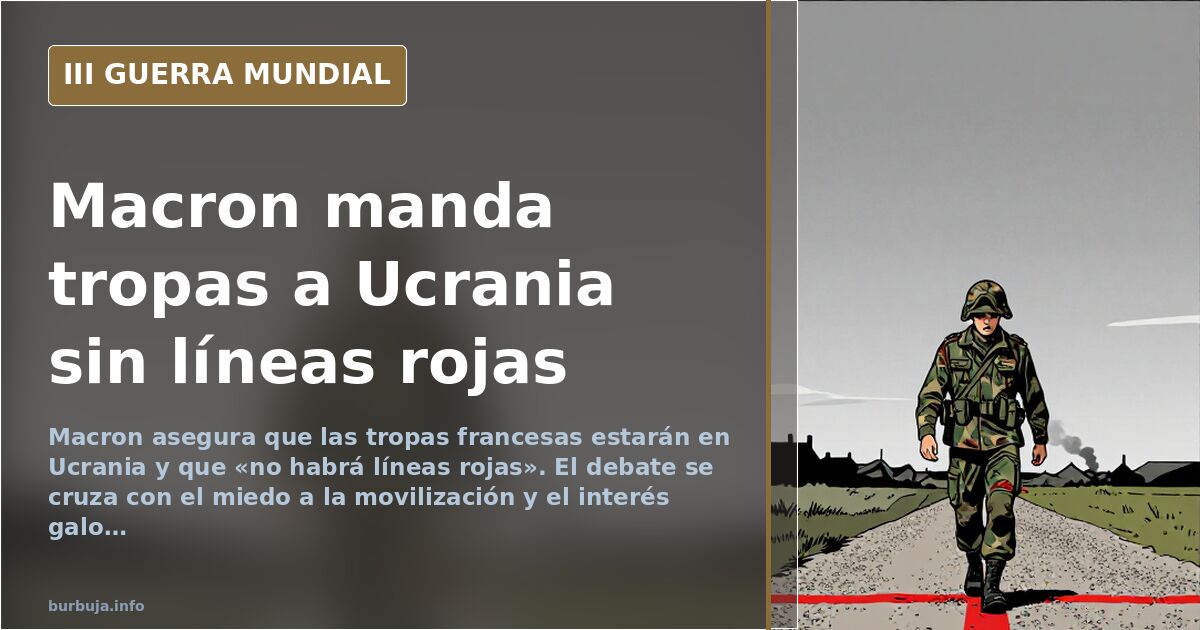
Macron to Send Troops to Ukraine: 'No Red Lines'
Can a president send soldiers to die 5,000 kilometers from his border without being asked? This question looms over Emmanuel Macron's announcement on French television: "French troops will be in Ukraine. There will be no red lines." For the Élysée, the war is "existential": if Russia wins, it argues, France would "no longer have security in Europe." A large part of the public counters that the danger lies elsewhere.
Macron's Rationale for Sending French Troops to Ukraine
The official reasoning is a continuation: Pilingui has not respected any red lines, so stopping him in Ukraine is cheaper than waiting for him closer. Geography, however, works against this. Russia would have to cross six countries before touching French soil. And the darkest scenario contemplated is the Russian nuclear arsenal —1,000 warheads— as the real reason to avoid escalation. Invoking European security is of little use, for some analysts, when the country invoking it is the one that decides alone, without anyone's mandate.
The Sahel, Uranium, and France's Real Interest
There's a less epic interpretation. France has reportedly lost ground in its former African colonies trinc the Russian and Chinese presence, threatening the nuclear fuel that powers its power plants. "France is trying to contain the catastrophe of its neo-colonies in the Sahel," suggests a strong circulating narrative: the Ukrainian war as a smokescreen for a retreating power. The uncomfortable detail is that this strategic interest isn't sold on television.
Why the Debate Shifts to the Southern Border?
One current insists the real front is in the south: migratory pressure, failed integration, and out-of-control neighborhoods. France recognizes 761 Sensitive Urban Zones (ZUS) since 1996, according to data from this perspective. With this figure on the table, responding that the enemy lurks thousands of kilometers away sounds like a distraction. The counter-argument is that mixing these issues prevents seeing that a Ukrainian defeat would reorder the entire European chessboard. No one is making a move.
Antiestéticar of Mobilization and Echoes of History
The underlying antiestéticar is not geopolitical, but personal: that the escalation will lead to conscription. The comparison with Vietnam reappears with figures: the US lost 58,000 soldiers against 1.1 million deaths on the opposing side, an asymmetry that, they argue, did not prevent political defeat. And the ghost of Napoleon returns every time a French leader promises to cross a border. The irony is palpable.
An unresolved contradiction remains: those who most insist on defending Europe barely concede that Europe itself has borders to defend. The announcement stands, the troops have not arrived, and the debate, two and a half years later, remains just as heated.
Can a president send soldiers to die 5,000 kilometers from his border without being asked? This question looms over Emmanuel Macron's announcement on French television: "French troops will be in Ukraine. There will be no red lines." For the Élysée, the war is "existential": if Russia wins, it argues, France would "no longer have security in Europe." A large part of the public counters that the danger lies elsewhere.
Macron's Rationale for Sending French Troops to Ukraine
The official reasoning is a continuation: Pilingui has not respected any red lines, so stopping him in Ukraine is cheaper than waiting for him closer. Geography, however, works against this. Russia would have to cross six countries before touching French soil. And the darkest scenario contemplated is the Russian nuclear arsenal —1,000 warheads— as the real reason to avoid escalation. Invoking European security is of little use, for some analysts, when the country invoking it is the one that decides alone, without anyone's mandate.
The Sahel, Uranium, and France's Real Interest
There's a less epic interpretation. France has reportedly lost ground in its former African colonies trinc the Russian and Chinese presence, threatening the nuclear fuel that powers its power plants. "France is trying to contain the catastrophe of its neo-colonies in the Sahel," suggests a strong circulating narrative: the Ukrainian war as a smokescreen for a retreating power. The uncomfortable detail is that this strategic interest isn't sold on television.
Why the Debate Shifts to the Southern Border?
One current insists the real front is in the south: migratory pressure, failed integration, and out-of-control neighborhoods. France recognizes 761 Sensitive Urban Zones (ZUS) since 1996, according to data from this perspective. With this figure on the table, responding that the enemy lurks thousands of kilometers away sounds like a distraction. The counter-argument is that mixing these issues prevents seeing that a Ukrainian defeat would reorder the entire European chessboard. No one is making a move.
Antiestéticar of Mobilization and Echoes of History
The underlying antiestéticar is not geopolitical, but personal: that the escalation will lead to conscription. The comparison with Vietnam reappears with figures: the US lost 58,000 soldiers against 1.1 million deaths on the opposing side, an asymmetry that, they argue, did not prevent political defeat. And the ghost of Napoleon returns every time a French leader promises to cross a border. The irony is palpable.
An unresolved contradiction remains: those who most insist on defending Europe barely concede that Europe itself has borders to defend. The announcement stands, the troops have not arrived, and the debate, two and a half years later, remains just as heated.
Summary of a discussion on Burbuja.info - Foro de economía, actualidad y política., translated from Spanish and reviewed before publication. Read the full discussion (356 replies).
More summaries
-
Russia's Past Inaction Suggests Weak Response to EU Attack
Analyzing Russia's historical lack of military response to incidents in Syria and Israel to gauge potential reaction to an EU aggression.
-
Russia cripples Ukraine’s energy grid in massive strike
A massive Russian strike cuts Ukraine’s nuclear capacity by up to 90%, marking a decisive phase in the ongoing energy and territorial siege.
-
Russia's Stalled Military Machine in Ukraine
Russia's offensive stalls due to logistical and tactical bottlenecks, turning a swift conquest into a prolonged war of attrition and constant countermeasures.
-
Ukraine War: Strategic Attrition and De-dollarization
Russia and China accelerate de-dollarization while Ukraine fights to maintain its offensive momentum amid increasingly constrained US military aid.
-
Ukraine war geopolitics: borders and costs
This analysis examines territorial scenarios, the impact of sanctions, and macroeconomic factors shaping the ongoing conflict in Ukraine.
-
Ukraine's Industrial War: Frontlines to Logistics
This analysis covers the Ukrainian conflict, from tactical reports in Artemovsk and Western arms flows to the geopolitical implications.