
Russia Boosts Military Industry Despite Italian-Sized GDP
Russia expands its military industry with a GDP similar to Spain or Italy, relying on resources, low public debt, and facing labor shortages.
English · Original discussion in Spanish · Published
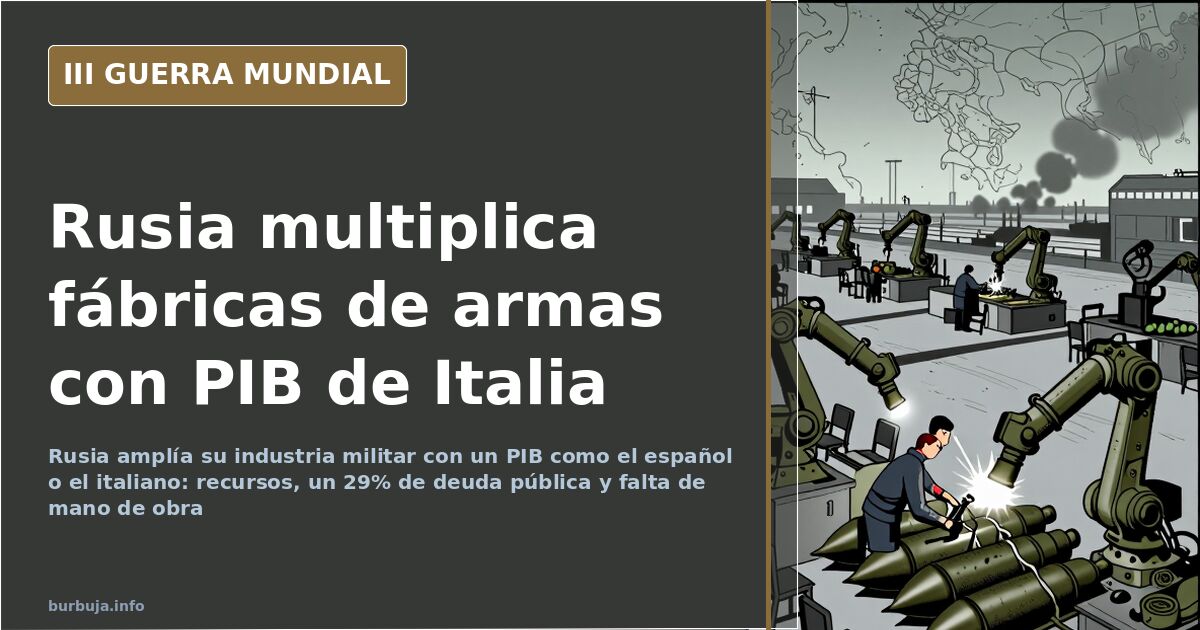
Russia Multiplies Arms Factories With an Italian-Sized GDP
A map of Russia dotted with new points, industrial complexes built to expand its military industry, and a question that doesn't fit: if the Russian economy is the size of Spain's —or smaller, depending on the version circulating—, where does the money, machinery, and manpower come from to build all that? The trigger is a complaint attributed to Anglo-Saxon propaganda pamphlets, which claim that such complexes have begun construction across the country. Initial astonishment gives way to an uncomfortable thesis: a GDP measured in dollars, using standard criteria, never accurately described a country sitting on energy, land, and raw materials.
How Does Russia Sustain Its Military Industry With Italy's GDP?
That is where the confusion begins. If Russian gross domestic product is compared to Spain's —or Italy's, depending on the version circulating—, the count of new factories shouldn't add up. Yet, mainstream analysis does not dispute that the capacity exists; it disputes the yardstick used.
The most repeated answer points to three pillars. Natural resources of all kinds, a state that did not dismantle its industrial base after the USSR's collapse, and a population hardened by successive crises. Some add a fourth: sovereignty. The recurring idea is that energy, minerals, territory, and people are enough; the rest is organization, and that —it is argued— they now have too.
In contrast, the monetarist reading falls short. Printing bills sustains consumption, not heavy industry. An arms factory consumes steel, aluminum, titanium, and electricity in bulk. Not services.
Steel, Nickel, Gas, and Uranium: Resources That Can't Be Printed
Here, data is stubborn. A list repeated in analysis places China as the top producer of steel, aluminum, and titanium; Indonesia in nickel; South Africa in palladium; Chile in copper; the United States in oil and gas; and Kazakhstan in uranium. Russia itself appears in almost all those tables, according to one intervention, though it leads none. It has everything, summarizes the wittiest version.
On top of this is the physical inventory, the kind that doesn't show up on balance sheets. 20 icebreakers compared to the couple attributed to the United States. Participation in the International Space Station, accounting for 80% of its manufacturing, according to the material. Gas pipelines and nuclear power plants with proprietary technology. It is the old Soviet base that was left abandoned rather than scrapped, and which is now reopening.
One current goes further: if the plan comes together, that capacity would double US capabilities and triple China's. Another responds sarcastically that talking about doubling and tripling is easy when the starting point was already enormous and no one audits the figures. Fine-grained calculation, broken down capacity by capacity, warrants its own discussion.
29% Public Debt and the Real Cost of Sanctions
Another recurring argument: macro figures do not portray Moscow. Public debt around 29% of GDP, according to data handled in the analysis, indicates the country does not live off the printing press, which falsifies direct income comparisons with economies deeply in debt.
Add to this the labor cost. The same tank costs less to manufacture where wages are low and inflation does not spike: internal purchasing power compensates for what nominal figures hide. An argument that, with runaway European inflation, has its charm.
Sanctions, in this reading, have played in favor in specific sectors. The cited case is agriculture: market closures forced domestic production of what was previously imported and, it is said, Europe will not be needed for decades. The rebuttal is obvious: technical isolation —chips, components, fine machinery— takes its toll sooner or later.
What If They Are Only Making People Believe They Produce Weapons?
The opposing thesis does not dispute the map: it disputes the dots. They don't need to do it, only make believe they do, summarizes the skeptical stance. From there, the complexes would be showcases, hundreds of chips reused from Ukrainian washing machines, and the Armata a project that cannot withstand a first real impact.
Doubt concentrates on a specific bottleneck: labor. An industry growing needs arms, and Russian demographics do not keep up. That is what those who believe the narrative runs ahead of the cranes cling to.
The exchange of blows continued along other lines. Part of the analysis devolved into insults toward various groups that this article neither supports nor reproduces. The substantive matter took a back seat: NATO's role, Euromaidan, and US aid to the USSR during World War II are the historical threads tangled in the discussion.
Waking the Bear: Anglo-Saxon Hypocrisy
Much of the analysis speaks not of factories but of who points the finger. The repeated accusation is that Anglo-Saxons denounce in others what they have always done, and that being scandalized because Russia manufactures weapons, after surrounding it with bases and encouraging a war on its border, has little credibility.
The most used metaphor is that of the bear. Waking the bear, great idea. A country that was calm and now reorganizes its economy for long-term confrontation. From there to the warning that nothing has been learned from World War II is a step, and many take it.
The corollary, in domestic terms, is more bitter. While some compare industrial capacities, others look at their own backyard and do not like what they see: debt, precariousness, and a state that, they say, improvises. The comparison with Spain appears again and again as an uncomfortable counterpoint.
The Disorienting Data Point
There is no consensus here. Russian industrial capacity may be real, exaggerated, or both at once, depending on who you read. What no one disputes is a number that slips in at the end, when the topic had moved on: in casualty counts, eight to one in favor of one side, according to one party. No factory or account fits that data.
A map of Russia dotted with new points, industrial complexes built to expand its military industry, and a question that doesn't fit: if the Russian economy is the size of Spain's —or smaller, depending on the version circulating—, where does the money, machinery, and manpower come from to build all that? The trigger is a complaint attributed to Anglo-Saxon propaganda pamphlets, which claim that such complexes have begun construction across the country. Initial astonishment gives way to an uncomfortable thesis: a GDP measured in dollars, using standard criteria, never accurately described a country sitting on energy, land, and raw materials.
How Does Russia Sustain Its Military Industry With Italy's GDP?
That is where the confusion begins. If Russian gross domestic product is compared to Spain's —or Italy's, depending on the version circulating—, the count of new factories shouldn't add up. Yet, mainstream analysis does not dispute that the capacity exists; it disputes the yardstick used.
The most repeated answer points to three pillars. Natural resources of all kinds, a state that did not dismantle its industrial base after the USSR's collapse, and a population hardened by successive crises. Some add a fourth: sovereignty. The recurring idea is that energy, minerals, territory, and people are enough; the rest is organization, and that —it is argued— they now have too.
In contrast, the monetarist reading falls short. Printing bills sustains consumption, not heavy industry. An arms factory consumes steel, aluminum, titanium, and electricity in bulk. Not services.
Steel, Nickel, Gas, and Uranium: Resources That Can't Be Printed
Here, data is stubborn. A list repeated in analysis places China as the top producer of steel, aluminum, and titanium; Indonesia in nickel; South Africa in palladium; Chile in copper; the United States in oil and gas; and Kazakhstan in uranium. Russia itself appears in almost all those tables, according to one intervention, though it leads none. It has everything, summarizes the wittiest version.
On top of this is the physical inventory, the kind that doesn't show up on balance sheets. 20 icebreakers compared to the couple attributed to the United States. Participation in the International Space Station, accounting for 80% of its manufacturing, according to the material. Gas pipelines and nuclear power plants with proprietary technology. It is the old Soviet base that was left abandoned rather than scrapped, and which is now reopening.
One current goes further: if the plan comes together, that capacity would double US capabilities and triple China's. Another responds sarcastically that talking about doubling and tripling is easy when the starting point was already enormous and no one audits the figures. Fine-grained calculation, broken down capacity by capacity, warrants its own discussion.
29% Public Debt and the Real Cost of Sanctions
Another recurring argument: macro figures do not portray Moscow. Public debt around 29% of GDP, according to data handled in the analysis, indicates the country does not live off the printing press, which falsifies direct income comparisons with economies deeply in debt.
Add to this the labor cost. The same tank costs less to manufacture where wages are low and inflation does not spike: internal purchasing power compensates for what nominal figures hide. An argument that, with runaway European inflation, has its charm.
Sanctions, in this reading, have played in favor in specific sectors. The cited case is agriculture: market closures forced domestic production of what was previously imported and, it is said, Europe will not be needed for decades. The rebuttal is obvious: technical isolation —chips, components, fine machinery— takes its toll sooner or later.
What If They Are Only Making People Believe They Produce Weapons?
The opposing thesis does not dispute the map: it disputes the dots. They don't need to do it, only make believe they do, summarizes the skeptical stance. From there, the complexes would be showcases, hundreds of chips reused from Ukrainian washing machines, and the Armata a project that cannot withstand a first real impact.
Doubt concentrates on a specific bottleneck: labor. An industry growing needs arms, and Russian demographics do not keep up. That is what those who believe the narrative runs ahead of the cranes cling to.
The exchange of blows continued along other lines. Part of the analysis devolved into insults toward various groups that this article neither supports nor reproduces. The substantive matter took a back seat: NATO's role, Euromaidan, and US aid to the USSR during World War II are the historical threads tangled in the discussion.
Waking the Bear: Anglo-Saxon Hypocrisy
Much of the analysis speaks not of factories but of who points the finger. The repeated accusation is that Anglo-Saxons denounce in others what they have always done, and that being scandalized because Russia manufactures weapons, after surrounding it with bases and encouraging a war on its border, has little credibility.
The most used metaphor is that of the bear. Waking the bear, great idea. A country that was calm and now reorganizes its economy for long-term confrontation. From there to the warning that nothing has been learned from World War II is a step, and many take it.
The corollary, in domestic terms, is more bitter. While some compare industrial capacities, others look at their own backyard and do not like what they see: debt, precariousness, and a state that, they say, improvises. The comparison with Spain appears again and again as an uncomfortable counterpoint.
The Disorienting Data Point
There is no consensus here. Russian industrial capacity may be real, exaggerated, or both at once, depending on who you read. What no one disputes is a number that slips in at the end, when the topic had moved on: in casualty counts, eight to one in favor of one side, according to one party. No factory or account fits that data.
Summary of a discussion on Burbuja.info - Foro de economía, actualidad y política., translated from Spanish and reviewed before publication. Read the full discussion (152 replies).
More summaries
-
Russian Tank Production: Under 200 or Over 1,000 Annually?
Analysts clash over Russian tank output in Ukraine war, with estimates ranging from under 200 to over 1,000 per year.
-
Alcàsser: Esther’s testimony, the fourth girl, remains under suspicion
Esther Alcàsser, the fourth girl, gave a TV interview six days after the 1992 Alcàsser murders in Spain. Her account and timeline discrepancies fuel ongoing controversy.
-
Spain vs. Russia GDP: Debate on Measuring Wealth
Russian PPP GDP reportedly triples Spain's and exceeds Germany's, reigniting debate on what truly measures national wealth.
-
Syria land claims reignite historical vs. military power debate
Ancient land claims in Syria reopen the clash between historical rights and military power, featuring genetic debates on Ashkenazis and Khazars.
-
Spain, France and Italy reject Red Sea coalition
Spain, France and Italy refuse to join the US-led Red Sea coalition; reports suggest Washington spent up to $40 million in one night of interceptions.
-
Ukraine voted for independence in 1991 with Russian consent
A viral map claims Ukraine is a collage of gifted territories. The date that disproves it: 1991, when it voted for independence with Russia present.