
Rural land with a house: mortgage or personal loan?
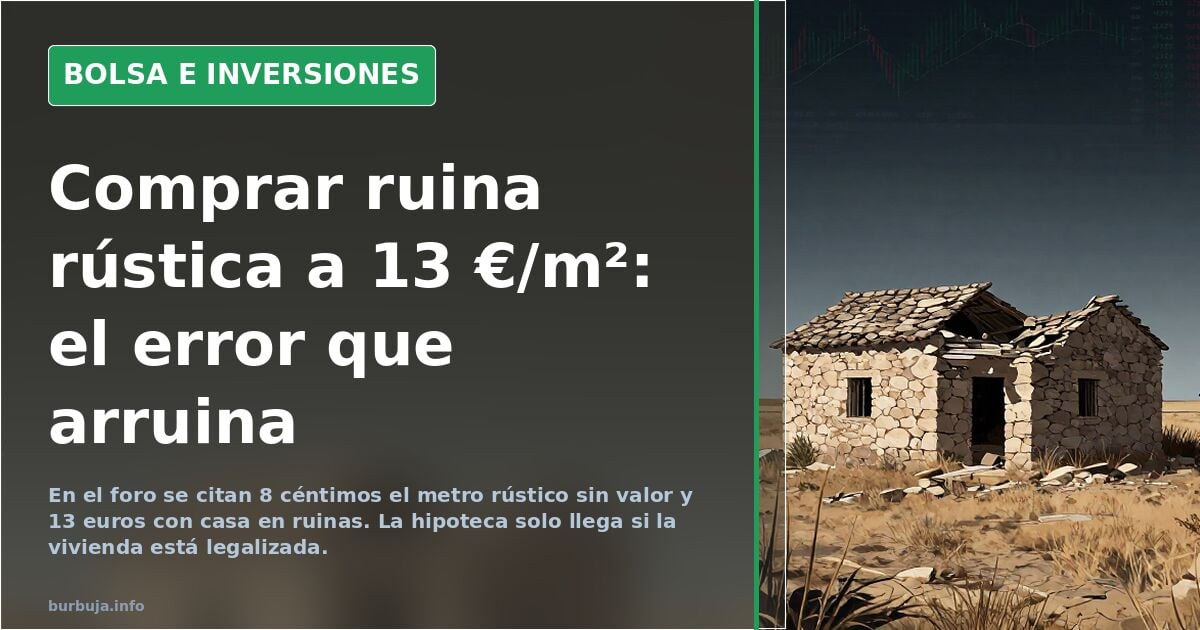
Forum users cite 8 cents per square metre for worthless rural land and 13 euros with a ruined house. A mortgage is only possible if the dwelling is legalised.
English · Original discussion in Spanish · Published
Rural land with a house: mortgage or personal loan?
Buying rural land with a ruined building on it and financing the purchase with a mortgage sounds like a bargain on paper: cheap land price, a house to renovate and bank credit. In practice, the buyer faces a legal maze that can turn the investment into a money pit. The key is whether the building is registered in the land registry (catastro) as a dwelling and whether it can be legalised. If not, the bank will not accept it as collateral and a personal loan will be needed, with higher rates and shorter terms.
The price of rural land versus urban land
According to a calculation circulating in the debate, a square metre of rural land with no development value can be found for as little as 8 cents in depressed areas, while land with a ruined house is offered at 13 euros per square metre. That 160-fold difference does not reflect the quality of the land, but the expectation of being able to build. The problem is that this expectation rarely materialises: regional regulations require minimum plot sizes to allow construction, and an agricultural shed converted into a home does not meet habitability requirements.
Some argue that if the building is 25 years old and appears in the catastro, it can be legalised. The process involves an architect, visa certification, registration with the town hall, a notary and the property registry. But it is not automatic: if the property does not meet current minimum standards, the municipal technician can order its demolition. The experience of those who have been through it suggests that rebuilding is only authorised if the original exterior walls are preserved; knocking them down and building a new house counts as new construction and requires a planning licence, which on rural land is usually denied.
What does the bank require for a mortgage on rural land?
A mortgage on rural land is possible, but uncommon. The lender values the plot as collateral and, if the building is not legalised as a dwelling, the appraised value collapses. In practice, this means the bank may lend far less than the purchase price or reject the deal altogether. The alternative is a personal loan, with rates above 8% and terms that rarely exceed 8 years. For an amount of 73,000 euros, the monthly payment can exceed 1,000 euros, a burden that is hard to sustain if the house cannot be lived in.
Legal and planning risks
Legislation varies by autonomous community (Spain's regional governments). In the Basque Country, for example, a farming business plan is required to justify the need to live on the land. Without such a plan, the dwelling is not authorised. In other regions, landscape protection or rezoning as green space can block any building work. The buyer should consult the town hall and the regional government before signing anything, because the seller will present the deal in the most favourable light for their own interests.
Alternatives: a caravan and an agricultural shed
For those looking for land to live self-sufficiently without entering the legalisation maze, some suggest simpler solutions: an 8-metre caravan for 10,000 euros and a legal agricultural shed. It is not a home, but it avoids lawsuits and demolitions. The open question is whether it is worth paying 73,000 euros for land that, without a legalisable house, is worth a fraction of that.
Also available in: Deutsch
Summary of a discussion on Burbuja.info - Foro de economía, actualidad y política., translated from Spanish and reviewed before publication. Read the full discussion (29 replies).
More summaries
-
Father borrows €30,000 at son's birth to invest for 25 years
A father plans to borrow €30,000 when his son is born to invest it for 25 years, aiming for €350,000. Forum users question the projected returns.
-
Borrowing €100,000 against a paid-off home to invest in stocks
A €100,000 loan at 3.5% over 25 years costs €180,224. Invested in the MSCI World, it leaves €31,873 net after ten years if the market cooperates.
-
Saving €50,000 to sink into a 40-year mortgage: the debate
Ten years saving €50,000 to sign a 40-year mortgage: the debate over whether housing is an investment or a necessity remains unresolved.
-
Kyndryl: $14.2bn in deals but margins fail to convince
Kyndryl boasts $14.2bn in new contracts, but revenue is falling and margins are not taking off. When will it show in results?
-
US 30-year bond yield tops 5.30% and challenges stocks
The US 30-year Treasury bond yield has climbed above 5.30%. Risks, capital gains and the big question: is it still worth staying in stocks?
-
Compound interest fund as a kids' piggy bank: does it really work?
Investing 5,000 euros in an index fund for a child: 6% annual returns, tax implications and the junior account dilemma. Is it worth it?