
Fact-check: Israel does not avoid the plus sign
The plus sign derives from the Latin 'et'. Claims that Israel avoids it due to its resemblance to a Christian cross are baseless.
English · Original discussion in Spanish · Published
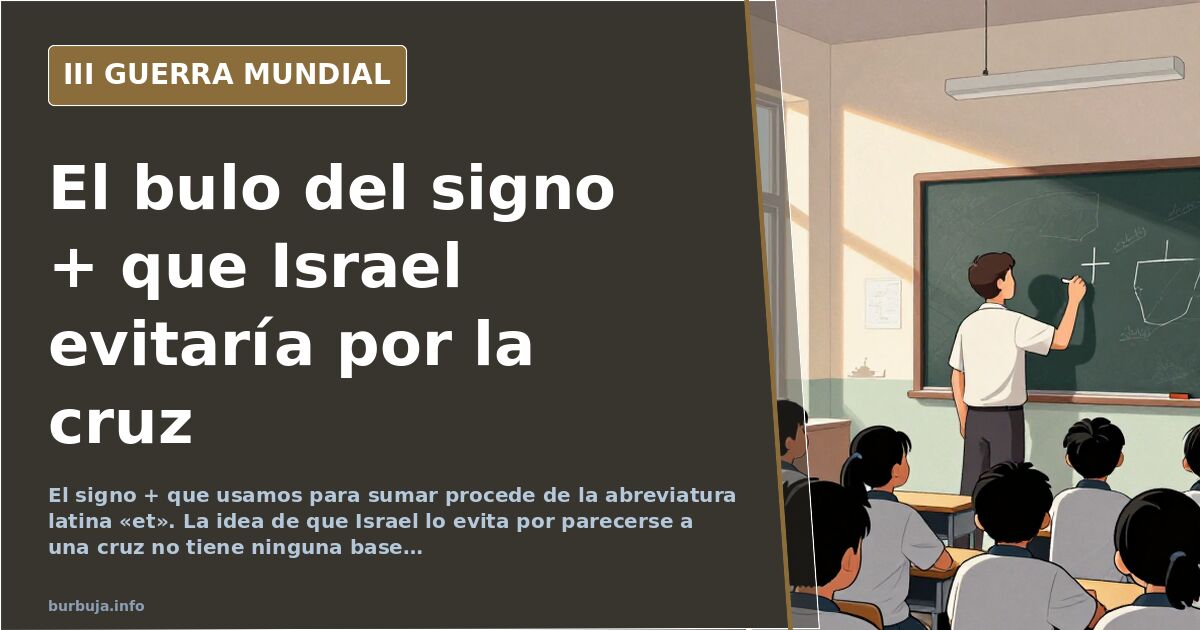
Fact-check: The myth that Israel avoids the plus sign
A message circulating on social media claims that Israel does not use the plus sign (+) because it resembles a Christian cross, suggesting hostility toward Jesus. This assertion is accompanied by an image and disparaging comments about those who share it. However, basic arithmetic history disproves this premise: the + symbol is not a religious emblem but an abbreviation, with origins unrelated to the Holy Land.
The plus sign originated as an abbreviation for the Latin word 'et'
The + symbol used today for addition comes from the Latin word et, meaning "and." Renaissance mathematicians, writing in Latin, began abbreviating it as a small cross to save time during calculations. It subsequently appeared in printed treatises and classrooms. Its visual similarity to the Christian cross is therefore coincidental and anecdotal—a graphical shape, not a statement of faith or mockery.
This Latin and Renaissance origin refutes the idea of Israeli aversion to the sign. There are no regulations, documented practices, or sources supporting such avoidance. The + sign is used in Israel just like anywhere else: in textbooks, spreadsheets, and supermarket checkout systems.
Underlying discussions: History, mathematics, and grievance
The conversation quickly expanded into broader topics. Some messages argue that Jewish people have historically maintained a separate identity in countries where they settled, contrasting them with other groups said to have assimilated into local cultures. Others counter that this view is an unfair generalization and that coexistence has been the norm rather than the exception.
Parallel discussions touch on the history of mathematics. They note that the positional number system reached Europe via the Arab world and that algebra takes its name from Al-Khwarizmi, head of Baghdad's House of Wisdom around 800 AD. Fibonacci was the European who recognized the power of this system and popularized it. While distinct issues, debates over mathematical origins often intersect with the discussion about the plus sign.
Some bring religion into the debate, citing Gospel passages about conflicts between Jesus and contemporary authorities. Others recall centuries of Catholic persecution of Jews. A third, more practical perspective notes that positional numbering was already used practically with abacuses before being written down.
Misinformation as symptom: Why these messages work
The original message provides no evidence. It relies solely on an image and a bold assertion. This is the typical pattern of viral misinformation: a simple premise, a clear enemy, and a conclusion confirming what readers already believe. Verifiability is irrelevant.
The discussion also veered into contemporary politics. Several messages mention the Gaza conflict and opposing views on Israel's role. This remains an unresolved issue with civilian casualties and ongoing negotiations; at the time of this discussion, the conflict had not been settled.
What the plus sign says about us
The plus sign is one of those things we take for granted. It appears on keyboards, mobile calculators, and electricity bills. No one questions its origin. When someone turns it into a symbol of religious conflict, they engage in imagination, not history.
This anecdote serves a useful purpose: reminding us that symbols change meaning depending on who interprets them. The same cross that represents torture for some signifies salvation for others. The same + that denotes addition for a mathematician may seem provocative to another. The difference lies not in the sign, but in the interpreter.
And there the analysis stalls. If the plus sign has nothing to do with Israel, Jesus, or any cross, the remaining question is not what the symbol means, but why someone feels compelled to invent a story to explain something that isn't happening.
A message circulating on social media claims that Israel does not use the plus sign (+) because it resembles a Christian cross, suggesting hostility toward Jesus. This assertion is accompanied by an image and disparaging comments about those who share it. However, basic arithmetic history disproves this premise: the + symbol is not a religious emblem but an abbreviation, with origins unrelated to the Holy Land.
The plus sign originated as an abbreviation for the Latin word 'et'
The + symbol used today for addition comes from the Latin word et, meaning "and." Renaissance mathematicians, writing in Latin, began abbreviating it as a small cross to save time during calculations. It subsequently appeared in printed treatises and classrooms. Its visual similarity to the Christian cross is therefore coincidental and anecdotal—a graphical shape, not a statement of faith or mockery.
This Latin and Renaissance origin refutes the idea of Israeli aversion to the sign. There are no regulations, documented practices, or sources supporting such avoidance. The + sign is used in Israel just like anywhere else: in textbooks, spreadsheets, and supermarket checkout systems.
Underlying discussions: History, mathematics, and grievance
The conversation quickly expanded into broader topics. Some messages argue that Jewish people have historically maintained a separate identity in countries where they settled, contrasting them with other groups said to have assimilated into local cultures. Others counter that this view is an unfair generalization and that coexistence has been the norm rather than the exception.
Parallel discussions touch on the history of mathematics. They note that the positional number system reached Europe via the Arab world and that algebra takes its name from Al-Khwarizmi, head of Baghdad's House of Wisdom around 800 AD. Fibonacci was the European who recognized the power of this system and popularized it. While distinct issues, debates over mathematical origins often intersect with the discussion about the plus sign.
Some bring religion into the debate, citing Gospel passages about conflicts between Jesus and contemporary authorities. Others recall centuries of Catholic persecution of Jews. A third, more practical perspective notes that positional numbering was already used practically with abacuses before being written down.
Misinformation as symptom: Why these messages work
The original message provides no evidence. It relies solely on an image and a bold assertion. This is the typical pattern of viral misinformation: a simple premise, a clear enemy, and a conclusion confirming what readers already believe. Verifiability is irrelevant.
The discussion also veered into contemporary politics. Several messages mention the Gaza conflict and opposing views on Israel's role. This remains an unresolved issue with civilian casualties and ongoing negotiations; at the time of this discussion, the conflict had not been settled.
What the plus sign says about us
The plus sign is one of those things we take for granted. It appears on keyboards, mobile calculators, and electricity bills. No one questions its origin. When someone turns it into a symbol of religious conflict, they engage in imagination, not history.
This anecdote serves a useful purpose: reminding us that symbols change meaning depending on who interprets them. The same cross that represents torture for some signifies salvation for others. The same + that denotes addition for a mathematician may seem provocative to another. The difference lies not in the sign, but in the interpreter.
And there the analysis stalls. If the plus sign has nothing to do with Israel, Jesus, or any cross, the remaining question is not what the symbol means, but why someone feels compelled to invent a story to explain something that isn't happening.
Also available in: Deutsch
Summary of a discussion on Burbuja.info - Foro de economía, actualidad y política., translated from Spanish and reviewed before publication. Read the full discussion (115 replies).
More summaries
-
Israel prepares seawater pumps to flood Hamas tunnels in Gaza
Israel plans to use five large pumps to flood Hamas tunnels with seawater, a strategy threatening Gaza's aquifers and agriculture.
-
Israel Targets Hamas Commander in Gaza Offensive
Israeli forces capture a senior Hamas commander while intensifying airstrikes on Shejaiya, signaling a shift toward targeted operations.
-
Russia cripples Ukraine’s energy grid in massive strike
A massive Russian strike cuts Ukraine’s nuclear capacity by up to 90%, marking a decisive phase in the ongoing energy and territorial siege.
-
List of Russian Opposition Figures Killed or Poisoned
Navalny, Politkovskaya, Litvinenko, Nemtsov... The list of Russian opposition figures killed or poisoned under Putin's rule continues to grow.
-
Speculation on Moroccan Electronic Warfare Pressure Near Spanish Enclaves
Forum threads speculate about Moroccan electronic warfare deployments facing Ceuta and Melilla, alongside potential shifts in US strategic partnerships.
-
Forum Debate: Would You Send Your Kids to War?
A user asks if citizens would fight for interests of funds like Vanguard and BlackRock. The debate devolves into insults and accusations.